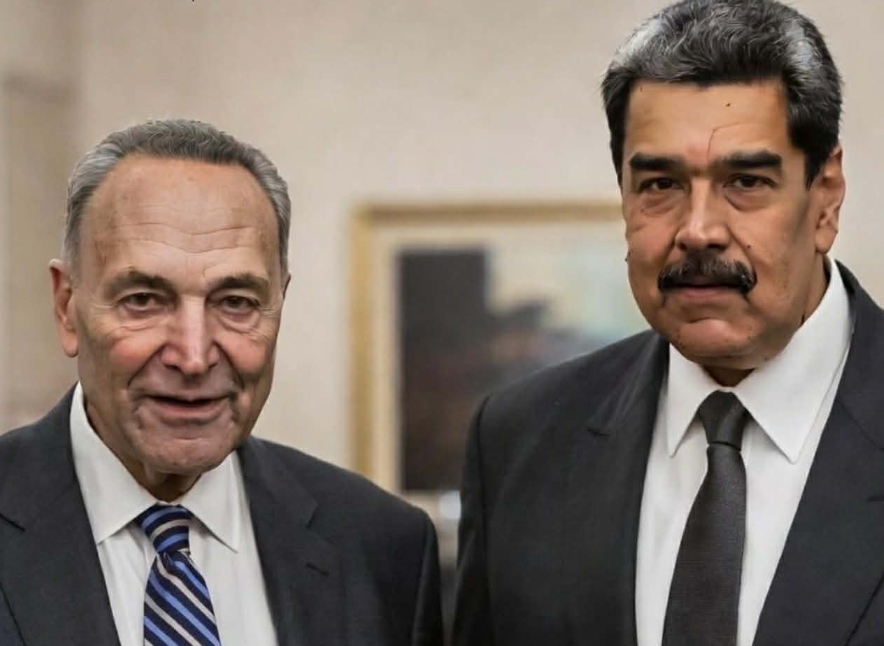
Senator Chuck Schumer’s anger was not subtle, measured, or restrained. It erupted into the public sphere with an intensity that was impossible to ignore. Within minutes of Donald Trump announcing that Venezuelan strongman Nicolás Maduro had been captured, the Senate’s top Democrat appeared visibly shaken, issuing a stark warning that “everybody is totally, totally, totally troubled and worried.” The repetition itself betrayed the moment. To Trump’s supporters, this was not a thoughtful expression of concern—it was panic. And in their eyes, that panic said far more than any carefully written press release ever could.
For many on the political right, Schumer’s reaction was a telltale sign of something deeper: proof that when American power is actually exercised, not merely discussed or threatened, much of the political class recoils rather than rallies. They argue that Washington has grown comfortable with endless caution, procedural delay, and moral posturing, but deeply uncomfortable with decisive action that carries real-world consequences. In that light, Schumer’s words didn’t sound like leadership—they sounded like fear of disruption.
Trump’s allies quickly framed the moment as a snapshot of Washington’s long and uneasy relationship with accountability on the global stage. For years, they point out, Nicolás Maduro presided over the systematic destruction of Venezuela. Once one of South America’s wealthiest nations, it was reduced to a hollowed-out shell: hyperinflation erasing savings overnight, food shortages becoming routine, hospitals collapsing, and millions of citizens fleeing across borders in desperation. Organized crime and drug cartels flourished under state protection, while political opponents were jailed, exiled, or silenced.
Throughout that collapse, American and international officials issued condemnations, imposed sanctions, and held conferences. But to Trump’s supporters, those actions amounted to noise without teeth. Statements were released. Panels were convened. Meanwhile, Venezuelans continued to starve, migrate, and disappear. In their view, the humanitarian disaster unfolded in plain sight while the world debated optics and legality.
Against that backdrop, Trump’s declaration that Maduro had been captured landed like a thunderclap. It wasn’t just shocking in Caracas—it reverberated through Washington itself. Suddenly, a situation long treated as an abstract foreign-policy dilemma was transformed into a concrete action with irreversible consequences. The question was no longer what the United States should do, but what it had already done.
To Trump’s base, the anger and alarm from Democratic leaders did not signal responsibility or restraint. Instead, it reinforced a belief they have held for years: that the establishment fears instability, backlash, and diplomatic fallout more than it fears entrenched dictators. They interpret that fear as a preference for managing decline rather than confronting it, for maintaining appearances rather than altering outcomes.
In contrast, they view Trump’s posture as a deliberate rejection of what he often calls a “weakness first” foreign policy. In their narrative, Trump represents a willingness to draw unmistakable lines—and then enforce them, regardless of elite discomfort. Where others speak cautiously about norms and precedent, Trump acts. Where others worry about reaction, he prioritizes results.
This contrast has become central to the political story Trump’s supporters tell themselves and others. On one side, they see leaders who tremble over how America is perceived, who calculate risk until action becomes impossible. On the other, they see a leader determined to demonstrate what American power can still accomplish when it is unapologetically applied.
Whether one views that approach as dangerous or necessary depends on ideology. But for Trump’s base, Schumer’s reaction was not a warning—it was validation. In their eyes, it confirmed that disruption is precisely what the moment demands, and that decisive force, not endless deliberation, is what finally breaks the cycle of impunity that dictators like Maduro rely on.