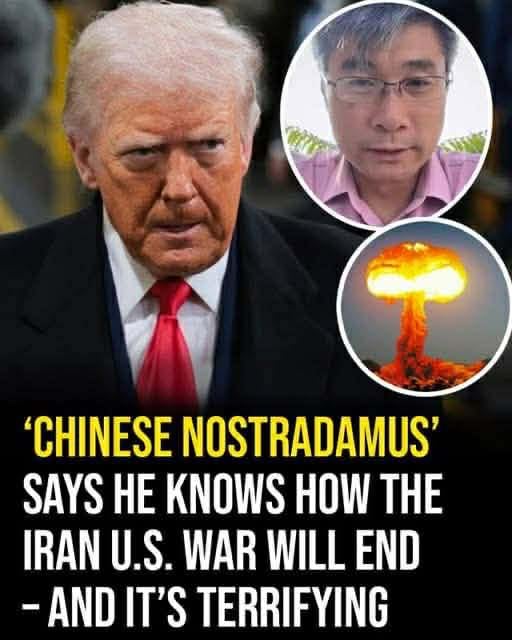
The warning is brutal, and the implications are staggering. Professor Xueqin Jiang, often referred to in the media as the “Chinese Nostradamus,” has made a chilling pronouncement about the trajectory of the United States in its escalating conflict with Iran. Unlike casual pundits or headline-seeking analysts, Jiang frames his predictions not as conjecture, but as a culmination of decades of strategic observation, historical parallels, and geopolitical modeling. According to him, America is not merely at risk of struggle—it is poised to lose. His assessment has rattled experts and citizens alike, because he insists that Washington has, perhaps unknowingly, walked into what he describes as a 20-year strategic trap. In Jiang’s eyes, the enemy it faces is not a conventional one; it is an opponent meticulously constructed for attrition warfare, leveraging drones, missiles, asymmetric tactics, and economic leverage with a patience that outlasts any short-term American campaign. As whispers of World War III circulate in international media, Jiang’s final, deeply unsettling prediction has left millions around the globe questioning whether the era of unquestioned U.S. military dominance might already be fading.
Jiang’s reasoning, while often couched in dramatic rhetoric, is grounded in a strict strategic logic rather than prophecy. He argues that Iran has, over the past two decades, methodically built a military posture optimized for what he calls “grinding, attritional conflict.” Unlike conventional wars in which force and speed dominate, Jiang contends that Iran’s approach is measured, cost-effective, and psychologically persistent. Cheap drones, long-range missiles, and small-scale cyber operations are all calibrated to inflict cumulative damage over years. In this paradigm, the American superpower, with its sprawling and technologically sophisticated military, becomes paradoxically vulnerable. Each million-dollar missile interceptor or advanced fighter jet is tested against adversary equipment that costs mere fractions of the price, creating a systemic imbalance over time. The numbers are deceptively simple: it is not necessarily the side with the largest arsenal that prevails, but the one that can sustain the fight economically, strategically, and psychologically across years of attrition. Jiang emphasizes that this form of warfare rewards patience, endurance, and adaptability—qualities he argues the U.S. military has deprioritized in favor of speed, firepower, and high-tech superiority optimized for a different era of combat.
The professor’s warnings extend far beyond the battlefield, entering the realm of global economics, energy infrastructure, and humanitarian risk. Jiang highlights the strategic significance of critical nodes such as desalination plants, oil terminals, and the Strait of Hormuz—chokepoints whose disruption could trigger cascading crises affecting millions of lives. Damage to these infrastructures would not only compromise essential resources like water and energy but could also destabilize entire financial systems reliant on the steady flow of the petrodollar. In Jiang’s analysis, the impact of these economic shockwaves would ripple far beyond the Middle East, undermining sectors of the U.S. economy and sowing uncertainty in global markets. He suggests that a prolonged conflict could erode confidence in U.S. economic and military invulnerability simultaneously, fundamentally altering the perception of American power on the world stage.
Jiang’s perspective, often framed as “psycho-history” due to its blending of sociopolitical modeling with long-term strategic forecasting, is polarizing. Critics accuse him of exaggeration and fatalism, while supporters argue that his warnings reflect uncomfortable truths that traditional military and intelligence communities may overlook. Regardless of where one stands on his credibility, the core message is stark and unambiguous: this is not a fleeting skirmish or a conventional battlefield challenge. It is a test of resilience, foresight, and strategic patience. For the United States, the conflict with Iran—if it escalates along the lines Jiang predicts—could represent the moment when decades of perceived invincibility finally collide with the reality of a multipolar, contested, and increasingly unpredictable world.
In essence, Jiang is issuing more than a military forecast; he is sounding a geopolitical alarm. He envisions a world where the assumptions that have long underpinned American foreign policy—technological superiority, rapid response, overwhelming force—may no longer guarantee victory. In his model, the enduring victor will be determined not by the firepower it can wield in a single engagement, but by the patience, adaptability, and resilience it can sustain over decades. As policymakers, analysts, and citizens grapple with these warnings, one thing becomes clear: if Jiang’s vision bears even a fraction of accuracy, the next twenty years may redefine what it means to wield power on the global stage, shifting the balance from dominance to endurance, from certainty to caution, and from a unipolar world to a far more contested, multipolar reality.