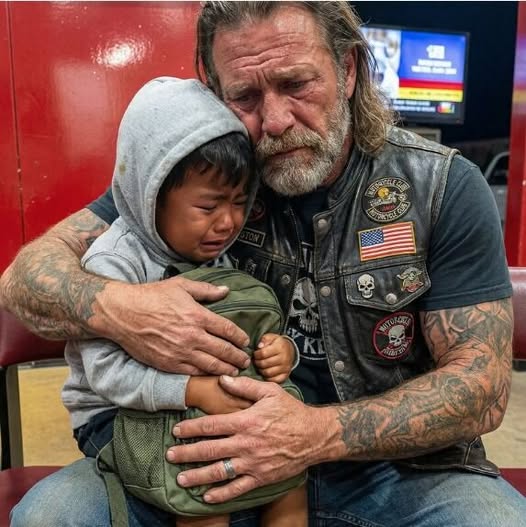
I heard him before I saw him — a fragile cry, desperate and full of fear, echoing across the empty parking lot like a wounded creature calling for help. My heart tightened as I followed the sound, carefully moving past the overflowing trash bags behind the dumpster. And then, I froze.
Two terrified little eyes stared up at me, wide and unblinking, full of fear and confusion. The world seemed to stop in that moment as the small, helpless form of a boy, no older than three, shivered in the shadows. His face was streaked with dirt, his clothes soaked through, and tears mixed with remnants of food. But it was his eyes—so full of raw, unfiltered emotion—that rewired something inside me forever.
My name is Daniel Torres. I’m fifty-three, a lifelong biker, and an Iraq War veteran. I’ve held dying men in my arms. I’ve watched my brothers bleed out on the sand and dirt of a foreign land. I thought that nothing in this world could surprise me, nothing could pierce the armor I’d built over decades. But standing there, face to face with that child, I was wrong. I had never encountered anything like this.
That afternoon, I’d made my usual stop at Maria’s Cocina, a small, family-owned Mexican restaurant on Highway 74. I had been going there for years, partly for the best tamales I could find in the area, but mostly because of the woman who ran it. Maria always treated me like family, calling me “mijo” like I belonged, like I was part of something bigger than just a customer. It was more than a place to eat; it was a sanctuary in a world that often felt cold and impersonal.
But that day, nothing was normal. The parking lot was filled with three white vans, all with government plates, and men in tactical gear were rounding up workers—Maria, the cooks, the servers, and the dishwashers—people who had been feeding this community every day. I watched in shock as Maria was shoved into one of the vans, her cries of protest swallowed up by the roar of the engine.
In just a matter of minutes, eleven people were taken. I wanted to help, but fear had gripped the remaining witnesses. They scattered, leaving only silence behind. Maybe I should’ve left, too. But then, I heard it—the sound of a child’s cry.
Behind the building, hidden behind trash bags, was a tiny boy. His small body trembled so violently that his teeth chattered. His gray hoodie was soaked with sweat, his cheeks streaked with dirt and tears. I could barely make out the words as he whispered:
“Mamá,” he said, his voice barely above a sob. “Mamá.”
My gut twisted. I crouched slowly, trying to keep my voice calm, but I could feel the anger and heartbreak rising. “Hey, little man. Are you hurt?” I asked softly.
The boy’s response was a guttural scream, not directed at me, but at the vans as they sped away, taking his mother with them. His small arms flailed, reaching for someone who wasn’t there. “MAMÁ! MAMÁ!”
It hit me like a punch to the chest. His mother had hidden him behind the dumpster before they came. She had tucked him away, telling him to stay quiet and wait for her to return. But she never had the chance. They had taken her and left her child behind, abandoned in the dust of their hasty exit.
I scooped the boy up in my arms, his tiny fists pounding against my vest, his legs kicking desperately. His cries were raw, filled with terror. But I held him tight. “I’ve got you,” I whispered, trying to reassure him. “You’re safe now. I promise.”
For a moment, I thought he might break free, but then something shifted in him. His body went limp, and he collapsed against me, clutching my vest with tiny, trembling hands. His sobs shook his little frame, so deep and painful I could hardly breathe. I didn’t know this child, but in that instant, I knew I had to protect him.
I made my way to the front of the restaurant, still holding him close. One officer remained, taping notices to the door. I was filled with a rage I hadn’t felt in years. “You left a child behind!” I shouted at the officer. “You took his mother and left him here alone. How could you?”
The officer looked at me, his face draining of color. “There weren’t supposed to be any children—we checked—”
“No,” I cut him off, my voice cold with fury. “You didn’t check.”
Phones began ringing, supervisors were called, and the chaos of the situation escalated. Everyone was scrambling to figure out what to do with a child they had accidentally abandoned. And there I stood, holding this little boy—Miguel—his small body still shaking in my arms.
Miguel’s mother, Elena Reyes, had fled Guatemala while pregnant, escaping an abusive relationship with a man who had already taken the lives of two of her children before Miguel was born. She crossed the border seeking refuge, hoping to give her son a chance at life in the United States. But even with all of that, the system ripped her from him, leaving her three-year-old son behind, alone and vulnerable.
Child Protective Services arrived, a tired woman with a clipboard in hand, but there was no compassion in her eyes. “We’ll place him in emergency group housing,” she said with a disinterested tone.
Miguel screamed again, the sound of it breaking my heart. His hands clawed at my chest as he tried to escape, his small body convulsing with fear. I couldn’t let him go. Not like this.
“He’s not going anywhere,” I said firmly, my voice shaking with anger and determination. “Not on my watch.”
“Sir, you have no legal standing—” the woman started.
“Then give me legal standing. I’m a veteran, a good man. I’ve got a clean record, I own my home. I will take him. Right now.”
“That’s not how this works—” she argued.
“Then make it work.” My words were steel.
Four hours later, I walked out of that parking lot with temporary custody of Miguel.
At home, the first night was hell. Miguel cried for eight straight hours—no food, no water—just pure, raw grief. I held him through every sob, every desperate cry. I rocked him until exhaustion claimed us both. By morning, Miguel was still clinging to me, small and fragile, but alive.
Over the next few days, my club—my brothers—came together. These men, some of the toughest I know, were no longer just bikers; they became family. Tattoos and scars didn’t matter. Miguel became their son, too. Clothes, toys, food—all came pouring in. James, fluent in Spanish, knelt down beside Miguel, talking to him with the patience only a father could offer. “Tell him I’m keeping him safe until his mama comes back,” I said.
James translated, and Miguel looked up, his eyes wide and searching. “He wants to know if you promise,” James said.
I crouched beside him, gently holding his small hand. “I promise, little man.”
Miguel hesitated for a moment, then he took my hand in his, a silent pact of trust. That was the moment I knew—no matter what, I was his protector now.
Four months passed, and Miguel’s healing began, though his nightmares never ceased. He still wakes up screaming, hides from uniforms, and won’t sleep unless he’s touching me. The trauma of his past is etched deeply in him, but I’ll never let him face it alone. As each day passes, Miguel is growing stronger, finding solace in the family that surrounds him. And through all of it, I became Dani to him.
Every two weeks, we visit Elena. The drive is long, five hours each way, and the visits are short—just thirty minutes behind glass. Elena cries when she sees him, and so does Miguel. I try not to, but it’s hard to hold back. Elena’s case is strong—proof of the abuse, the police reports, the hospital records, and Miguel’s citizenship. The hearing is tomorrow, and if they deport her, I will fight for custody. Miguel will not go back into foster care. Not on my watch.
Tonight, as I hold Miguel in my arms, his small body curled against mine, he whispers through his dreams:
“Dani… Mamá come home tomorrow?”
I swallow hard, my throat tight. “I hope so, buddy.”
He thinks for a moment, then softly asks: “If Mamá no come home… you stay with me?”
I pull him closer, my heart breaking. “Always.”
Tomorrow, fifty bikers will fill that courtroom—veterans, fathers, grandfathers—men who know that family isn’t just blood. It’s choice. And they will not let a judge forget the human cost behind the paperwork. Whatever happens, Miguel will not be alone. Not ever again.
Because when his mother hid him behind that dumpster, she was trying to save him. And by sheer chance, a biker found him. A biker who didn’t look away. A biker who picked up a terrified child and said, “I’ve got you.” And I always will.