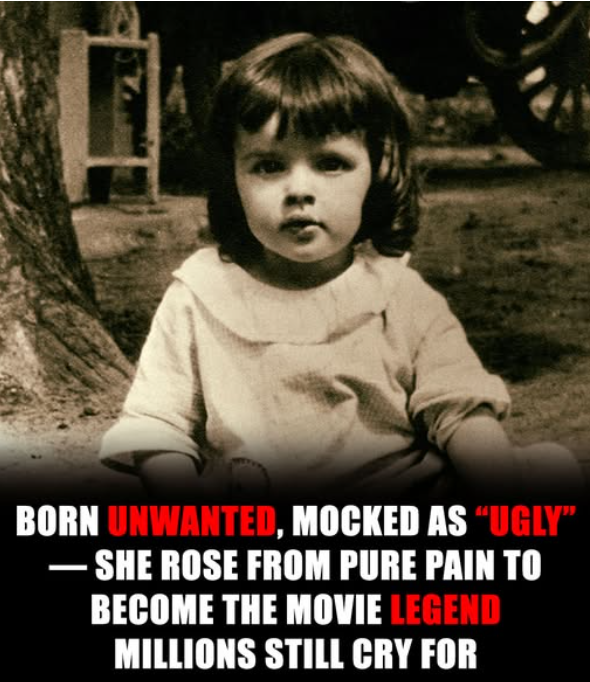
She glittered under merciless lights, a constellation of perfection in a world that never paused to ask if it hurt. Fame wrapped around her like barbed wire disguised as diamonds, beautiful but sharp, cutting into every part of her life. They called it destiny; to her, it felt more like a sentence. Behind every ovation, behind every flash of the cameras, lurked another demand—another expectation, another pill to take, another night where sleep became a distant memory. A little girl, barely old enough to understand the world, was traded for a legend, her innocence pawned for tickets, applause, and contracts that measured her worth in dollars and box office receipts rather than in love or health. Her humanity was the price of entertainment, and no one bothered to tally the cost.
She began as Frances Gumm, a child with a voice so clear it could slice through the air like sunlight through glass, and a simple wish to be loved—not for her talent, not for her potential, but for herself. Hollywood answered that wish with contracts, cruelty, and control. Every executive meeting, every audition, every studio note became a verdict on her existence. They measured her waistline, her marketability, her smile—not her well-being. She was seen as a product, a marketable miracle crafted to dazzle audiences, never as the frightened girl staring down endless workdays, marathon rehearsals, and sleepless nights filled with anxiety and pain. Her mother, caught in the machinery herself, pushed relentlessly; the studios tightened their grip. And slowly, inexorably, the message sank in: love was conditional, and applause was survival. A nod from an agent or a clapping audience was the only affirmation she would receive, the only proof that she mattered.
Yet beneath the surface of contracts and schedules, beneath the layers of makeup and costume, something heartbreakingly human endured. Judy Garland—Frances Gumm transformed into a cultural icon—sang with a voice that trembled with a truth the studios could not script. Her notes carried joy and sorrow, longing and exhaustion, hope and fear, all wrapped into melodies that were larger than life yet deeply intimate. Every performance revealed the cost of being everyone’s dream while never being allowed to be her own. She fought through the machinery of control, tried to assert her independence, and stumbled under its relentless weight. Each failure was magnified, each mistake cataloged as a flaw, yet she persisted, chasing a sense of safety and normalcy she had never been taught she deserved.
Her life became a complex paradox: adored by millions, yet often unseen and misunderstood by those closest to her. The world celebrated her voice, her charm, her talent—but rarely acknowledged the exhaustion and fear behind the sparkle. She navigated a labyrinth of emotional manipulation, forced routines, and public scrutiny that would have broken many adults, let alone a child. Drugs and stimulants were handed out like candy to keep her alert and compliant, masking the pain and emptiness that fame demanded she ignore. Behind the sequins and spotlights, she struggled to maintain the fragile threads of her identity, to remember who she was beneath the manufactured perfection.
And yet, through all of it, Judy Garland left an enduring mark that goes beyond her music or her films. She became a symbol of resilience, a human being whose struggles illuminate the hidden cost of entertainment, the cruelty that often accompanies genius. Her voice, her presence, her vulnerability—it all reminds us that no talent or applause is worth the sacrifice of a childhood. She embodied both the wound and the lighthouse: a warning of what can happen when ambition and exploitation collide, and a beacon guiding future generations to advocate for the humanity behind the stars.
Judy’s story is not just one of suffering but of remarkable courage. Every song she sang, every performance she gave, carried the weight of her history—the dreams of a little girl, the pressure of a machine, the longing for unconditional love. And even as she faltered, as her life veered into chaos and heartbreak, her legacy endured. It teaches us that the world can admire a voice without fully understanding the soul behind it, and that even amidst cruelty, the human spirit can still create beauty that transcends circumstance. Her life reminds us to look past the glitter, past the fame, and to remember the child who deserved love first, applause second.
In the end, Judy Garland’s story is both a lament and a guidepost. It is a cautionary tale about the cost of idolizing perfection at the expense of childhood, yet it is also a testament to the enduring power of authenticity, talent, and resilience. She was traded for a legend, yet she gave the world something timeless: a voice that could heal, a spirit that could inspire, and a life that still calls us to care—for the stars, and for the children behind them.