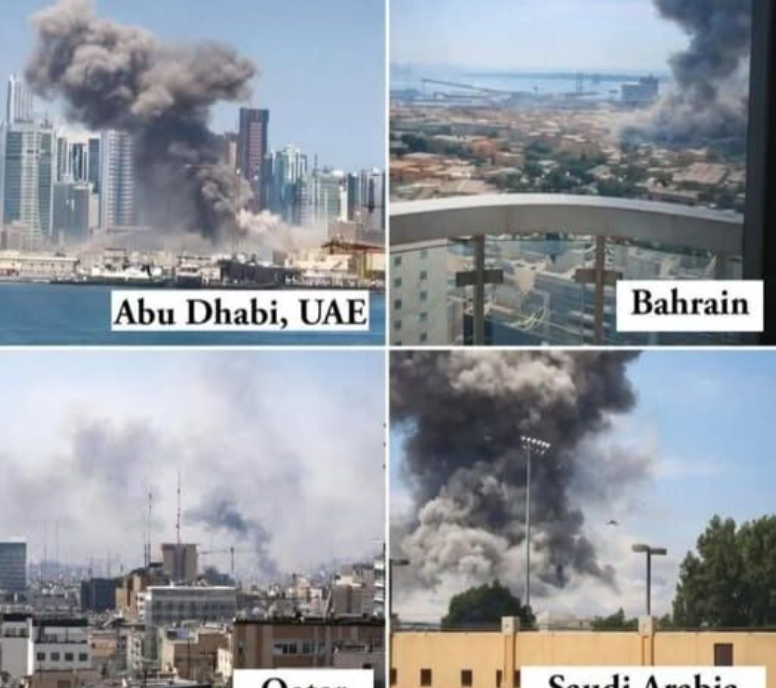
The Persian Gulf’s fragile stability has been shattered by a coordinated series of Iranian ballistic missile strikes, marking an unprecedented escalation that risks igniting a full regional war. In the early hours of March 1, 2026, Iranian state media confirmed that the military had authorized a multi-pronged attack on U.S. military installations across several Gulf nations. What had long been a “gray zone” of tension and proxy conflicts has now turned into a visible, high-intensity battlefield, prompting local governments to close airspaces and order millions of citizens into immediate lockdown.
The scale and coordination of the strikes point to meticulous planning. Targets across the United Arab Emirates, Bahrain, Qatar, and Kuwait were hit nearly simultaneously. In Abu Dhabi, massive explosions lit the night sky near Al Dhafra Air Base, a key hub for U.S. and allied air operations. Following the attacks, Emirati authorities shut down national airspace, grounding one of the busiest aviation crossroads in the world and underscoring the severity of the threat.
In Bahrain, the Al Jufair district in Manama—the site of the U.S. Fifth Fleet headquarters—saw thick black smoke rising from facilities linked to American naval operations. The Fifth Fleet is central to securing the Strait of Hormuz, and a direct hit on its headquarters represents both a symbolic and strategic strike against Western maritime power. Authorities warned residents to stay away from military zones, while the psychological impact on the capital was immediate.
Qatar faced similar pressure. Al Udeid Air Base, home to U.S. Central Command’s forward headquarters, became the center of intense missile defense activity. The Qatari Interior Ministry issued a mandatory shelter-in-place order, as Patriot missile batteries engaged incoming Iranian projectiles. At least one missile was intercepted mid-flight, confirmed by Qatari authorities, but the nation remains on high alert, with all civilian flights suspended until further notice.
Kuwait also felt the offensive. Explosions caused tremors across the capital and surrounding suburbs. Authorities instructed citizens to remain indoors, closing offices and businesses while the military prepared for further action. The directive emphasized civilian safety above all else.
This offensive follows months of deteriorating regional relations and previous U.S.–Israeli operations aimed at weakening Iranian military infrastructure. However, Tehran’s broad, simultaneous strike on four nations sends a stark warning: neutrality offers no protection, and hosting U.S. forces now carries immediate risks to sovereignty and civilian populations.
The international reaction has been swift. A coalition of thirteen nations is reportedly forming a unified military response, though diplomatic channels are struggling to keep pace with the rapid escalation. Oil markets have already spiked, as traders fear a potential closure of the Strait of Hormuz, threatening a disruption of global energy supplies on a scale not seen since the 1970s.
On the ground, U.S. personnel at Al Dhafra and Al Udeid operate under “Condition Black,” the highest alert level, assessing damage and preparing for potential follow-up strikes. Iranian missiles—believed to use maneuverable reentry vehicles capable of evading defense systems—have forced base commanders to reconsider previously secure assumptions.
Civilians in Manama, Abu Dhabi, and Kuwait City are living in ghost towns. Streets are empty as residents comply with orders to avoid military zones. Smoke from Al Jufair and the explosions at Al Dhafra are close enough to urban centers to amplify the fear of collateral damage, highlighting the high stakes for civilian safety.
As of this afternoon, the situation remains fluid. Iranian state television continues broadcasting nationalist messaging, framing the strikes as a “defense against Western aggression.” The U.S. Department of Defense has confirmed it is coordinating with regional partners, though full casualty assessments are pending. The closure of multiple national airspaces has stranded tens of thousands of international travelers, compounding the crisis.
The next 24 hours will be decisive. A massive retaliatory strike by the United States and its thirteen-nation coalition could trigger a broader war drawing in global powers, while restraint could embolden Tehran and signal a shift in regional dominance. For now, the world watches the black smoke over Bahrain and the closed skies of the UAE, waiting to see whether a path toward de-escalation emerges or the region is plunged into a devastating conflict.