Some jokes don’t need neon lights, flashy setups, or exaggerated performances to land—they thrive in the quiet spaces of life, in everyday moments where timing and perception collide. They work because they sneak up on you, take a sharp and unexpected turn, and leave you laughing a moment too late, often when you’ve already realized you should have seen it coming. These kinds of stories have survived decades—passed from bartender to patron, coworker to colleague, cousin to cousin, and across family dinners and holiday gatherings—because the mechanics of humor they exploit are timeless: precise timing, clever misdirection, and the predictable quirks of human nature. People never stop making assumptions. They never stop being misled by appearances. And they never stop laughing when reality, or someone else’s cunning, twists those expectations.
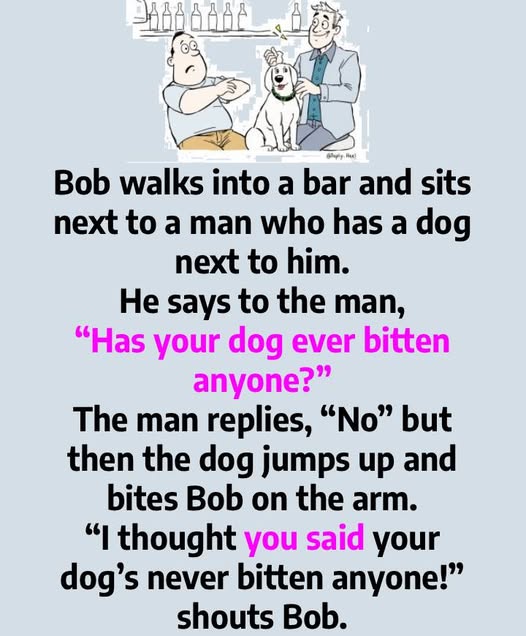
Take a classic example, simple in its setup but brutal in its execution. Bob walks into a bar after a long, tiring day, the kind of place where the lighting is muted, conversations trail off mid-sentence, and no one is surprised by anything anymore. It’s the familiar kind of bar where the regulars occupy a handful of stools at the counter, bartenders nod knowingly, and the world’s stress seems to settle briefly at the threshold. Bob takes a seat, glances around, and notices a man sitting next to him with a calm, obedient-looking dog lying at his feet. The animal radiates serenity, seemingly the picture of loyalty and discipline. Bob, cautious yet curious, decides to engage politely, starting a conversation with the man.
He nods toward the dog and casually asks whether the animal has ever bitten anyone. The man responds immediately, confidently, without hesitation, explanation, or preamble: “No.” That should have been the end of it. That should have been enough to satisfy any reasonable person.
But of course, it isn’t.
Within seconds, the dog leaps up and sinks its teeth into Bob’s arm. Chaos erupts. Chairs scrape across the floor. Drinks spill. People gasp. Bob yells, half in pain, half in disbelief, turning to the man beside him and shouting that he was told the dog had never bitten anyone. The man, utterly calm, meets Bob’s gaze and says, “I know. That’s not my dog.”
That’s it. No drawn-out setup. No dramatic character arcs. No moralizing at the end. Just the sharp, perfectly timed revelation that exposes assumptions, human credulity, and the danger of overconfidence in the answers we take at face value. The humor lands precisely because it mirrors life: people hear what they want to hear, assume clarity exists where none was promised, and sometimes reality bites them back—literally.
The same principle powers another timeless story, one wrapped in the chaos of holiday shopping and the subtle ethics of cleverness. Picture the pandemonium of a Christmas shopping center: crowded aisles, blaring music, frazzled faces, endless queues, and credit cards swiping relentlessly. In the middle of this frenzy, a woman realizes her handbag is missing. Panic sets in. Important documents, cash, personal items—all seem to vanish into the anonymous crowd. But after a tense moment, the bag is returned by an honest little boy. Relief floods her, and faith in human kindness seems restored.
She opens the bag, inspects the contents, and notices something curious. She distinctly remembers placing a single twenty-dollar bill inside. Now, however, there are twenty one-dollar bills instead. Confused, she points it out to the boy. Without hesitation, he explains that last time he found a lady’s purse, she had nothing left to give him as a reward. So this time, he made sure she would be able to give something.
Again, the punch lands not through shock, vulgarity, or exaggeration, but through clever observation and moral ambiguity. The boy is honest, yet practical. He didn’t steal, yet he acted strategically. He navigated human incentives better than most adults. The humor arises in the recognition of clever logic intersecting with social norms, and the reader is left laughing, thinking, and perhaps shaking their head at how strangely reasonable it all seems.
These stories endure because they operate at the intersection of intelligence, simplicity, and observation. They don’t require spectacle. They don’t rely on exaggerated emotions. They don’t need flashy production or media amplification. They rely on attentiveness and timing, on recognizing patterns in human behavior, and on flipping expectations in ways that feel simultaneously surprising and inevitable. Bars, shopping malls, casual conversations, and family gatherings are all theaters where such humor plays out naturally, proving that you don’t need a stage or a studio to deliver a masterful joke.
In a world increasingly dominated by viral content, short attention spans, and algorithmically optimized entertainment, these kinds of jokes still perform remarkably well. Clean humor, classic storytelling, and universally relatable scenarios are still highly shareable across social media, blogs, lifestyle websites, and entertainment outlets. They excel in evergreen categories—family-friendly humor, workplace anecdotes, holiday stories, and light-hearted viral reads. They engage wide audiences, remain accessible to all ages, and offer a momentary respite from stress without offending or alienating readers.
Beyond metrics and reach, these stories are deeply human. They highlight our imperfect communication, the assumptions we make, the ways cleverness and kindness intersect, and the moments when laughter emerges from realization rather than shock. They reveal the small truths of daily life: that people misunderstand each other, that assumptions can backfire, and that humor can bridge gaps in understanding.
This is why jokes like the dog in the bar or the resourceful holiday boy continue to thrive. They do more than make us laugh—they remind us to pay attention, to question assumptions, and to recognize the intelligence in everyday situations. They cut through noise, respect the reader’s intellect, and deliver exactly what they promise: a moment of levity in a chaotic, over-stimulated world.
In digital publishing, where engagement, dwell time, and shareability often dominate strategy, this style of humor quietly excels. Readers linger, smile, return to the story, and share it with friends. It builds connection as much as it delivers amusement. And ultimately, it proves that laughs don’t always need volume, absurdity, or spectacle. Sometimes, they just need intelligence, timing, and a touch of human insight.
Whether it’s a dog that technically belongs to someone else, or a child who understands human incentives better than grown-ups, these stories endure because they reveal patterns of life, miscommunication, and cleverness. They remind us that simplicity, sharp observation, and a perfectly timed twist are all that’s needed for humor to resonate deeply. Laughs don’t always need to be loud—they just need to be smart.