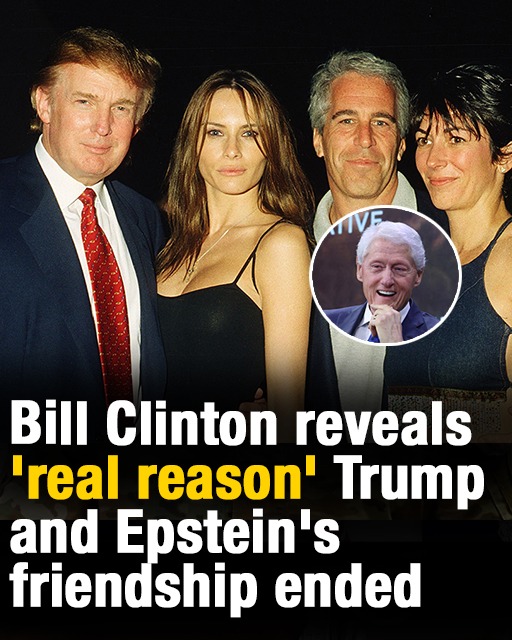
Bill Clinton has effectively detonated a political time bomb that reverberates far beyond Capitol Hill. Under oath, in a deposition that will be replayed endlessly across cable news networks and digital feeds, he revealed a claim that has sent shockwaves through political circles: Donald Trump, the former president whose every move has been dissected and debated, privately expressed regret over his “falling out” with Jeffrey Epstein. What is striking — and deeply controversial — is not simply that the two men disagreed, but the reason behind it. According to Clinton, Trump’s remorse was not rooted in a moral judgment of Epstein’s crimes, nor in horror over the exploitation and trafficking of underage girls. Instead, it was tied to a seemingly mundane dispute over a real estate deal, a property bidding war that soured a friendship that had once included charity events, social gatherings, and high-profile public appearances. That revelation stands in stark contrast — and direct conflict — with years of public statements in which Trump consistently denied any closeness to Epstein or, at the very least, painted their relationship as terminated because of Epstein’s “creepy” behavior. Lawmakers across the aisle are now forced to reconcile Clinton’s account with Trump’s long-standing narrative, while cameras and microphones capture every flinch, pause, and whispered consultation, ensuring that the public sees the unfolding drama in real time.
Clinton’s sworn testimony cuts sharply into the carefully curated story that Trump and his allies have maintained for years. Publicly, Trump has insisted that his association with Epstein ended decisively and heroically, emphasizing that he distanced himself once he became aware of the billionaire’s alleged abuses and the sexual exploitation of young women at Mar-a-Lago. Yet Clinton paints a different picture: he recalls a scene at a charity golf event, a setting far removed from the high-stakes political rhetoric and campaign rallies, where Trump reportedly expressed nostalgia for “some great times” shared with Epstein. The conversation, according to Clinton, centered not on moral outrage or ethical reckoning but on business matters — a rivalry over a property deal that led to their estrangement. Trump’s parting words, as described, were simple and understated: “I’m sorry it happened.” On the surface, a seemingly innocuous statement. But within the charged context of national politics and the broader Epstein saga, that casual remark now resonates like a cannon shot.
The implications of Clinton’s account are enormous. By framing the end of Trump’s relationship with Epstein as a matter of bruised egos and financial competition rather than moral revulsion, the deposition fundamentally challenges the narrative presented to the American public. It raises uncomfortable questions about how the former president defines loyalty, morality, and friendship, especially when intertwined with wealth and social power. In Washington, the political fallout is immediate: Republicans are quick to argue that Clinton’s testimony, by virtue of being cooperative and seemingly transparent, may actually shield Trump from accusations of complicity or prior knowledge. Democrats, on the other hand, seize upon the contradiction as evidence that a deeper investigation is necessary — that the public deserves clarity on the full scope of the Trump-Epstein relationship, the timelines involved, and the decision-making that followed.
Visual evidence compounds the tension. Old photographs, magazine profiles, and public records document decades of interaction between Trump and Epstein, while glowing quotes and social media posts add further texture, creating a mosaic of association that appears more deliberate and sustained than previously acknowledged. Clinton’s deposition now forces a reconsideration of that entire history, revealing a pattern in which the relationship was only abandoned when it ceased to serve mutual interests. The image of a moral or ethical break is replaced with one of transactional convenience: a friendship maintained for access, visibility, or opportunity, and ended when those benefits no longer aligned. For investigators, political operatives, and journalists alike, this shift reframes how the public interprets past denials, friendly public appearances, and even casual statements made by Trump about Epstein over the years.
Moreover, the timing of Clinton’s revelation amplifies its effect. Coming at a moment when scrutiny of Epstein’s network is renewed by recently released documents and ongoing federal inquiries, the deposition does not exist in isolation. Every mention of Trump’s name in conjunction with Epstein now carries weightier consequences, shaping media cycles, social commentary, and partisan debate alike. Analysts note that the casual tone described by Clinton — the regret framed in terms of property and opportunity rather than moral judgment — is precisely what makes the testimony so destabilizing. It strips away the veneer of ethics and heroism that Trump’s narrative had cultivated, leaving a raw, human glimpse into the calculation, priorities, and relational dynamics that once governed interactions between the two men.
In short, what emerges from Clinton’s deposition is less a clean moral judgment and more a nuanced, troubling portrait of a political figure navigating relationships with a convicted predator not out of horror or righteousness, but out of self-interest and ego. The casual, almost dismissive reflection — “I’m sorry it happened” — reverberates across political discourse, sparking fierce debate over credibility, transparency, and character. It underscores the stark divergence between public posturing and private sentiment, reminding the nation that the narrative of a heroically severed connection may often conceal a more pragmatic and morally ambiguous reality.
Ultimately, between old photographs, social media evidence, glowing quotes, and Clinton’s vivid account, the Trump-Epstein story now appears far messier than ever imagined. It is a relationship defined by convenience, competitive tension, and selective moral outrage, abandoned only when the friendship ceased to serve practical ends. For lawmakers, journalists, and the public alike, Clinton’s testimony is a watershed moment: a reminder that even the most controlled narratives can be disrupted in an instant, and that the truth, however uncomfortable, will always find its way to the surface.