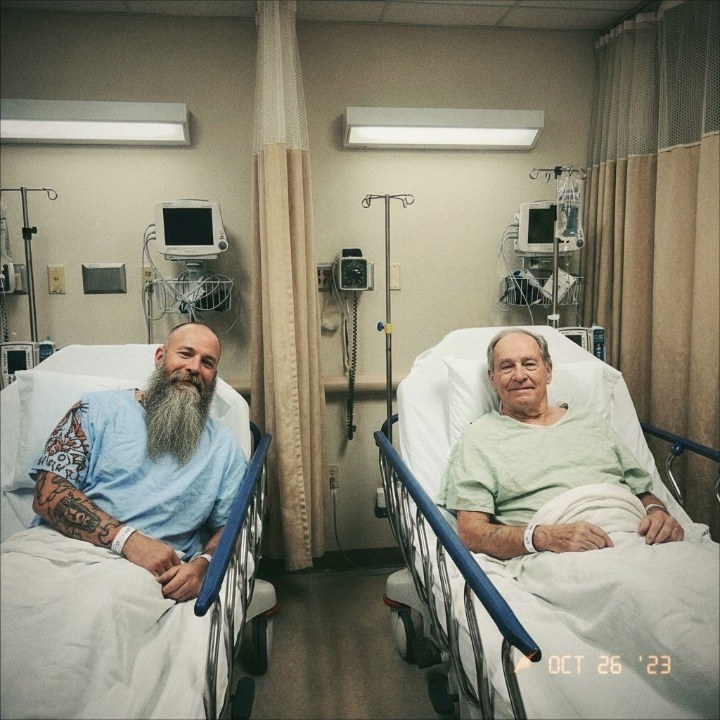
My name is Robert Brennan, and for nearly thirty years, I served as a district court judge. I sentenced people for a living. Hundreds—maybe thousands—stood before my bench while I weighed statutes, precedents, and procedure. I believed justice meant consistency. Distance. Control.
I told myself that if I followed the law precisely, morality would take care of itself.
But there was one case that seemed routine at the time. Today, it haunts me.
In 2008, Michael Torres appeared in my courtroom. He was twenty-four, charged with armed robbery. He had walked into a small convenience store with a gun, demanded money, fled with a few hundred dollars, and was arrested within minutes. No prior convictions. No history of violence. His hands trembled as he stood before me. When I read the sentence, he collapsed in sobs so raw it felt physical.
The law required a minimum of fifteen years because a weapon was involved. I had discretion beyond that.
I chose twenty.
I remember how steady my voice sounded. I remember the prosecutor’s quiet satisfaction. I remember the bailiff’s stillness. I remember the clerk’s pen scratching across the paper. I remember Michael’s face breaking in a way I had learned to compartmentalize. Another case. Another file. Another life changed forever.
I justified it easily. He would be out in his forties, I told myself. Plenty of time to rebuild. I even believed that was mercy.
Then I forgot him.
That’s what the system encourages. Move on. People become case numbers, not consequences.
Years later, my body forced me to stop pretending I was untouchable.
Kidney failure. Polycystic disease. Genetic and relentless. The diagnosis was blunt: without a transplant, I had months. My world shrank to dialysis sessions, lab results, and the quiet terror I tried to hide from my daughters. They smiled for me. I saw the fear in their eyes anyway.
We searched for a donor. Family. Friends. No matches. I was placed on the transplant list and learned what waiting really feels like when time is no longer theoretical.
Four months later, the call came.
“We have a living donor,” said the coordinator.
“Who?” I asked.
“They’ve requested anonymity until after surgery.”
I didn’t argue. When survival is on the line, you don’t question the hand offering it.
The surgery was scheduled for November. The hospital was hushed that morning, that sterile calm that makes everything feel unreal. As they wheeled me toward the operating room, we passed an open door.
Inside, a man lay on a gurney. Tattooed arms. Shaved head. A leather vest folded neatly on a chair.
Our eyes met for a brief second.
Something stirred in my memory—something unfinished—but before I could grasp it, the doors opened, the lights blurred, and anesthesia took me under.
I woke hours later with a new kidney and a nurse smiling down at me.
“The surgery was successful,” she said.
“Can I meet the donor?” I asked.
“He’s already in recovery,” she replied. “But he left this.”
She handed me an envelope.
Inside was a photocopy of a court document. My signature at the bottom. The sentencing order.
Michael Torres. Armed robbery. Twenty years.
At the top, written in blue ink, four words:
Now we’re even.
My daughter Rebecca arrived later, pale and shaken.
“Did you know?” she asked.
“Not until I woke up.”
“Why would he do this?” she whispered. “You sent him to prison.”
“I don’t know,” I said. “But I need to understand.”
She hesitated. “He checked himself out of the hospital. Against medical advice. He’s gone.”
He had left. He had given a piece of himself without asking for thanks, forgiveness, or explanation.
The doctors were stunned by the compatibility.
“It’s extremely rare,” one said. “Almost as if you’re related.”
We weren’t related by blood. But we were bound by a courtroom and fifteen stolen years.
While recovering, I pulled Michael’s file. I read it differently now. Not as a judge—but as a human.
Unemployment. A pregnant girlfriend. Eviction notices. A borrowed gun. Desperation dressed as bravado. The gun wasn’t even loaded. He demanded $347 and was arrested crying on the sidewalk.
I had called it public safety. I had called it justice.
Two weeks after surgery, I hired a private investigator.
Three days later, I had an address.
Michael worked at a motorcycle repair shop on the south side. I drove there myself. When he stepped out, he wasn’t surprised to see me.
“Judge Brennan,” he said calmly.
“Michael.”
We sat in a diner across the street.
“Why?” I finally asked.
He stirred his coffee slowly. “You saw the note.”
“Explain it.”
“It means I don’t carry you anymore,” he said. “I hated you for years. It nearly destroyed me. Then someone told me hatred is poison you drink hoping someone else dies.”
He looked at me steadily.
“I let it go. Not for you. For me.”
“And the kidney?” I asked.
“I chose it,” he said. “Prison takes choice away. This was mine. You had power once. I had power later—and I used it differently.”
I apologized. I told him I could have given the minimum.
He shook his head. “I walked into that store with a gun. You didn’t know it wasn’t loaded. We both made choices.”
He left the hospital early because he didn’t want gratitude to complicate the act.
“I didn’t do it to be your story,” he said. “I did it to be mine.”
We stayed in touch.
I began volunteering with reentry programs. Helping people rebuild instead of merely punishing them. Michael spoke at one session.
“The system punishes,” he said. “It doesn’t heal.”
Months later, I rode on the back of his motorcycle with a group called Second Chance Riders. Wind, fear, laughter—all of it felt like being alive again.
My medical results were perfect. The doctors called it a miracle.
I call it a reckoning.
Michael once wrote that we were even.
We’re not.
Because he didn’t just save my life.
He gave me the chance to finally understand the difference between law and justice—and to live the rest of my years honoring it.