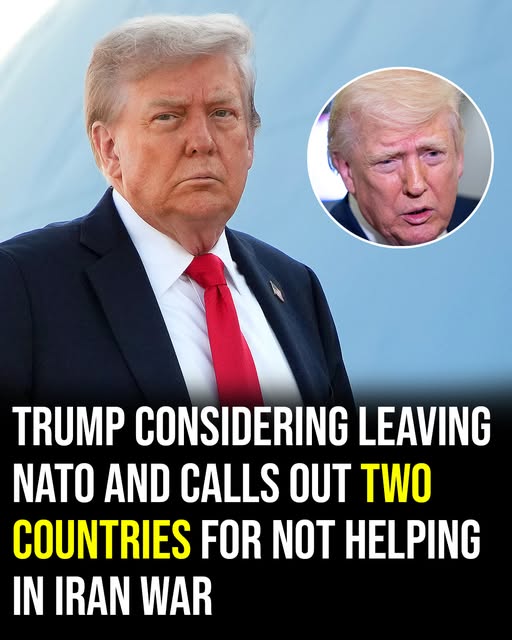
Tensions between the United States and its long-standing allies have escalated sharply, as Donald Trump has once again raised the prospect of withdrawing from NATO—this time in more direct and uncompromising terms than ever before.
In a recent interview, Trump made it clear that his skepticism toward NATO has not only persisted but intensified over time. What was previously framed as criticism or pressure for reform now seems to be evolving into something far more consequential: a serious consideration of leaving the alliance altogether.
“Oh yes, I would say it’s beyond reconsideration,” he stated, signaling that the notion of withdrawing is no longer hypothetical.
The timing of these remarks is far from coincidental. They come amid heightened geopolitical tensions, particularly in the context of ongoing conflicts involving Iran—a situation that has exposed divisions between the United States and several of its closest European allies. According to Trump, the lack of support from key partners during this conflict has reinforced his view that NATO is not functioning as it should.
For years, Trump has described NATO bluntly, questioning both its effectiveness and its value to the United States. In this latest commentary, he went even further, calling the alliance a “paper tiger”—a phrase suggesting weakness, lack of credibility, and limited real-world impact.
This characterization strikes at the foundation of NATO itself.
Formed in 1949, NATO was established as a collective defense alliance, initially with 12 member nations, including the United States, the United Kingdom, France, and Canada. Today, it has grown to 32 countries, representing one of the most significant military alliances in modern history. At its core lies the principle of mutual defense—that an attack on one member is considered an attack on all.
Trump’s remarks challenge that very principle. By suggesting that NATO lacks strength or unity, he is not merely critiquing policy; he is questioning the credibility of the alliance as a whole, raising broader concerns about the future of transatlantic cooperation.
In his latest critique, two countries were specifically targeted: the United Kingdom and France.
Both nations have long been regarded as among America’s closest allies, with deep historical, political, and military ties. Yet in Trump’s view, their actions—or inactions—during the Iran-related conflict fell short of expectations. He criticized the UK for what he perceived as a refusal to participate in aggressive measures against Iran, signaling frustration not just with policy but with what he considers a lack of commitment.
France also faced sharp criticism, accused of obstructing logistical support related to military operations. According to Trump, these actions were not merely unhelpful—they actively hindered efforts aligned with U.S. interests.
Whether fully substantiated or not, these accusations reflect a broader pattern in Trump’s approach to international relations. He consistently emphasizes a transactional view of alliances, where contributions, support, and direct benefits are central. In this framework, partnerships are evaluated by measurable participation rather than long-standing diplomatic ties—a stance that frequently clashes with traditional diplomatic approaches emphasizing cooperation, shared values, and strategic alignment over time.
Trump’s critique of the UK went even further, questioning Britain’s military capabilities, particularly its naval strength, and commenting on perceived deficiencies in its defense infrastructure. While controversial, these remarks align with his broader assertion that some NATO members rely too heavily on the United States while contributing less themselves.
This is not a new argument. Throughout his career, Trump has repeatedly called on NATO members to increase defense spending, citing uneven burden-sharing. While some countries have responded by raising their military budgets, tensions over this issue have persisted for years, and the current remarks have reignited the debate.
Trump’s history with NATO also includes other points of friction. Notably, his previous interest in acquiring Greenland—a territory under the Kingdom of Denmark—met strong opposition and added complexity to U.S.-European relations.
Taken together, these incidents reflect a consistent pattern: a willingness to challenge established alliances, question long-standing agreements, and push for changes in line with his conception of U.S. national interest.
What sets the current situation apart is the level of escalation. Discussing withdrawal from NATO is far more than a minor adjustment—it represents a potential fundamental shift in global strategy. The United States has been a central pillar of NATO since its inception, and its departure would have far-reaching consequences, affecting not only NATO’s internal cohesion but global security dynamics as a whole.
Such a move would raise urgent questions about deterrence, coordination, and the balance of power across multiple regions, while forcing other member states to reassess their own roles and responsibilities.
For now, the notion of leaving NATO remains a possibility—but the language Trump has used suggests it is being seriously considered, enough to influence conversations at the highest levels of government and defense.
Responses from allied nations have been measured, emphasizing the importance of continued cooperation and stability. Publicly, unity is the focus, even as private assessments likely gauge the potential risks with heightened urgency.
The stakes are enormous. NATO is not merely an organization; it is a framework that has defined international security for decades. Any shift in its structure or membership carries consequences far beyond individual countries.
For Trump, the central question seems to be whether NATO, in its current form, serves U.S. interests effectively. For other observers, the question is broader: what happens if it does not?
As discussions continue, one point is clear: the future of NATO is no longer a settled matter. The outcome of this debate could reshape global alliances in profound and unpredictable ways.