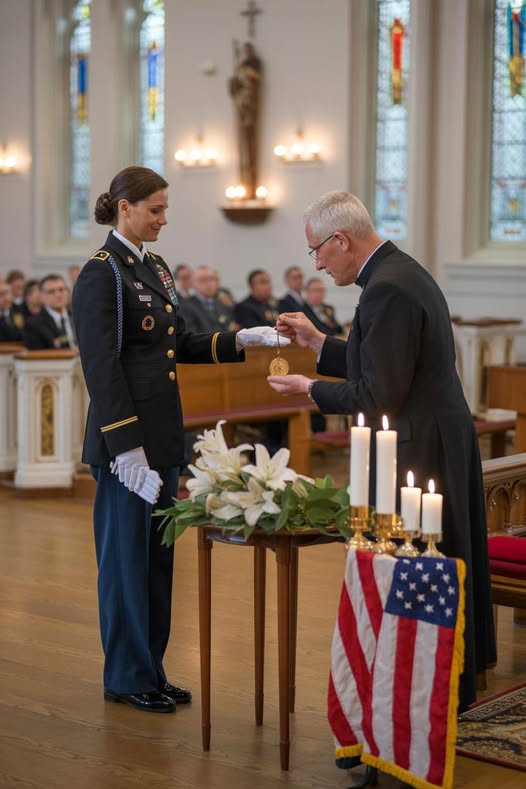
The church in Savannah was filled to capacity. Familiar faces from the town, former neighbors, and several of my mother’s colleagues from the hospital where she had volunteered faithfully every Tuesday afternoon for nearly ten years had gathered. Members of her book club were there, along with representatives from the historic preservation society she had joined when her health began to decline. Some people I recognized immediately, others I didn’t, but all of them wore dark clothing and carried that quiet, heavy stillness that seems to settle naturally around a casket.
My stepfather, Thomas Brooks, stood near the front pew, greeting people with the controlled warmth of someone accustomed to public appearances. His demeanor was composed, his gratitude measured, his grief carefully portioned out in small, appropriate gestures. He shook hands, offered brief condolences, placed a reassuring hand on each visitor’s arm as they passed. He looked exactly like a grieving husband should, and I realized I had watched him perform this role for years without ever questioning its authenticity. That was Thomas’s defining trait—he never exaggerated. Everything about him was precise, calculated, and deliberate.
I had arrived from Fort Liberty the night before on a sleepless red-eye flight, gone straight from the airport to the funeral home, and changed into my Army dress uniform in a restroom filled with the scent of flowers and harsh cleaning chemicals. It had been nearly a year since I last returned to Savannah. The Army has a way of keeping you occupied—that’s the polite version. The truth was, coming home had begun to feel like something that required emotional preparation, something I hadn’t always been ready to confront.
Father Raymond Hail had known my family for decades. Before his assignment to the parish, he had served as a military chaplain overseas, which was how he had come to know my biological father—or so I had always been told. My father, Daniel Mercer, was said to have died in a boating accident on Lake Lanier when I was two years old. That story had always existed in my life like a photograph placed on a shelf—present, acknowledged, but rarely examined closely.
The service concluded in the familiar rhythm such ceremonies always follow. The organ music softened and faded, hands were folded, and a receiving line formed. People spoke of my mother’s strength, her kindness, her resilience. I nodded, thanked them, and stood quietly while Thomas worked the opposite side of the room. It was then that Father Hail approached me, stepping close enough that his voice could cut through the low murmur of the sanctuary.
“Captain Brooks,” he said quietly. “May I have a moment?”
There was something unsteady in his voice. That was the first thing I noticed.
He led me into the vestry, a small room with a wooden table and a rack of old vestments hanging along the wall. Once the door closed, the sounds from outside faded into a distant hum, as if we had stepped into a separate world.
He didn’t hesitate.
“Your real name is not Brooks,” he said. “Your father was a Marine. A decorated one. And he did not die the way you were told.”
For a brief moment, I thought he was referring to Thomas. Then I realized he wasn’t.
“His name was Daniel Mercer,” he continued.
Of course I knew that name. It was on my original birth certificate—the one I had never seen, the one I had never thought to question.
“He drowned,” I replied. “Lake Lanier. I was two.”
“That’s the story,” Father Hail said. Not correcting me, just repeating it in a way that made the words feel heavier.
He reached into his jacket and placed a small brass key in my hand. Attached to it was a plastic tag: Locker 27, Fairview Storage.
“Your mother left instructions,” he said. “She intended to tell you herself.” He paused. “She didn’t get the chance.”
My mother had spent the past year moving between hospitals. There had been time—opportunities that never materialized.
“Don’t go home tonight,” he added. “Thomas is already searching for documents.”
Before he could finish, my phone buzzed. A message from Thomas: Where are you? We need to talk before you leave town.
Too fast.
When I stepped back into the sanctuary, Thomas was already watching me. His gaze carried that familiar attentiveness—subtle, but unmistakable. He approached with practiced ease.
“Everything alright?” he asked.
“Fine.”
His eyes flicked briefly toward the vestry door, his expression unchanged but something beneath it shifting.
“We should head back. People are coming by.”
“I have a few things to handle first.”
He held my gaze a moment longer than necessary. “Don’t be late.” It sounded less like a suggestion and more like a directive.
Outside, the humid Georgia air clung heavily to my uniform. I sat in my rental car, turning the small brass key over in my palm. It was ordinary, unremarkable. My phone buzzed again.
Come straight home. We need to review your mother’s files tonight.
Files. He hadn’t mentioned those before.
Fairview Storage was about fifteen minutes away, tucked near an aging strip mall and a gas station that looked unchanged since the early 2000s. I had driven past it countless times growing up without ever noticing it. A teenager at the front desk waved me toward the back row without asking questions. Rows of storage units stretched out like archives of other people’s lives.
Unit 27 was near the end. No padlock—just a keyhole. I paused, listening to the faint sound of wind against metal and distant traffic.
The door slid open with a harsh metallic rattle.
Inside sat a single clear plastic bin.
On top was a manila envelope with my name written in my mother’s handwriting: Mercer. Not Brooks. I stared at it longer than I expected.
Beneath it were folders, a USB drive taped to the side, and a framed photograph of a man in Marine dress blues. Tall, composed, decorated. I recognized his eyes—they were mine.
Inside the envelope was an original birth certificate. Not a copy. Official. Name: Elena Marie Mercer. Father: Daniel Thomas Mercer. No mention of Brooks.
I read it twice.
Then I compared it to the amended version in my records—issued years later, listing Thomas Brooks as my father.
They hadn’t replaced the truth. They had rewritten it.
The documents beneath revealed financial records—insurance payouts, trust transfers, legal filings—all tied to Thomas. The timeline was precise. Too precise. Events moved quickly after Daniel’s death, not with grief, but with efficiency.
Emails on the USB drive told a deeper story. Daniel had discovered financial discrepancies and demanded an audit. Thomas had delayed. Then Daniel died. After that, everything transitioned smoothly.
Too smoothly.
When my phone buzzed again with a message from Thomas telling me to leave the storage unit, I understood—he knew, or at least suspected.
The final document was a letter from my mother. She wrote that she hadn’t known before marrying Thomas, that she discovered the truth later through hidden files. By then, it was too late. She had been financially and legally trapped, afraid of losing custody if she fought him.
So instead, she documented everything. Quietly. Carefully. For sixteen years.
I left the storage unit and went to a diner from my high school days. While sitting there, I accessed military records, public documents, and old reports. Patterns began to form—financial irregularities, property transfers, altered narratives.
The official report of Daniel’s death was brief and inconclusive. No autopsy. Minimal investigation. A single witness who mentioned raised voices—plural.
That contradicted the story I had always been told.
The following day, I spoke with someone who had worked with Daniel. She confirmed the financial discrepancies and revealed she had been dismissed shortly before his death for refusing to delete backup files.
The pieces fit together.
At the Office of Inspector General, I submitted everything. Not accusations—just facts, documentation, timelines.
The investigation moved forward quickly.
Thomas tried to intimidate me, sending legal threats, attempting to regain control. But the evidence was already in motion.
When the federal review began, the focus remained on financial misconduct and obstruction. Not homicide—but enough to expose what had been hidden.
Eventually, Thomas accepted a plea agreement. No dramatics, no denial—just quiet acknowledgment.
Later, I petitioned to correct Daniel Mercer’s military record. The “instability” notation added after his death was removed due to lack of evidence.
His record was restored to what it had always been: honorable.
I returned to Savannah months later and stood at his grave. For the first time, I truly saw it.
I placed his dog tags beside the stone, then mine beside them. My name—Mercer—engraved properly at last.
Some questions remained unanswered. What truly happened that night on the lake might never be known.
But the truth that could be proven was documented, recorded, and resolved.
And for the first time, everything felt complete.