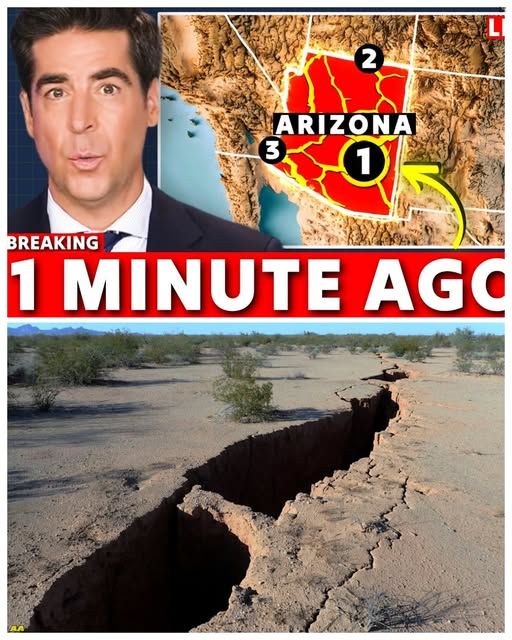
Across Arizona’s booming cities, sprawling suburbs, and vast, iconic deserts, a silent crisis is unfolding beneath the surface. The ground is quietly tearing itself apart, and it is happening without sirens, without warnings, without headlines to match its danger. Families step out into their backyards to find yawning fissures slicing through driveways, walls leaning where they should be straight, and entire plots of land subtly, then violently, collapsing beneath their feet. Roads buckle, fields fracture, and the stability of neighborhoods once taken for granted begins to erode in real time. This is not an earthquake, not a sudden, unpredictable tremor, but something far slower, more insidious, and ultimately just as destructive: the consequences of a state built on water borrowed from the future.
Arizona’s meteoric growth—the gleaming high-rises of Phoenix, the ever-expanding suburbs, and the seemingly endless desert developments—has long been a story of success. Yet beneath this narrative of progress, the land itself is sending urgent signals that have gone largely ignored. For decades, aquifers that historically buffered the arid landscape have been drained at rates far beyond what nature can naturally replenish. The groundwater, once a reliable pillar supporting life and growth, has been siphoned off for agriculture, residential sprawl, and industrial development. As these vital reservoirs vanish, the subsurface soils no longer have the buoyancy or cohesion to hold themselves up. The weight of the land, of buildings, roads, and everything built on top of it, becomes too much, and the earth responds by cracking, buckling, and opening deep fissures that stretch for hundreds of feet in some places.
These fractures are not just cosmetic scars on the desert floor—they are destructive forces that slice through farms that feed local communities, subdivisions where families live and raise children, highways that carry commuters to work, and buried utilities critical for water, gas, and electricity. Once the subsurface collapses, the support is gone forever. Homes built on seemingly solid ground suddenly find themselves tilting, foundations cracking, and infrastructure failing. Driveways that were once sturdy now split down the middle, creating hazards that can’t simply be patched over. The danger is both visible and hidden: some fissures gape wide for all to see, while others silently undermine the land beneath unsuspecting structures, waiting until the next rain, the next heat wave, or the next vehicle weight to reveal the instability.
Scientists have been sounding the alarm, mapping the fissures and tracking the compaction of the soil, but there is no simple fix. The land, once collapsed, cannot be “repaired” in any traditional sense. Unlike a broken water pipe or a cracked wall, the fissures are evidence of systemic stress—a warning that the desert, for all its beauty and apparent permanence, is fragile when pushed beyond its limits. Researchers stress that the causes are human-driven, not purely geological. The over-extraction of groundwater, the sprawling urbanization, and the lack of strict environmental regulations have combined to create the perfect conditions for these slow-motion disasters. Each fissure is not just a crack in the earth, but a crack in policy, in planning, and in the way Arizona balances growth with sustainability.
Local communities are now grappling with the implications. Homeowners are confronting the reality that their land, purchased with trust and investment, may no longer be stable. Farmers are finding fields once fertile now segmented by deep, jagged scars that make irrigation and planting nearly impossible. Cities face the challenge of repairing roads that can no longer be taken for granted and ensuring that essential utilities do not fail as the ground shifts beneath them. The economic and social costs are mounting, and the question looms large: how much longer can Arizona continue to expand without confronting the consequences of building on borrowed ground?
Adapting is no longer optional; it is essential. Scientists, planners, and policymakers are increasingly calling for stronger groundwater management rules, better urban planning that takes the land’s fragility into account, and a frank acknowledgment of areas where development should no longer occur. Ignoring the fissures, hoping they will remain small or inconsequential, is not a strategy. Every year that water continues to be extracted unsustainably, every subdivision built on over-stressed soil, and every policy that prioritizes growth over resilience increases the likelihood that fissures will continue to spread and that communities will face disasters that could have been mitigated.
The fissures in Arizona are more than just geological phenomena. They are a metaphor for the challenges of growth in an environment defined by scarcity. They remind us that the land is not infinite, that its resilience is not guaranteed, and that human ambition must be tempered by respect for natural limits. In the deserts and cities of Arizona, the cracks in the earth are also cracks in governance, in foresight, and in planning. They reveal the tension between desire and reality: the desire to expand, to thrive, to build, and the reality that some limits cannot be ignored without consequence.
The choice facing Arizona is stark: continue building on unstable ground and risk further collapse, or acknowledge the warnings, enforce sustainable practices, and redefine what growth truly means in a desert landscape. Stronger groundwater protections, informed urban planning, and honest public discourse are not just environmental necessities—they are survival strategies. The cracks underfoot are a warning, a quiet cry from the desert itself: if Arizona is to endure, it must learn to respect the very foundation on which it stands.