Margaux had never pictured her seventies unfolding this way: a modest one-bedroom apartment on the outskirts of town, a pension that felt smaller with each passing year even when the amount stayed unchanged, and a silence that wrapped around her like a heavy mist.
Her husband, Matthieu, had been gone for eight years. What remained were a few worn pieces of furniture, a wardrobe that still carried the faint trace of his cologne, and a quiet that didn’t merely occupy space—it transformed it. They had never had children. There were no nieces or nephews stopping by, no noisy holidays, no ringing phone calls except the occasional one from her sister in Arizona, brief conversations on birthdays and Christmas that felt more like duty than closeness.
Most days, Margaux kept company with a flickering television and, when the weather allowed, a stray cat that liked to sit on her kitchen windowsill and blink lazily at the world.
For four decades, she had worked as a seamstress. She hemmed trousers, fixed broken zippers, patched worn elbows, and altered wedding dresses for women trembling with anticipation. She had spent years at a dry cleaner’s, then taken on extra sewing at home to keep bills from stacking too high. Even now, despite aching joints and fingers that stiffened in the cold, her hands still knew the motions by heart. Needle. Thread. Fold. Pin. Stitch. The rhythm soothed her more than any medication ever had.
Knitting filled her evenings the way conversation once had. It gave her something to focus on besides the walls. It kept loneliness from sinking too far inside her.
Money was always tight. Margaux lived cautiously, as if moving through a house made of glass. She clipped coupons, bought generic brands, waited for sales, and weighed every purchase against food and medication. She walked to the grocery store because bus fare added up. Long ago, she had learned that small expenses grow heavy when repeated day after day.
One afternoon, she miscalculated her shopping. The bags weighed more than she expected, and by the time she stepped outside, her arms already ached. She managed a few steps before stopping half a block later, forced to set the bags down on the pavement and stretch her cramped fingers.
“Do you need help with those?”
Margaux looked up to see a woman in her mid-thirties with kind brown eyes and a gentle, unassuming smile. She wore simple jeans and a faded jacket, nothing flashy, yet kindness clung to her like sunlight on water.
“I really couldn’t,” Margaux said, even though her shoulders burned.
“You’re not asking,” the woman replied. “I’m offering.” She lifted both bags with ease. “Which direction?”
“Two blocks,” Margaux answered, surprised at how quickly relief softened her pride. “Maple Street. Brick building. Second floor.”
They walked together. The younger woman chatted casually—about the weather, a pothole that never got repaired, how the neighborhood changed each year. When they reached Margaux’s building, she carried the bags upstairs without complaint and placed them on the kitchen counter as if she’d done it countless times before.
Margaux stood there, unexpectedly moved. “Thank you,” she said. “You’re a good person. Your parents must be proud.”
The woman’s smile faltered for a brief moment. Something deeper passed behind her eyes.
“I never knew my parents,” she said gently. “I grew up at St. Catherine’s Orphanage on Fourth Street.”
Margaux’s chest tightened. “Oh, I’m sorry—I didn’t mean—”
“There’s no need,” the woman replied calmly. “It was a good place. They took care of us. I’m Manon, by the way.”
“Margaux,” she replied, feeling an unexpected desire to keep the stranger there a little longer. “At least stay for some tea?”
Manon glanced at her watch. “I have a shift soon. Maybe another time.” She paused at the door. “Take care of yourself, Margaux.”
Then she was gone.
Margaux made tea and sat at her small table, still warmed by the brief human connection. That was when she noticed the bills tucked neatly beneath the sugar bowl on the counter—three crisp hundred-dollar notes.
Her breath caught.
She hurried to the window, but Manon had already turned the corner and vanished. Margaux held the money with trembling hands, tears blurring her sight. It wasn’t just the amount—it was knowing that someone who had grown up without a family had still found space to give.
For days afterward, the words St. Catherine’s Orphanage echoed in her thoughts. Margaux had passed that stone building countless times without noticing it. Now it felt close, personal, like a door she had walked past without ever knowing what lay behind it.
She wanted to return the kindness, but she had no phone number, no address, no way to find Manon. What she did have was a lifetime of skill and a basket of yarn she’d collected when it was cheap—leftovers from old projects and bargain bundles she couldn’t resist.
Her fingers still worked.
That night, she began knitting a small red sweater, bright as winter berries.
Two weeks later, it was finished. Then she made another. Then a scarf. Then a hat. She chose durable yarn, the kind that could endure playground tumbles and countless washes. She imagined small shoulders, cold hands, wind-bitten ears. Every stitch felt like a quiet sentence: You matter. You are not forgotten.
Within a month, she had a modest pile—three sweaters, a scarf, a hat, mittens. One early morning before dawn, she folded them carefully, placed them in a sturdy bag, and walked to St. Catherine’s. She set the bag on the steps, knocked twice, and walked away quickly, her heart pounding as if she’d done something forbidden.
No note. No name. This wasn’t about recognition. It was about warmth.
The following month, she did it again.
And again.
The routine became her private ritual. She bought yarn only on sale, worked by lamplight, and crafted pieces meant to last. Sweaters, scarves, hats, mittens, tiny blankets—useful things stitched with quiet love. Six years slipped by in that rhythm, her days woven together by careful budgeting and steady hands.
Sometimes, as she walked away from the orphanage, she heard children laughing inside. The sound struck her like sunlight breaking through clouds. It made the aching fingers worthwhile. It made the silence of her apartment feel less empty.
She never saw Manon again. In time, Margaux stopped wondering whether the woman had ever heard about the bags left on the steps. It no longer mattered. The kindness had taken on a life of its own.
Then, on a chilly Tuesday in late October, something changed.
Margaux had just finished her coffee and was sketching a new winter hat pattern when she heard a soft thud outside her front door. No one ever visited. No packages arrived this early. The sound made her stomach tighten.
She opened the door and froze.
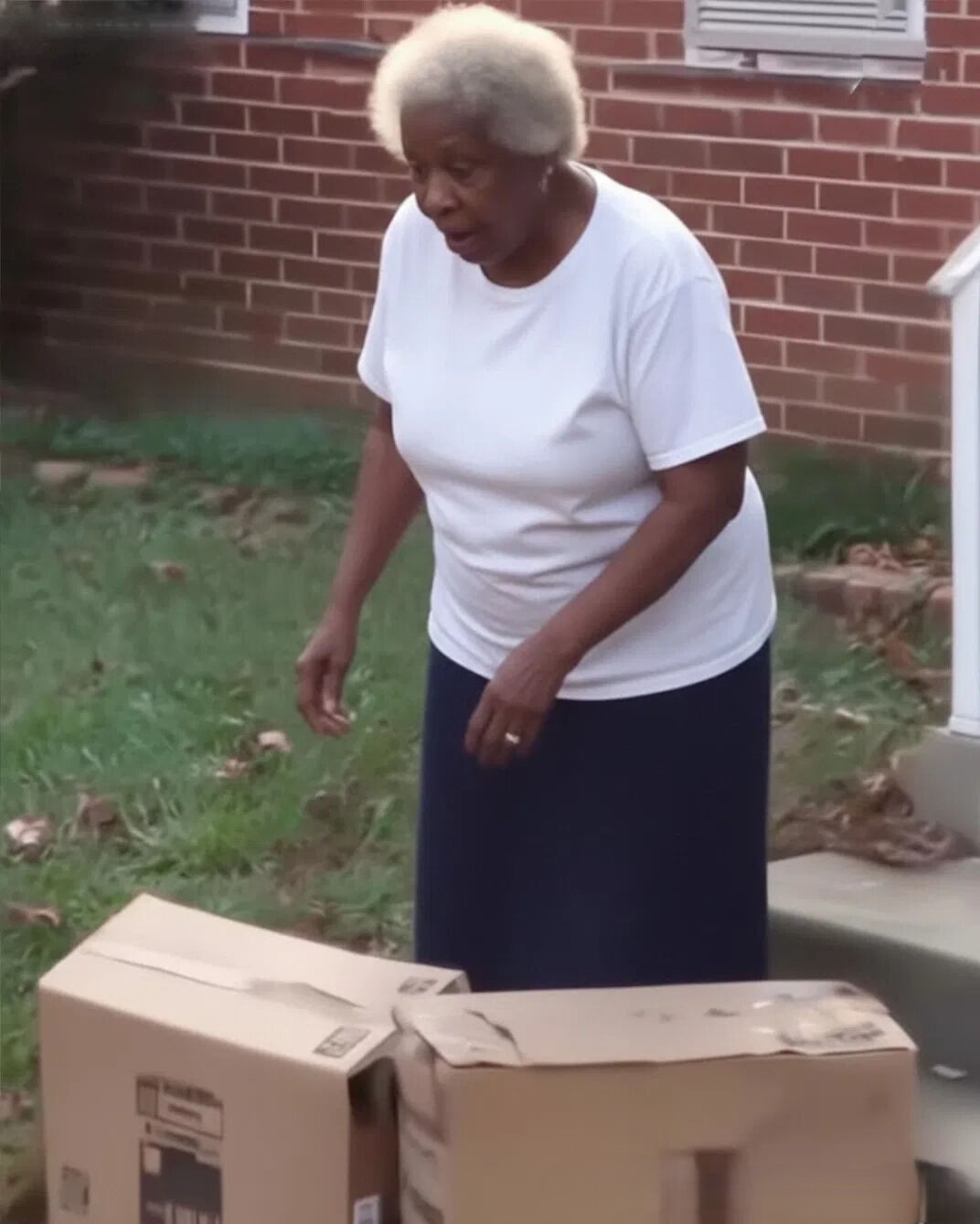
Two large boxes sat neatly on her doormat. Her name was written on both in careful, deliberate handwriting. There was no return address. No delivery truck. No sound of footsteps in the hall.
Her heart trembled with a strange mix of fear and awe. Slowly, she dragged the boxes inside and shut the door.
The first box was lighter than expected. She cut the tape with kitchen scissors, hands shaking. Inside was a brand-new sewing machine—sleek and modern, the kind she’d admired through shop windows but never allowed herself to buy. Beneath it lay a thick envelope and a folded letter.
She opened the envelope first.
Two thousand dollars, stacked neatly.
She pressed her hand to her mouth, stunned.
Then she unfolded the letter.
It was from St. Catherine’s.
They described the monthly bags that appeared like clockwork. How children stayed warm in her sweaters, wrapped themselves in her scarves, pulled her hats down over their ears and boasted about them. They explained that a local donor had recently given the orphanage a generous gift, and the staff agreed that some of that generosity belonged to the woman who had quietly given for years. They thanked her—and then asked something that blurred her vision.
They wanted to work with her officially. To pay her fairly. To let the children meet the woman who had kept them warm.
Margaux read the letter three times, tears soaking the page. She had never wanted to be known. Anonymity had been her safety—proof that she gave without expectation.
Then she remembered the second box.
She opened it and broke down.
Inside were dozens of children’s drawings, handwritten cards, paper hearts, crooked stick figures in sweaters and hats, bright suns drawn in crayon. Messages written in uneven letters:
“Thank you for my red sweater. It’s my favorite.”
“I wear your hat every day.”
“You make me feel warm.”
“I love you, whoever you are.”
Margaux cried harder, the kind of crying that loosens something deep inside—grief turning into gratitude, loneliness softening into connection.
A gentle knock sounded at the door.
She wiped her face, rose slowly, and opened it.
Manon stood there.
A little older now, silver strands woven through her dark hair, but with the same warm eyes and steady presence.
“Margaux,” she said softly, tears shining. “There’s something I want you to see.”
She stepped aside.
The hallway was filled with children—two dozen of them, smiling, fidgeting, bouncing with excitement. They wore sweaters, scarves, and hats Margaux recognized instantly: the red one, the blue-striped one, the green mittens with snowflakes. Her hands had made them. Her quiet nights had made them.
“Surprise!” the children shouted together.
They rushed forward, small arms wrapping around her waist, voices overlapping.
“Thank you, Miss Margaux!”
“I love my sweater!”
“Will you teach me to knit?”
“Can we come again?”
Margaux sank to her knees, overwhelmed, her heart too full for her chest.
Manon made her way through the crowd and took Margaux’s hands. “I work at St. Catherine’s now,” she said. “I’m a social worker. I wanted to give back to the place that raised me.” Her voice trembled. “Three months ago, I found one of your old bags behind a storage shelf. There was a receipt inside with your name.”
Margaux covered her mouth. “I never wanted anyone to know.”
“That’s exactly why it matters,” Manon whispered. “You kept showing up when no one was watching. You didn’t do it for praise. You did it because you cared.”
A little girl in a pink sweater tugged at Margaux’s sleeve and asked, “Are you lonely like us?”
The question shattered her and healed her in the same moment.
Margaux brushed the child’s hair back. “I was,” she admitted. “But I’m not anymore.”
Manon smiled through tears. “The board approved everything,” she said. “If you want, you’ll be paid for your work. And the children can visit. You won’t be alone in this.”
Margaux looked around her small apartment—once filled with silence, now alive with laughter, color, and the warmth she’d been stitching into fabric for years. She felt Matthieu’s absence as a gentle ache, but for the first time in a long while, it didn’t feel like the end of her story.
“I accept,” she said.
The children cheered, and the sound filled the room like a beginning.
Margaux had spent six years leaving kindness in secret, convinced it would disappear into the world without a trace. Instead, it returned to her as a sewing machine, a stack of drawings, and a hallway full of children wearing proof that love doesn’t need an audience to be real.
Sometimes, the good we give away finds its way back home—right when we need it most.