I wasn’t looking for secrets. I was just trying to get through my mother’s house without falling apart.
She had died at eighty-five, quietly, the way she had lived after my father passed. Once the funeral was over and the visitors had gone, I was alone in the house where it had always just been the two of us. I took a week off work and told my husband I needed space. I thought I was prepared. I wasn’t.
Every room felt smaller without her. Every object carried weight. I spent days opening drawers, sorting papers, deciding what to keep and what to let go. Grief doesn’t arrive all at once; it ambushes you in the middle of ordinary tasks—folding a sweater, finding a note in a cookbook, seeing her handwriting where you least expect it.
On the fourth day, I climbed into the attic.
The ladder groaned under my weight, dust blooming into the air as the bare bulb flickered. There, the old photo albums were stacked in a sagging box. I carried them downstairs, sat on the floor, and began turning the pages.
There I was—birthday candles, scraped knees, missing teeth, awkward school photos. A whole childhood preserved in glossy rectangles. I cried more than once, quietly, just enough to feel hollowed out.
Then one photograph slipped loose and fell face-down.
When I turned it over, my breath stopped.
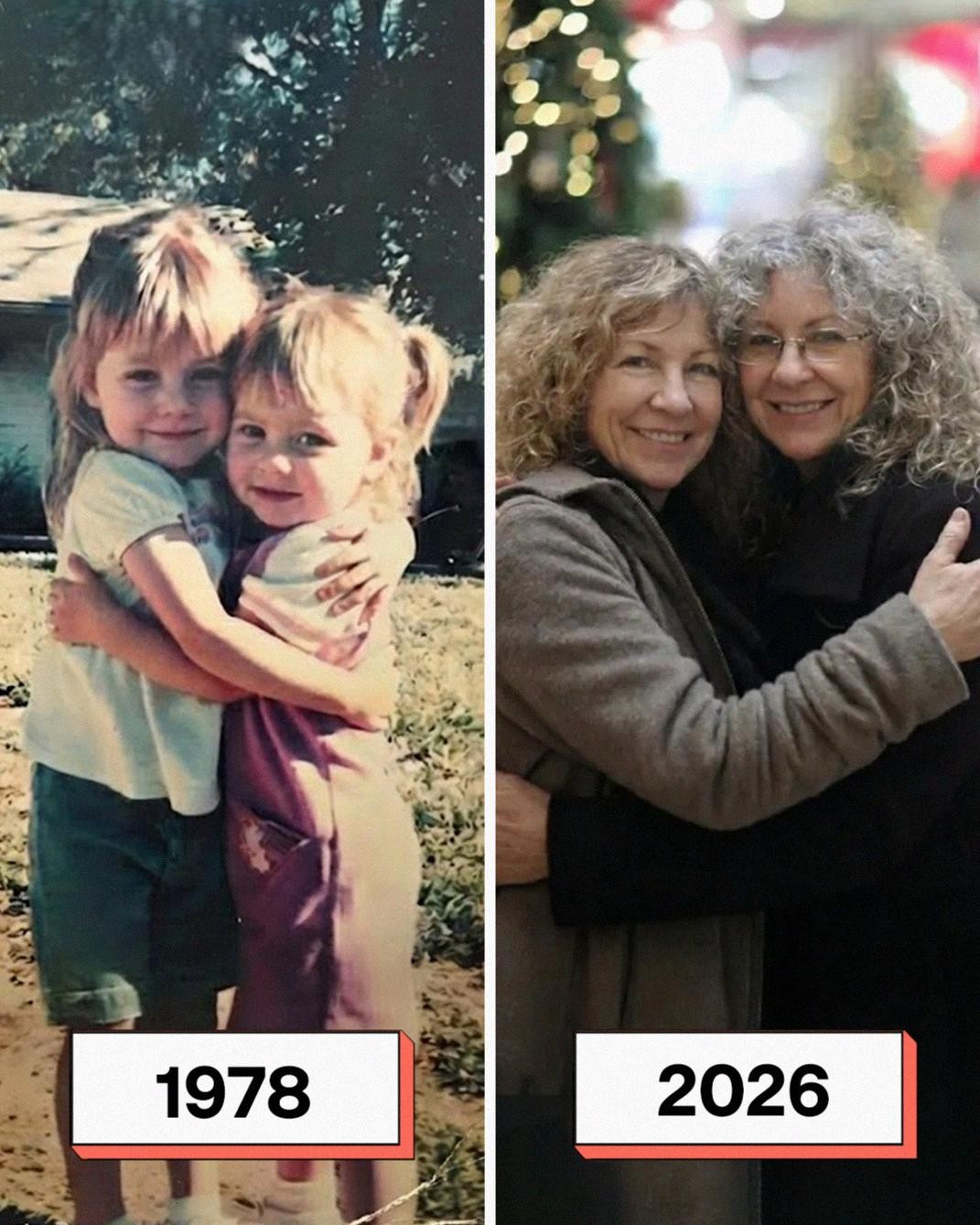
There were two little girls in the picture.
One of them was me. I knew it instantly—two years old, chubby cheeks, familiar eyes. The other girl stood beside me, slightly taller, maybe four or five.
She had my face.
Not a family resemblance. The same eyes. The same mouth. The same nose. It was like looking into a mirror that didn’t belong to me.
On the back of the photograph, in my mother’s handwriting, were three things: a date—1978—and two names.
“Anna and Lily.”
I was Anna. I had always been Anna. And I had never heard the name Lily.
I went through every album again, more slowly this time. Checked the backs, corners, plastic sleeves. Hundreds of photos of me and no other images of that girl. Just that one, hidden as if it wasn’t meant to exist.
My mind tried to supply reasonable explanations—a neighbor’s child, a cousin, someone temporary. But nothing held. That girl didn’t just look like me. She belonged to me. And yet she had vanished completely.
The thought I had been avoiding surfaced, heavy and undeniable:
What if she was my sister?
I searched my memory as far back as I could. There had never been another child in our house. No second bed, no shared toys, no stories that started with “when you girls were little.” It had always been just my mother and me.
Then I thought of Aunt Margaret.
My mother’s sister lived less than two hours away, and we hadn’t spoken in years. Their relationship had always been strained, but after my father died, it collapsed entirely. Silence replaced whatever bond they had once had.
Now that silence felt deliberate.
I didn’t call ahead. I was afraid of excuses, of delays. I needed the truth while I still had the courage to face it. I put the photograph on the passenger seat and drove straight to her house.
When she opened the door, she looked older than I remembered—thinner, grayer, leaning on a cane. She stared at me for a long moment, then stepped aside without a word.
I handed her the photograph.
The moment she saw it, her face crumpled. Her hand flew to her mouth, and she sank into a chair as if her legs had given out.
“Oh,” she whispered. “I was afraid you’d find this one day.”
My chest tightened. “Who is she?”
Margaret closed her eyes, as if bracing herself. “Sit down,” she said. “You deserve the truth.”
At the kitchen table, she told me everything my mother never could.
My father had been unfaithful for years. Not with strangers. With her.
She said it plainly, without drama, as if she had lived with the words so long they had lost their shock. She had gotten pregnant. She told people the man had disappeared. No name. No explanation.
Soon after, my parents married. Then I was born.
For a while, the lie held. But as Lily grew, the resemblance became impossible to ignore. My mother noticed. She didn’t need proof.
What followed were arguments that shook walls, betrayals layered upon one another. When my father died, any fragile connection between the sisters shattered completely.
Margaret raised Lily alone. My mother raised me alone.
Two parallel lives, separated by silence.
“She doesn’t know about you,” Margaret said quietly. “I thought I was protecting her.”
I went home numb. I didn’t call anyone. I didn’t cry. I just let the truth settle until it stopped spinning.
A week later, I called Margaret and told her I wanted to meet her daughter—not to disrupt her life, not to demand anything. Just honesty.
She hesitated, then agreed to talk to Lily first.
When Margaret called back, her voice was cautious but steady. “She wants to hear from you.”
I stared at the phone number for a long time before sending a message. I kept it simple: who I was, what I’d learned. I didn’t expect anything beyond a conversation.
She replied the next evening. She had questions. She said she had always felt something missing, something unspoken. We talked that weekend, carefully circling truths neither of us had been ready to carry.
Calls turned into longer conversations. Memories overlapped in strange ways. When we finally met in person, the resemblance startled even us.
But what mattered most was how natural it felt to sit across from her. The awkwardness faded quickly. We weren’t strangers forcing a bond. We were sisters who had simply met late.
Finding Lily didn’t fix the past. It didn’t absolve the choices that shaped our lives before we had any say in them. But it gave me something real in the present.
At fifty, I didn’t just uncover a secret. I gained a sister.
Some stories don’t end neatly. They don’t erase pain or rewrite history. But they offer something else—clarity, honesty, and the chance to build forward instead of wondering forever what was missing.
Now, when I look at that photograph of two little girls standing side by side, I don’t see a mystery anymore. I see a beginning that was delayed, not denied.
And that is enough.