I am Danielle “Danny” Mercer, a Major General in the United States Army. In the structured, high-stakes universe I inhabit, I command thousands of troops, manage budgets that eclipse the GDPs of some small nations, and navigate decisions that determine the fate of lives in volatile regions around the globe. My days are defined by precision, discipline, and the relentless demand for accountability. My nights are filled with strategy briefings and after-action reports that never allow for pause. Yet, despite all the authority vested in me, there is a history of quiet invisibility that no rank can erase. In the soft, pastel-hued streets of my childhood in Virginia, I was never a leader. I was simply an inconvenience, a sharp, metallic object that refused to fit neatly into the cushioned, curated expectations of my family.
Growing up, my presence was treated as a draft slipping through a weathered old house: something to be shut out by pulling the heavy velvet curtains tight and pretending the chill wasn’t spreading across the floorboards. My father saw my natural authority as defiance, my insistence on independence as an affront to his traditional views of womanhood. My mother, elegant and composed, saw my intelligence as an unseemly display, a liability in polite society that needed to be masked or redirected. And then there was Lauren, my younger sister—the golden child. She existed in soft light, nurtured by gentle words and the warmth of approval, blossoming into the perfect image of what our parents wanted. Meanwhile, I lingered in shadow, my potential ignored, unspoken, a latent storm waiting for a place to break free.
The first escape came with West Point. I left for the academy the week after high school graduation, and in that moment, the boundaries of my childhood began to collapse behind me. The years that followed were forged in grit, exhaustion, and the silence that only a foxhole at three in the morning can provide. I learned to move through chaos with quiet precision, to find calm in the eye of storms, to lead when lives depended on the smallest decisions. By the time I pinned on my second star, the letters from home had dwindled into nothingness. After my father’s funeral five years ago—a day when I stood in full dress blues and my family treated me as a stranger—the silence became absolute, a vacuum where recognition should have been.
Then came an envelope, arriving on an ordinary Thursday morning like a phantom from another life. It was heavy, cream-colored cardstock with flowing, expensive calligraphy, impersonal yet precise. Lauren was getting married to a Captain named Ryan Andrew Cole. The wedding was to be a high-profile affair, a plantation near Charlottesville adorned with pristine white columns and meticulously arranged ivory roses. There was no mention of our relationship as sisters, no acknowledgment of my career, nothing but the perfunctory details of date, time, and location. Yet, at the bottom, there was a handwritten note in my mother’s familiar looping script that cut through me like a scalpel: “Please behave.”
Two words—so innocuous to the uninitiated—yet they had the power to reduce a Major General who had commanded brigades in hostile environments to a petulant child worried about stepping on a social landmine. I nearly declined, tempted by the thought of skipping another family performance in which I was treated as irrelevant. But a stubborn ember of my younger self, the girl who had endured years of dismissive silences and subtle erasures, flared. I would attend. I would go as the woman I had become, armored with experience, authority, and a history they had refused to recognize. I wanted them to see that the “draft” they had tried to seal out had turned into a storm they could no longer ignore.
The wedding day arrived, sun high in a clear Virginia sky, warmth tempered by gentle spring breezes. I stepped onto the gravel path in my Class A uniform. No pastel dress, no attempt at civilian camouflage—this was not a day for compromise. My heels clicked with an unyielding rhythm, announcing presence, authority, and inevitability. Heads turned. Whispers followed. The silver stars pinned on my shoulders and the rows of ribbons adorning my chest broadcast a story the guests could scarcely comprehend, a life measured in operations, lives saved, and the heavy, relentless burden of command.
My mother, Patrice, met me with a carefully neutral expression, her eyes betraying the faintest flicker of irritation. She did not embrace me. She offered the barest semblance of social recognition, a soft brush of air against my cheeks and a half-hearted sigh at my choice of attire. “You certainly chose to make a statement,” she murmured, her voice teetering between reprimand and fascination, as though my career had become a fashion faux pas. She escorted me with clinical precision to Table 19, the overflow section in the farthest corner from the family’s inner circle, a deliberate act of social marginalization I had long anticipated.
Seated there, I observed the theater of familial pretense. My relatives offered glances layered with curiosity, judgment, and subtle discomfort. When I mentioned a recent strategic summit in the Pacific, a cousin’s wife scoffed, dismissing my accomplishments and comparing my global command to the “exhaustion” of a family trip to Disney World. In their minds, my life’s work was trivial, reduced to the inconvenience of someone’s notion of luxury or discomfort. I sipped water in silence, a spectator to a charade in which I had long since stopped participating. Lauren, radiant in white, glided past, eyes flicking momentarily toward me with the faintest acknowledgment, a pause in her choreography that felt almost apologetic before she returned to her rehearsal of domestic perfection.
The reception unfolded under a massive white tent, thousands of fairy lights twinkling like stars trapped in glass. Conversation was polite, laughter measured, a carefully orchestrated celebration. It might have sufficed for most people, but not me. I was attuned to hierarchies invisible to them, to the undercurrents of respect, power, and recognition. And then it happened.
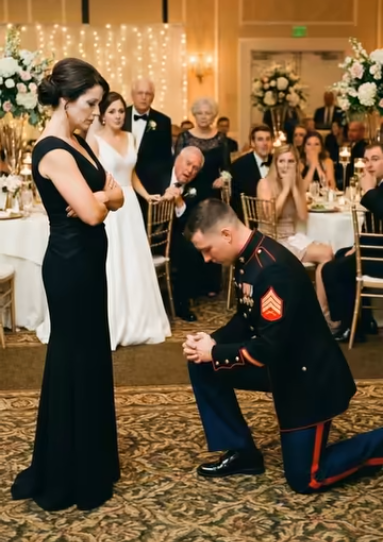
The groom’s commanding officer, Colonel Vance, arrived late. A man of steel resolve and no-nonsense military bearing, he had served alongside me in the 10th Mountain Division. His eyes found me immediately, and recognition flared in an instant. He ignored the receiving line entirely, bypassing bride and groom, and marched straight toward me. No handshake, no casual greeting. He snapped to attention, delivering a formal, resonant salute that silenced the room.
“General Mercer,” he boomed, voice carrying over the hum of conversation. “I had no idea you were related to the bride. It is an honor to see you, Ma’am.”
The tent fell into an unusual, electrified stillness. Silverware paused mid-clink. Conversations faltered. My mother, mid-sentence with the local preacher, froze. Lauren’s lips parted slightly, her carefully constructed composure cracking under the weight of the recognition she had never anticipated. Suddenly, the “Captain” she had married—now standing beside his Colonel, acknowledging a rank she had ignored—was dwarfed by the undeniable presence of the General in the room.
“At ease, Colonel,” I said, voice steady, commanding, carrying the weight of my authority. “It is a family event. No need for formalities.”
Vance, however, ignored the gentle correction, turning to the crowd with unrestrained admiration. “You all should know how fortunate you are,” he declared. “General Mercer is among the Pentagon’s finest strategic minds. Her leadership in the Middle East has saved countless lives. Her career is legendary.”
The realization rippled across the crowd like a wave. My mother’s expression shifted from polite dismissal to stark, unguarded shock. For the first time, she was confronted not with an abstract idea of my career, but with its full gravity. Lauren’s carefully curated social hierarchy crumbled before her eyes, her sister at the apex, commanding the respect of the very people who defined military excellence.
The power dynamic had shifted in a single heartbeat. Cousins who had mocked my career suddenly offered seats closer to the front. My mother’s voice, for the first time stripped of airy condescension, trembled as she admitted, “Danielle… I didn’t realize… we knew you were in the Army, but we didn’t know you were… this.”
“I’ve been ‘this’ for a long time, Mother,” I said softly, the words carrying decades of unspoken resilience.
Lauren, overwhelmed by the sudden reordering of the room, swayed slightly, supported by her husband. The draft of my childhood, the dismissal and erasure, had finally erupted into a gale, rearranging the landscape of recognition entirely.
I did not stay for cake. I had seen the eyes, the shock, the acknowledgment—but it was not mine to collect. Validation was unnecessary; my authority had been earned and recognized in the most demanding theaters of life. I rose, heels clicking in a steady rhythm over gravel, leaving behind the plantation, the ivory roses, and the fairy lights. As I drove into the quiet night, I inhaled deeply, tasting freedom for the first time in decades. I was Danielle Mercer—a Major General, a leader, a storm—and for the first time, I was fully home in myself.