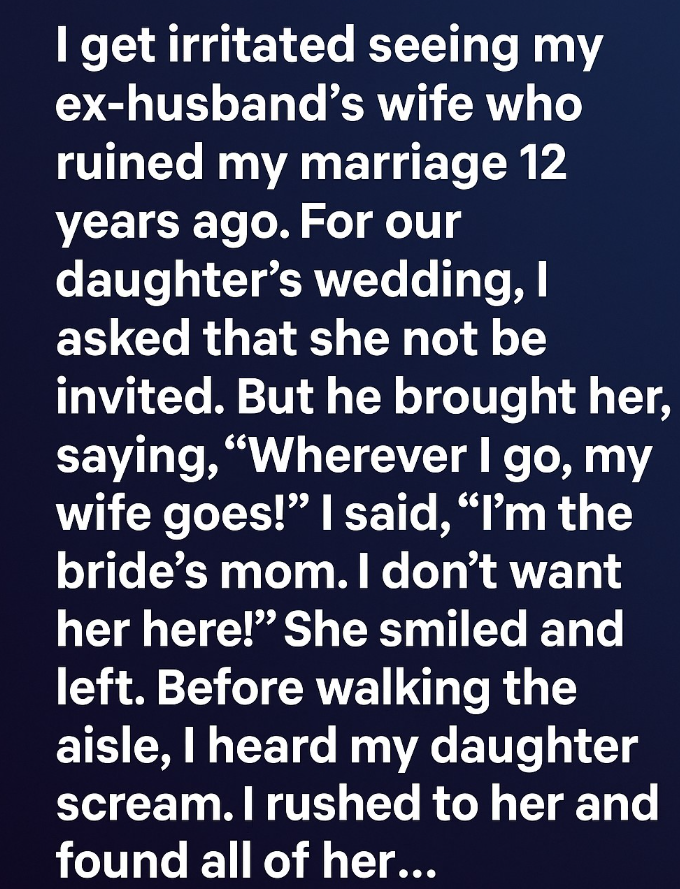
Twelve years after my marriage ended, I was still carrying bitterness like a stone pressing against my chest. The one person I refused to tolerate was my ex-husband’s wife—the woman I had long blamed for shattering my life. So when my daughter’s wedding approached, I made one clear request: she was not to be invited. This was my daughter’s day, and I didn’t want old wounds turning it into a battlefield.
But on the morning of the ceremony, my ex arrived—and so did his wife, right beside him. He didn’t seem ashamed. “Wherever I go, my wife goes,” he said with his familiar stubbornness. I snapped, “I’m the bride’s mother. I don’t want her here.”
She didn’t argue or defend herself. She just offered a small, quiet smile and stepped aside, leaving us in our tension. I assumed her absence meant victory—that I had finally drawn a line she wouldn’t cross. But the day had its own plan.
Minutes before the ceremony, a scream echoed down the hallway. My daughter’s scream. I ran, heels slipping on the polished floor, and found her in the bridal suite, surrounded by scattered petals, a ruined bouquet, and a torn hem caught on a chair. She wasn’t hurt, but she trembled, tears streaking her makeup. The pressure of the day had finally broken through her calm exterior.
When she saw me, she collapsed into my arms. “Mom, I just want peace today,” she whispered. “Please… please help me.”
Her words cracked something open inside me. I realized how much of my own pain had seeped into her life, how the hostility between me and her father’s wife had created an atmosphere thick enough to suffocate her. This wedding wasn’t about my past. It wasn’t about what I had lost. It was about her—her joy, her beginning, her moment.
I steadied her breathing, lifted her chin, wiped her tears, and carefully repaired what I could of her dress. As I worked, someone approached quietly. I braced myself for confrontation. Instead, my ex-husband’s wife stepped into the room, holding the bouquet—repaired, reshaped, more beautiful than before.
“I added flowers from the décor table,” she said softly. “She deserves a beautiful day.”
Her gesture disarmed me. For twelve years, I had cast her as the villain—the one who took everything. But here she was, not competing, not posturing, not intruding. She was simply trying, quietly and genuinely, for my daughter.
I felt my resentment loosen, just a little.
Soon, the ceremony began. My daughter, radiant and composed again, walked down the aisle with a grace that took my breath away. I held back tears as I watched her step into the next chapter of her life. My ex-husband watched proudly from the other side. His wife kept her distance, standing far enough back to respect boundaries—present but unobtrusive.
And in the soft music, the white petals, the sunlight spilling through the stained glass, something inside me shifted. I realized healing doesn’t always come from apologies or explanations. Sometimes it comes in a single quiet moment—a reminder that the world has moved on, and you are allowed to move with it.
At the reception that evening, laughter filled the room, and earlier tension faded into memory. I approached her, not in anger but with intention. “Thank you,” I said. Not just for the bouquet, not just for stepping back, but for letting the day belong to my daughter.
She nodded. No defensiveness. No gloating. Just understanding.
In that small exchange, the weight I had carried for over a decade finally eased. I realized that my anger had drained me far more than it had ever hurt her. My daughter’s wedding wasn’t just her beginning—it became mine, too.
Forgiveness didn’t erase the past. It didn’t excuse what had happened. But it freed me from being controlled by it.
That night, my daughter left with her new husband, glowing and joyful. I went home feeling something I hadn’t felt in years—a sense of peace. A sense that I could finally stop fighting a battle that no longer needed to be fought.
Her wedding day healed more than one heart. It reminded me that love isn’t always loud, and closure isn’t always dramatic. Sometimes, it’s quiet—a repaired bouquet, a respectful distance, a soft nod across a crowded room.
And sometimes, it arrives exactly when you stop expecting it.