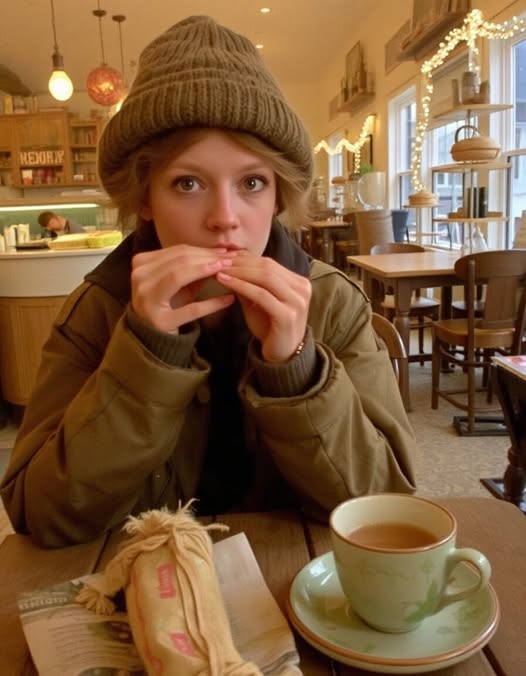
The bakery was almost closed when the bell above the door chimed softly, announcing the arrival of a timid boy. He hesitated for a moment on the threshold, his thin jacket doing little to keep out the chill of the early evening, and his shoes damp from the puddles outside. His hands clutched at a worn, creased paper bag, and when he finally spoke, it was in a voice so soft I had to lean in to hear him: “Do you have any old bread?”
The request startled me at first. Most customers expected fresh pastries, not scraps from the previous day. Yet, something in his posture — the slight slump of his shoulders, the anxious glance at the floor, the way his fingers tightened around the bag — told me this was not a child asking for pity, but someone trying to preserve dignity in a world that had little to offer him. Instead of day-old rolls, I offered him a warm seat by the window and laid out an assortment of freshly baked pastries, letting the scent of cinnamon and vanilla mingle with the crisp evening air. Slowly, the tension in his small frame eased, and his wide, cautious eyes began to reflect relief rather than fear. When he thanked me with a shy, almost hesitant smile, something gentle settled in my heart — a reminder that kindness, like bread, feeds far more than just the body.
The next evening, he returned, clutching the same battered paper bag as if it were a talisman. There was a flicker of fear behind his eyes, a silent plea that pierced straight through to me. “Please don’t call anyone,” he whispered, almost as if saying it aloud could undo him. We sat together over steaming cups of hot chocolate and fresh sweet rolls. He began to speak, carefully at first, about his mother — her illness, her inability to work, the weight of responsibility that had fallen on him. He wasn’t asking for charity, only a chance to hold onto a semblance of normalcy, a way to feed her and himself without losing his pride. Listening to him, I realized this wasn’t a moment for sympathy, but for trust, compassion, and quiet support. I learned that sometimes giving is not about grand gestures, but simply about creating space for someone to exist without fear.
Weeks passed, and the bakery gradually became his sanctuary. Each evening he arrived with new stories — tales from school, laughter he had missed, and small victories no one else noticed. I learned about his favorite books, the dreams he held onto tightly, and the moments of solitude where he allowed himself to hope. Every so often, he would glance at the door nervously, worried someone might catch him in the act of being a child amid hardship. And yet, night after night, he returned, and the routine of the bakery offered him stability he could count on.
When I finally met his mother, the impression was indelible. Her voice was weak but carried a kind of courage that had weathered many storms. She spoke with gratitude and quiet fear, asking me to watch over her son should she falter, and I promised her without hesitation. Over time, with the help of kind doctors and community professionals, she began the treatment she so desperately needed. Slowly, hope began to seep back into their small lives, like sunlight creeping over frost-covered fields.
Two years later, the boy returned — taller, more confident, eyes bright and sparkling with the light of renewed life. His mother walked beside him, smiling, her own strength fully restored. Together, they brought a new energy to the bakery, a warmth that radiated through the small shop with every word, every gesture, every shared laugh. On Sundays, they arrive carrying flowers, stories of the week, and that quiet resilience that can only come from surviving hardships with love intact. Their presence is now a blessing not just to themselves, but to everyone who walks through the bakery door.
What began with a simple, timid request for bread became something far greater — a shared journey of healing, trust, and love. I once thought my gift was baking, a skill to bring sweetness to the world. But I learned it was something far more profound: the ability to be a safe place when someone needed it most, a small hearth of kindness where fear and hunger could be met with understanding and care. And in that act, I discovered the true power of community, of listening, and of being present in a world that so often asks us to turn away.
Even now, years later, when the bell above the door rings, I still glance up with hope, knowing that the smallest gestures — a warm seat, a kind word, a pastry shared — can ripple outward in ways we cannot always see, feeding not just the body, but the soul.