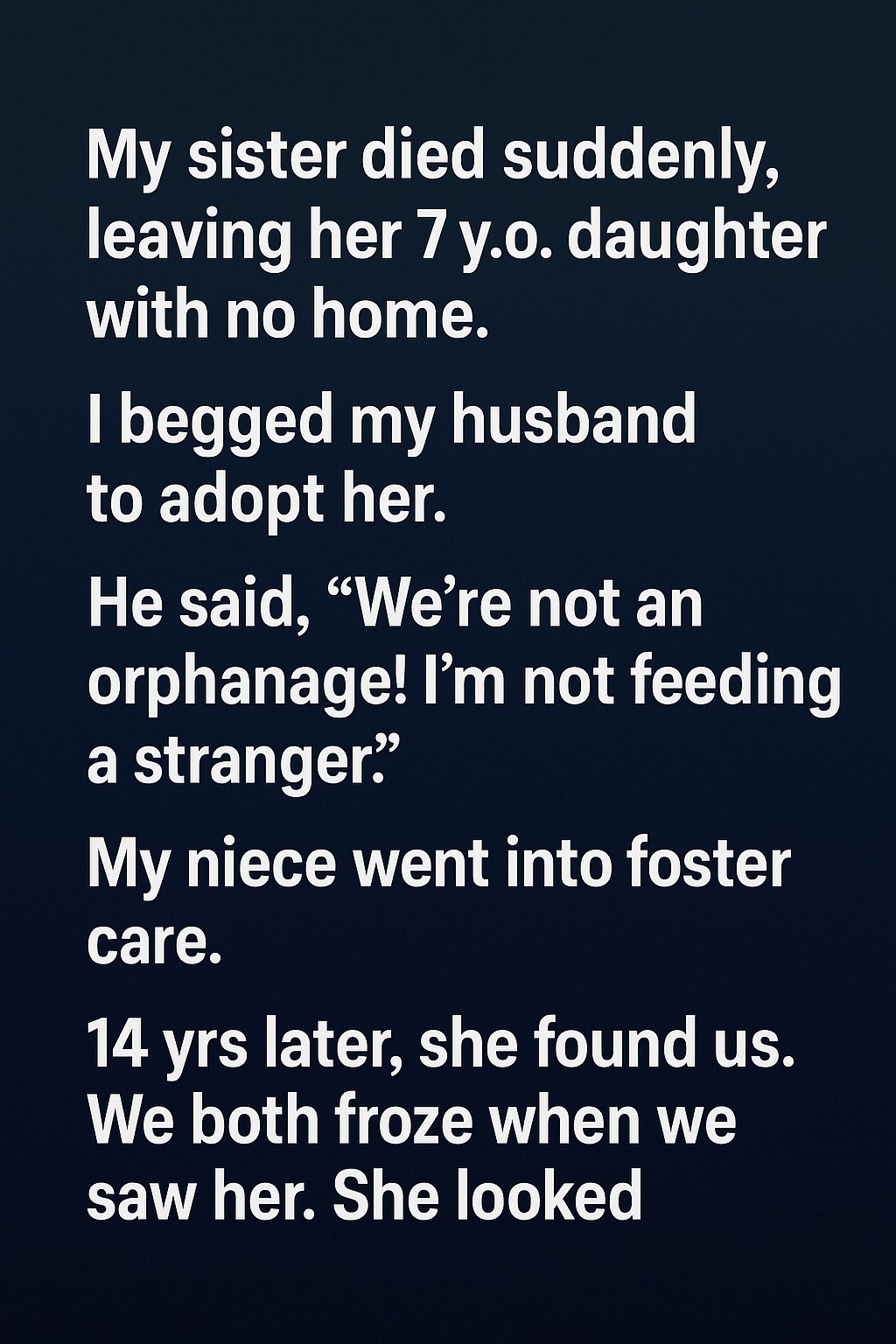
My world shattered the day my sister died, a rupture so sudden and absolute that it felt as if the very air around me had fractured. I remember the shock, the disbelief, the terrible, hollow ache that spread through every corner of my life. And in the midst of my grief, one thought refused to leave me: her little girl, my niece, had nowhere to go. I remember pacing our living room, my hands clenching and unclenching, my mind screaming at my husband, begging him, pleading him, to take her in. But he said no. He had reasons, fears, boundaries I could not sway. I watched, helpless and terrified, as my niece was swept into the system—an anonymous number in a bureaucratic flow of paperwork, rules, and regulations. That guilt settled in my chest like a permanent weight, a quiet, constant companion that followed me everywhere, whispering of my failure and my inability to protect her.
Years passed in a blur of birthdays marked only by empty chairs, questions asked too late, and milestones we weren’t there to witness. Every holiday, every small triumph of her early childhood, became a reminder of our absence, a reminder of what we had not done. And then, fourteen years later, on an ordinary day that could have gone unnoticed, someone knocked on our door. I froze, unsure if my mind was playing tricks, unsure if I dared hope for what I knew I longed for. Slowly, cautiously, I opened it—and there she was.
She stood there, no longer the trembling little girl I had last seen, but a poised, confident young woman whose presence seemed to fill the room. She had my sister’s eyes, wide and searching, yet carried her own quiet strength, an assurance shaped by years we hadn’t been there. I felt every buried memory, every regret, every unspoken apology rise to the surface in that moment. The night we had signed nothing, the day we had said nothing, the years we had done nothing—they all converged, leaving me raw and vulnerable. I braced myself, ready for anger, accusation, perhaps even the silent judgment I had long assumed she carried. But instead of blame, she offered conversation. She came not with accusations, but with stories, reflections, and the warmth of someone who had survived, thrived, and still held space for love.
She told us about the family who raised her, the people who showed up when we did not. She spoke of friends who became guides, mentors who became family, and quiet moments of joy that stitched together a life we had feared would fray. She described experiences that shaped her, triumphs she had achieved, and challenges she had overcome—all without bitterness, without resentment clouding her words. Her narrative was not a judgment, but a testament to resilience, to love found in unexpected places, and to the capacity for human hearts to heal even when abandoned. Listening, I realized that the love she had received outside our family had not replaced us, but it had not let her break. She had carried our absence with grace, transforming pain into strength.
Her forgiveness was not an eraser of what had happened, but a gentle, guiding light held over old wounds. She did not demand that we make amends in grand gestures or try to rewrite the past. Instead, she offered peace, an invitation to be part of her present without requiring us to fix everything we had left broken. We sat together, crying and laughing, apologizing and listening, until the room seemed filled with something we had not felt in years—connection, fragile yet profound, a bond tenderly forged in the ruins of regret. Each word she spoke, each story she shared, reminded me that healing is not linear, that forgiveness is not a single act but a process, a choice continually renewed.
In the days that followed, our interactions expanded beyond the doorsteps and polite visits. We shared meals, walks, and conversations that stretched into the evenings. Slowly, we learned each other again—not as the people we had once been, but as the people we had become. She shared her passions, her dreams, and her fears. I shared mine, tentatively, feeling the old walls of shame and guilt slowly crumble under the gentle weight of her acceptance. There was no rush, no pressure, only the patient, deliberate building of trust and understanding.
As we spent more time together, I began to notice the small ways she mirrored her mother, in gestures, in the tilt of her head, in the laughter that echoed memories of childhood we could no longer reclaim. Yet she was her own person, a unique individual shaped not only by loss but by the love and guidance of those who had stepped in where we could not. Seeing her navigate life with such grace and integrity became both humbling and inspiring, a reminder that our failures did not define her entirely, and that redemption was possible even for the absent and flawed.
Our relationship slowly transformed from one of tentative reconciliation to genuine companionship. Birthdays, holidays, and simple everyday moments became opportunities to connect, to create memories together, and to make up in small ways for the years we had missed. Each shared laugh, each story exchanged, each quiet evening spent in each other’s company strengthened a fragile bridge built on courage, understanding, and forgiveness. It was not a replacement for the lost time, nor did it erase the pain of absence—but it was a new beginning, tender and hard-won, shaped by choice rather than obligation.
Through this journey, I learned the depth and power of resilience and compassion. My niece’s ability to forgive, to embrace her past without being trapped by it, taught me that love can be restorative even after years of neglect and failure. I realized that our mistakes, while painful, do not have to dictate the future, and that courage can take many forms—not only in action but in grace and empathy. Witnessing her strength, I understood that family is not merely about presence or legal obligation, but about connection, care, and the conscious choice to support one another despite imperfections.
In the end, what we rebuilt together is not perfect, nor does it erase the years lost to fear, indecision, and circumstance. But it is ours, a living testament to the enduring power of forgiveness, the resilience of the human heart, and the possibility of new beginnings. Our bond, fragile yet determined, stands as proof that even after the deepest wounds, love can return, nurture, and transform. It is not a replacement for the past, but a beacon for the future—a tender, hard-won beginning, crafted in the quiet courage of understanding, presence, and the willingness to forgive.