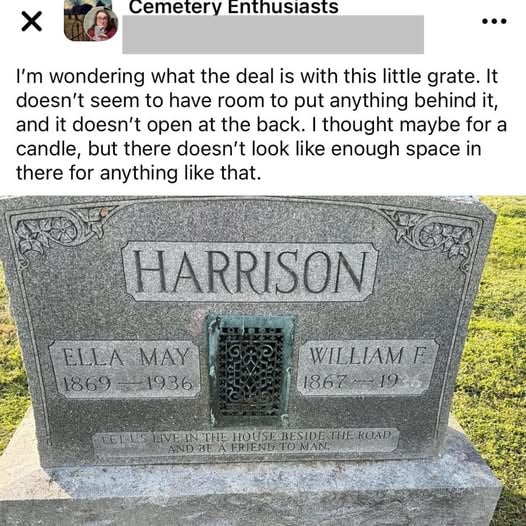
The first thing you notice is the grate.
Not the name, not the dates carved carefully into the stone—but the grate itself. It draws your eye immediately, as if it doesn’t quite belong there and yet somehow belongs more than anything else. It looks like it was pulled straight from the floor of an old, long-forgotten parlor and set gently into the grave marker. A piece of something once lived in, once loved. Something warm.
It shouldn’t be in a cemetery. And yet, standing there, it feels heartbreakingly right.
It feels like a fragment of home.
A final doorway.
A quiet, stubborn promise that warmth doesn’t simply disappear—not even here.
Set into the marker like a hidden memory, the cast-iron grate transforms the grave into something more than a place of ending. It becomes a threshold. A passage. Not something sealed, but something that still connects.
You can almost imagine the houses it once belonged to—those old homes from a century ago, where heat rose slowly through patterned vents in the floor. Families would gather around them without thinking twice, letting warmth drift upward as they talked, worked, laughed, lived. Children would sit cross-legged nearby, voices echoing softly through the rooms. It was never just about heat. It was about presence. About being together.
And now, here, that same simple object carries all of that with it.
In this quiet space, surrounded by stillness, the grate feels like a memory pressed into iron. It suggests that something of that life—those small, ordinary moments—refused to be left behind. That the feeling of home, once deeply known, could not simply vanish with time or with death.
Instead of closing something off, it opens something gently. It invites thought. It invites feeling. It suggests that this place is not just where someone rests—but where something continues.
There is something deeply human about that.
The choice is not loud. It isn’t grand or dramatic. There are no towering statues or elaborate carvings meant to impress. Instead, there is this—something quiet, familiar, almost overlooked. And yet, it speaks more honestly than anything else could.
It says: this was someone who understood warmth.
Someone who created it.
Someone who shared it.
And then, paired with the words of Sam Walter Foss’s “The House by the Side of the Road,” the meaning deepens even further.
The poem carries a gentle vision of a life lived in openness—a life spent welcoming others, offering rest, being present for those who passed by. It is not about grandeur or recognition, but about kindness, about being a place others could turn to.
And suddenly, the grate is no longer just an object.
It becomes part of that same idea.
Just as it once allowed warmth to rise and spread through a home, here it symbolizes something that continues to reach outward. It suggests openness, invitation, a quiet generosity that doesn’t end.
Together, the iron and the verse create something more than a memorial. They create a feeling.
Not of loss alone—but of continuation.
The stone doesn’t shout. It doesn’t demand attention. Instead, it speaks softly, almost like a memory shared between people who understand without needing to explain.
It whispers that true home was never just walls or rooms or a physical place.
It was something carried in gestures, in presence, in the way someone made others feel.
And that kind of home doesn’t stay buried.
It lingers.
It moves.
It lives on in the people who remember, and in the quiet spaces where its warmth is still felt.
Standing there, you don’t feel like you’re looking at an ending.
You feel like you’re standing at the edge of something that continues—
something gentle,
something enduring,
something that refuses to fade.
A doorway, not closed, but simply… waiting.