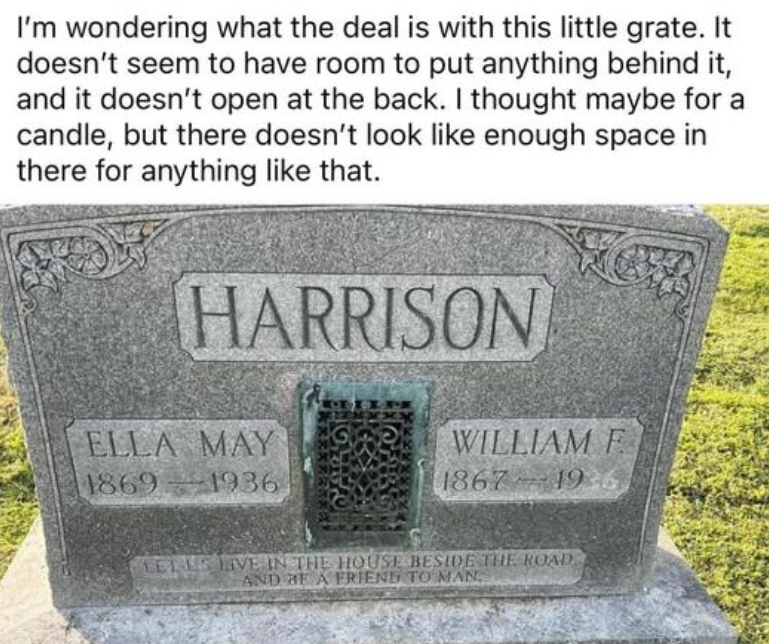
In the quiet, hallowed grounds of a century-old cemetery, where granite obelisks and marble angels compete for the sky, it is often the smallest, most unconventional details that possess the greatest power to arrest the soul. Among the weathered inscriptions and moss-covered bases, there exists a particular grave marker that defies the traditional vocabulary of mourning. It does not feature a weeping willow or a draped urn; instead, it is embedded with a small, intricate cast-iron grate. To the casual observer, it is a puzzling piece of hardware—a utilitarian object misplaced in a landscape of the eternal. But to those who understand the language of the hearth, this metal fixture is a profound and poetic tribute to the concept of “home” as a sanctuary that transcends the boundaries of life and death.
The grate itself is an unmistakable relic of late 19th- and early 20th-century domesticity. These ornamental iron floor vents were once the quiet heartbeats of the American home, essential components of gravity-fed heating systems. In an era before modern HVAC, these grates allowed the rising warmth of a basement furnace or a wood-burning stove to circulate upward, breathing heat into the chilly upper chambers where families gathered to sleep and dream. They were functional, yes, but they were also beautiful—designed with complex geometric patterns and scrolling flourishes that reflected a time when even the most invisible aspects of a house were treated with artistic intention. By incorporating such an object into a headstone, the bereaved have made a radical statement: the person resting beneath this soil was defined not by their worldly accolades, but by the warmth they radiated within the four walls of their domestic life.
This symbolic connection is deepened by the presence of an inscription from Sam Walter Foss’s classic poem, “The House by the Side of the Road.” Written in the late 1890s, the poem serves as an anthem for the hospitable and the kind-hearted. It rejects the idea of the hermit or the distant observer, instead celebrating the individual who chooses to live “where the race of men go by,” offering a place of respite and a spirit of welcome to every passing traveler. The pairing of Foss’s words with the iron grate creates a multilayered metaphor. Just as the physical grate served as a conduit for life-sustaining warmth to spread through a house, the individual memorialized here was a conduit for emotional warmth, spreading generosity and openness to everyone who crossed their threshold.
To look upon this marker is to be reminded that history is not merely composed of wars and treaties, but of the sacred, private spaces we build for those we love. Throughout the Victorian and Edwardian eras, the home was viewed as a “secular cathedral,” a fortress against the cold, industrializing world outside. The cast-iron grate was a vital part of that fortress’s soul. It represented the threshold—the transition point between the biting winter air and the glowing interior of the family circle. On this gravestone, the grate suggests that the deceased has not truly departed, but remains at the doorway of an eternal home, forever holding the door ajar for those they left behind. It implies a presence that is welcoming and constant, a spirit that continues to offer “shelter to the traveler” in the form of cherished memories.
The use of decorative ironwork in a cemetery also speaks to the inseparable nature of beauty and utility in the craftsmen’s movements of the past. In our modern age of plastic and mass production, we often forget that the objects we interact with daily can carry significant emotional weight. For the person buried here, the floor grate might have been the very spot where they stood to warm their hands after coming in from the snow, or where their children huddled on cold mornings to get dressed for school. It is an artifact of the mundane made miraculous by the passage of time. It transforms a cold piece of metal into a vessel of nostalgia, reminding us that our identity is often tied to the small, physical rituals of our daily existence—the creak of a floorboard, the turn of a brass knob, or the feel of warm air rising through a patterned grate.
In a broader sense, this grave marker invites us to reconsider the meaning of a “final resting place.” If the goal of a memorial is to capture the essence of a life, then a symbol of domestic warmth is perhaps more accurate than any soaring monument. We spend our lives seeking safety, comfort, and belonging—the three pillars of the idea we call “home.” When someone provides that feeling for others, they become a landmark in the emotional geography of their loved ones. The iron grate is a visual shorthand for that legacy. It suggests that while the physical body may be cold, the “heat” of their influence continues to rise and circulate, warming the hearts of the living just as it once warmed the rooms of a house.
There is a gentle, lingering profoundness in the idea that warmth does not disappear; it simply travels. This is the ultimate promise of the “House by the Side of the Road” philosophy. Kindness is a form of energy, and energy is never truly lost. Standing before this unique stone, one can almost feel the phantom draft of a well-stoked furnace. It encourages a sense of continuity, a belief that the hospitality practiced in life is a skill that carries over into whatever lies beyond. The memorial suggests that the individual is not trapped in the “lonesome place” of the grave, but is instead part of a grander, more inclusive household where the fire never goes out and the door is never locked.
The next time you find yourself in an ancestral home, perhaps feeling the solid weight of an old iron grate beneath your feet, take a moment to consider the invisible currents of history flowing through it. Think of the generations who relied on those simple metal slats for survival and comfort. Reflect on the laughter that once echoed through those vents and the quiet conversations that drifted between floors. Like the grate on that singular gravestone, these architectural details are more than just steel and soot; they are the anchors of our shared humanity.
Ultimately, the grave with the familiar design tells us that the best thing we can leave behind is a sense of warmth. It challenges us to be the “house by the side of the road” for others, to live with our grates open and our spirits welcoming. It reminds us that even when the house is empty and the fire has dimmed, the memory of the heat remains. In the end, we are all just travelers looking for a place to get warm, and there is no greater tribute than to be remembered as the person who provided the fire. As the seasons change and the cemetery grass turns from green to gold to white, that small iron grate stands as a silent, eternal promise: here lived a soul who knew how to make the world a little less cold.