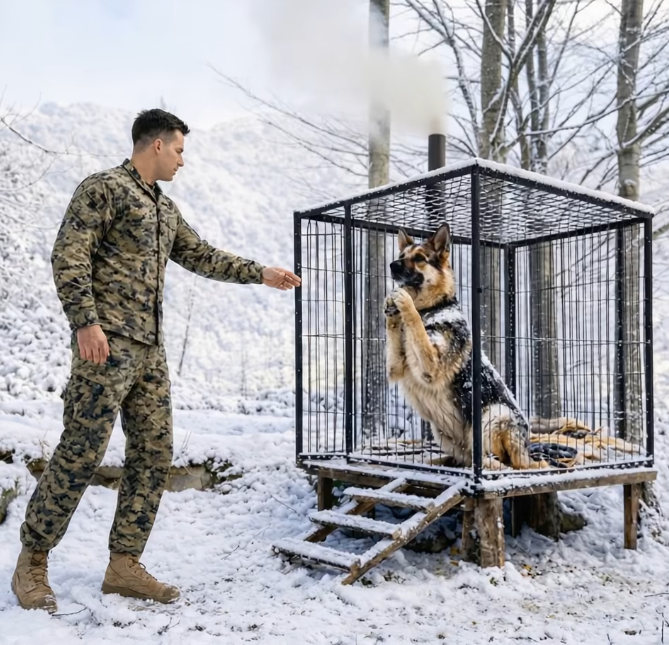
The mountains of North Ridge do not forgive, and they certainly do not forget. They offer no second chances, only the indifferent witness of jagged peaks and frozen pines. On a Tuesday before dawn, when the sky was a bruised smear against the horizon and the temperature had plummeted far below ten degrees, Ethan Cole’s phone rang. It was Sheriff Daniel Reeves, his voice calm but carrying an undercurrent of something primal—alert, urgent, yet unpanicked. Ethan, a man whose past as a Navy SEAL was etched into the scars on his arms and the quiet isolation of his cabin, recognized that tone immediately. Something was on the ridge that did not belong, and it was his problem to solve.
Snow crunched under Ethan’s boots as he climbed toward the summit, the wind slicing across his face with the merciless sting of icy steel. Visibility was near zero, but instinct guided him. Fifty yards from the main trail, something unnatural caught his eye: the glint of metal beneath a drift of frost. There it was—a steel cage, bolted to the skeletal trunk of a dead pine, half-buried in snow. The thick bars were encrusted with ice; the snow bore no footprints. Whoever had placed it here had intended that nothing would survive—or escape. Inside the cage, curled in a trembling mass of fur, was a German Shepherd. His eyes, wide and alert, scanned the ridge despite the frost crusting his lashes. His body was skeletal, his paw quivering with the rhythmic tremors of hypothermia.
Ethan crouched low, speaking in a calm, measured tone—the kind used to extract men from conflict zones. The dog’s ears twitched. The cage door was rigged with professional intent, wires twisted tight to make escape impossible. Ethan worked quickly, cutting through the bindings, shedding his heavy coat to wrap the shivering animal. The Shepherd went limp in his arms, surrendering to warmth. Ethan noticed the thick scar around the dog’s neck, a dark testament to years chained and broken.
Back at the cabin, the woodstove roared to life, casting dancing shadows on the log walls. Dr. Lena Hart, the region’s only veterinarian, arrived to assess the animal. She examined the Shepherd—malnourished, dehydrated, and bearing the remnants of a professional K-9 harness with faded serial stitching. This was no ordinary pet abandoned out of neglect. This was a trained asset, used and discarded, a victim of methodical cruelty. Ethan named him Ranger, and as the dog stabilized, a chilling truth emerged: Ranger feared machinery, engines, chains—the sounds of industry. His terror was conditioned, a vestige of a life spent enforcing control and enduring abuse.
On the third morning, Ranger led Ethan deep into the timber, far beyond marked trails. With the precision of a seasoned scout, the dog located concealed snares, then a sprawling, illicit logging operation. Stacks of timber hidden under camouflaged tarps, fuel caches buried in the brush—this was no petty poaching. It was an organized, industrial-scale extraction running rampant through federally protected land.
The owners quickly revealed themselves. Three men, led by Caleb Turner—a man whose smile was sharp and cold as a guillotine—approached Ethan’s cabin, claiming ownership of Ranger. They carried forged documents and spoke threats thinly veiled with civility. Ranger, however, chose the truth. He positioned himself between Ethan and the intruders, hackles raised, eyes fixed on Turner with silent fury. The men understood immediately: this dog was the only living witness to their crimes.
Conflict escalated. Townspeople were torn between the promise of logging jobs and the preservation of law and forest. Someone tried to drive Ethan and Ranger off a mountain road. They survived by crashing into the dense tree line, the roar of a truck disappearing into snow and shadow. It was clear: this was no longer about a dog. This was about power, greed, and the belief that winter would hide their tracks forever.
The final confrontation came on a moonless night. Sheriff Reeves, bolstered by State Wildlife and federal agents, moved on Northpine Resource Group—the corporate shell behind the devastation. Ethan and Ranger served as vanguards, navigating the tactical units through the dense forest where GPS failed and technology faltered. Ranger was their guide, sniffing out tripwires, alerting to hidden hazards. When one suspect tried to flee down a ravine, Ranger sprinted, cutting him off with a bark that echoed like a gunshot, ending the flight before it began.
By dawn, the operation was dismantled. Seven men were in custody, evidence collected, and the steel cage recovered—a frozen, rusted monument to cruelty. Ranger watched silently as the cage was loaded onto a flatbed, his posture finally relaxed. The forest was still scarred, but a sense of justice had returned.
In the months that followed, the community grappled with the aftermath. While some mourned lost income, most were shaken by the inhumanity of the cage. A new group, The Ridge Guard, emerged—locals dedicated to monitoring and protecting the forest. Ethan became their trainer, Ranger their vigilant, silent mascot.
Healing was quiet, measured, and deliberate. Ranger no longer flinched at engines; he moved with purpose and confidence. During long patrols, he would pause at the exact spots where snares had been, marking the land he had helped reclaim. Ethan understood that justice was not about vengeance—it was about prevention, restoration, and ensuring the innocent could survive.
Nearly a year later, Ethan sat on his porch with Ranger resting his head on his boot. The mountains around them breathed a lighter rhythm. Ethan realized a single choice—one refusal to turn away from a cage in the snow—had unraveled a network of greed. The scars of chains and illicit activity remained, but so did the memory of courage. Ranger closed his eyes, finally safe in the wilderness that had once been his grave, and Ethan understood that their partnership had saved more than a forest—it had saved the principle that survival demands vigilance, courage, and unwavering resolve.