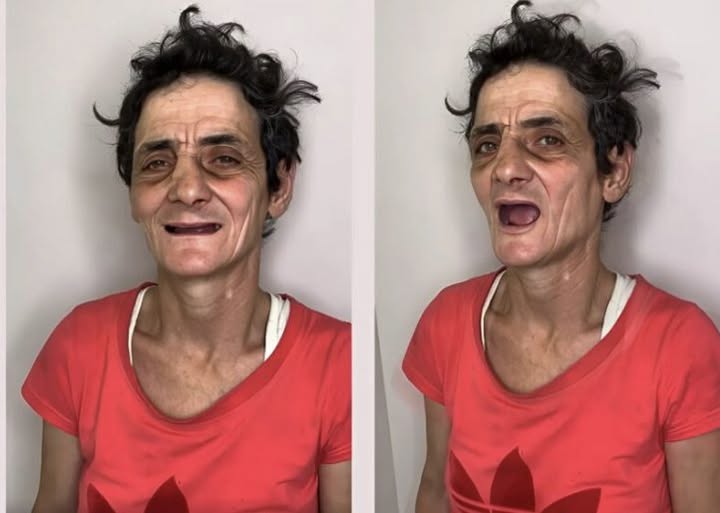
She thought she was beyond saving. Every morning, the mirror confirmed it with brutal honesty: the hollow cheeks that made her look decades older, the cracked lips that spoke of nights spent outside in cold air, the bruised shadows beneath her eyes that told stories she never dared to say out loud. Her body felt like an empty shell and her spirit like a flickering candle barely holding on. People didn’t see her as a person anymore—only as something unfortunate on the sidewalk, something to sidestep, something that made them walk faster and look away. She had become invisible in the way only the forgotten can be. And then, one day, a stranger did something extraordinary. She stopped. She saw her. She listened. She reached out for Rita’s trembling hands and whispered words so gentle they felt unreal: “Let me take care of you today.”
Rita had spent years shrinking herself into the smallest version of who she once was, convinced she deserved every cold shoulder, every averted gaze, every moment of silence from strangers who treated her as though she were contagious. She had learned to expect the worst—impatience, rushed glances, the kind of politeness that masks disgust. So when she sat in Shafag’s salon chair, she braced herself for the usual routine: quick questions with no real interest behind them, hands working mechanically, eyes avoiding hers, the quiet judgment wrapped in professionalism. She was prepared for distance, for the tiny signs of discomfort people try so hard to hide.
But Shafag was different from the very beginning. She didn’t ask what Rita had done wrong or why she looked the way she did. She didn’t ask what she had lost or how she had fallen this far. Instead, Shafag asked something no one had asked Rita in years: “What makes you feel most like yourself?” The question startled her. Herself? She had forgotten who that even was.
As Shafag worked, everything felt intentional and gentle. Warm creams softened Rita’s tired skin, and the faint scent of lavender wrapped around her like a memory of safety. Scissors moved slowly, not just cutting away damaged strands but peeling back the weight of years spent feeling unworthy. Shampooing her hair felt almost ceremonial. For the first time in so long, Rita wasn’t bracing for pain or humiliation; she was experiencing care. Real, quiet, patient care. And somewhere between the trimming, the washing, and the soft conversation, Rita realized this wasn’t a rescue mission. This wasn’t someone swooping in to save her because she was broken. It was an invitation—an invitation to step back into her own life, into the body she had treated like an enemy, into a future she thought she didn’t deserve.
When the transformation was complete, the final moment in front of the mirror felt strangely secondary. Yes, her hair shone with a healthy softness she barely recognized. Yes, her lips curved naturally again, no longer cracked or tight with shame. Yes, her face held color instead of gray exhaustion. But the real change wasn’t on the surface. It was in the way she inhaled deeply, standing taller than she had in years. The way her shoulders relaxed instead of folding inward. The way she looked at her own reflection without flinching, without apologizing, without searching for what was wrong.
Stepping outside, the world felt different—not because the street had changed, but because she had. She didn’t search for shadows to hide in. She didn’t map out escape routes the moment she walked through a door. She moved forward as someone who finally felt invited back into humanity. The weight she had carried for so long didn’t vanish, but it shifted—no longer crushing her, but reminding her she had survived enough to earn this moment.
And for the first time in years, the future didn’t feel like a locked room she had no right to enter. It felt like a place she was allowed to arrive. A place waiting for her. A place where she could begin again.