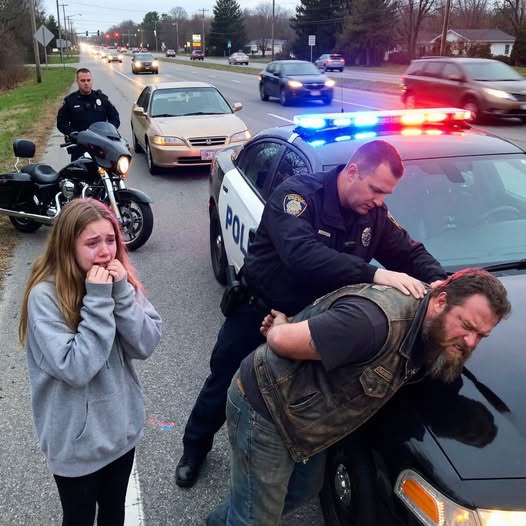
A biker followed my teenage daughter for three miles, and I called the police with trembling hands, struggling to hold my phone.
Emma was crying on the other end of the line, driving our old, dented Honda, her voice breaking as she tried to stay focused on the road. Behind her, she said, was a massive man on a Harley—bearded, broad-shouldered, leather vest, loud engine—sticking close to her bumper. Every time she turned, he turned. Every lane change, he followed. Every attempt to shake him failed.
“Mom, he won’t stop,” she sobbed. “I turned twice. I sped up. I slowed down. He’s still there. I’m scared.”
“Stay on the phone,” I told her, forcing calm into my voice, though my chest felt like it was caving in. “I’m calling 911 right now. Don’t stop. Drive to the police station.”
I was twenty minutes away at work, completely powerless. My sixteen-year-old daughter was being followed, possibly hunted, and all I could do was listen to her panic through a speaker.
The dispatcher asked for details. I relayed everything as fast as I could.
“Emma, describe the motorcycle.”
“It’s black. Really loud. He’s wearing a vest with patches. Mom, he’s getting closer. He’s waving at me to pull over. I’m not stopping. I won’t stop.”
“Good,” I said. “Do not stop. Police are on the way.”
Then I heard sirens through her phone. Relief hit me so hard I nearly cried.
And then Emma screamed.
“Mom! The police are here! They pulled him over! They’re—” Her voice cracked. “They’re laughing. They’re shaking his hand. Mom, why are they talking to him like that?”
My heart dropped.
“What do you mean laughing?” I said. “Emma, stay in your car. Lock the doors. I’m coming.”
I broke every speed limit getting there.
When I arrived, the scene made no sense. Emma’s car was pulled over. Two cruisers were nearby. And the biker—the man I had imagined as a threat—was standing casually with the officers, talking like they’d known each other for years.
Emma was still locked inside her car, shaking.
I ran to her, opened the door, and she collapsed into me, crying so hard she could barely breathe.
“I don’t understand,” she kept saying. “I thought he was going to hurt me.”
One of the officers approached. “Ma’am, are you her mother?”
“Yes,” I snapped. “Why isn’t he in handcuffs? He followed my daughter for miles. She’s a minor.”
The officer raised his hands calmly. “I understand why you’re upset. But this man isn’t a suspect. His name is Thomas Reed. He’s a twenty-year fire department veteran and part of a motorcycle safety group. He wasn’t stalking your daughter.”
“Then why was he following her?”
Thomas stepped forward. Up close, he was intimidating—tall, solid, covered in tattoos—but his eyes were gentle. Regretful.
“I’m sorry I scared your daughter,” he said quietly. “That was never my intention.”
“Then what was?” I demanded.
He looked at Emma. “Do you remember the gas station a few miles back?”
Emma nodded slowly.
“Two men in a gray sedan,” he continued. “They pulled up next to you. Said something to you.”
Emma’s face drained of color. “They said I was pretty. Asked if I wanted to go to a party.”
My stomach dropped.
“I saw them,” Thomas said. “I saw how they watched you. I saw them follow you when you left.”
The officer stepped in. “Ma’am, those men were stopped two blocks away. Both have prior arrests. One for assault. One for crimes involving minors.”
I felt my legs weaken.
“They had zip ties and duct tape in their trunk,” the officer added quietly.
Thomas spoke again. “I didn’t follow your daughter,” he said. “I followed them. I stayed between them and her. Every time they got closer, I made sure they noticed me. I wanted to wave her down and explain, but I knew stopping would’ve scared her more. And I look like exactly the kind of guy parents warn their kids about.”
Emma stared at him. “You were protecting me?”
“I have a daughter your age,” he said. “When I saw those men watching you, all I could think was, what if that were her?”
Emma stepped away from me and did something none of us expected. She hugged him.
Thomas froze, then wrapped his arms around her carefully, like she might shatter.
“Thank you,” she whispered. “I thought you were going to hurt me.”
“I know,” he said, his voice thick. “But I’d rather you be afraid of me for twenty minutes than alone with them for twenty seconds.”
I finally found my voice. “Why would you stay?” I asked him. “You could’ve just called the police and left.”
He was quiet for a moment. Then he pulled a worn photograph from his vest. A young woman. Bright eyes. Barely more than a girl.
“My sister,” he said. “She disappeared from a gas station in 1987. She was nineteen. They found her three weeks later.”
Silence settled over us.
“I couldn’t save her,” he continued. “But maybe I can save someone else’s sister. Someone else’s daughter.”
The men in the gray sedan were taken away. Statements were filed. The road cleared.
Before Thomas left, Emma stopped him.
“Your daughter,” she asked softly. “Does she know what you do?”
He smiled. “She does. She’s proud.”
Emma nodded. “She should be.”
Years passed.
Emma is eighteen now. She’s studying criminal justice. She wants to help victims. She says one person paying attention can change everything.
Last month, she stepped in for a scared girl at a gas station. Played it cool. Stayed until help arrived.
She called me afterward and said, “I just did what someone once did for me.”
A biker followed my daughter for three miles, and I called the police.
And it turned out the monster I feared was the reason my daughter made it home alive.
Sometimes protection doesn’t look safe. Sometimes heroes don’t look friendly. And sometimes the person you’re afraid of is the only thing standing between your child and real evil.
Thomas didn’t save the world that day. He didn’t ask for praise. He just refused to look away.
That’s what real guardians do.
They stay. They watch. They protect.
Even if it means being misunderstood for three long miles.