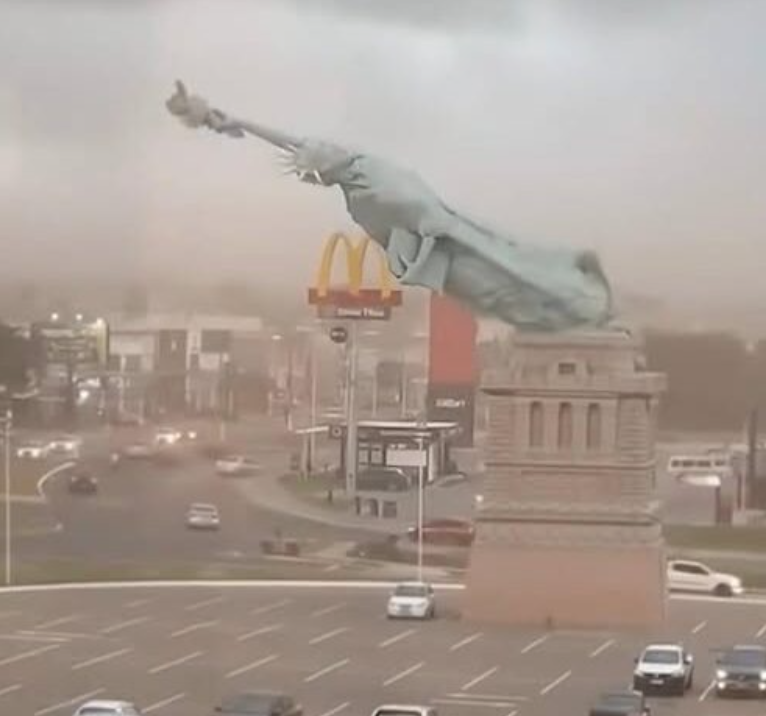
Late Tuesday night, the skyline of the local community was forever changed as a relentless storm struck, ultimately toppling a beloved landmark. A 115-foot replica of the Statue of Liberty, long regarded as a symbol of regional pride and a prominent roadside beacon, could not withstand the force of the high-velocity weather system. As midnight approached, the statue collapsed from its pedestal, leaving residents to grapple with the sudden loss of a familiar emblem. While emergency crews worked to contain the debris, the emotional impact on the community has been profound, marking a somber chapter in its history of weathering extreme events.
The storm began earlier in the evening with sharp atmospheric changes, as a rapid drop in barometric pressure brought a cold front into contact with warm, humid air. By 10:00 PM, a light drizzle had turned into torrential rain, accompanied by straight-line winds that pummeled the landmark. Meteorological readings indicated gusts approaching the intensity of a major tropical storm, generating a sustained load that stressed the statue’s framework. For hours, the statue stood firm, its copper-colored face illuminated by flashes of lightning. But the relentless battering eventually proved too much.
Nearby residents described the final collapse vividly. The sound was more than a crash—it was a layered symphony of screeching metal and a bone-jarring impact, which some initially mistook for an earthquake. “It felt like the ground was shaking,” one neighbor recalled, as the vibrations rattled windows and sent objects tumbling from shelves. When the 115-foot structure hit the ground, it caused secondary hazards: power lines were severed, arcs of electricity danced across rain-slicked debris, and the area plunged into darkness, lit only by the flashing lights of first responders.
Emergency crews labored through the night to secure the area. Authorities focused on preventing fire or further collapses, as the fallen statue sprawled across roads and surrounding grounds. Remarkably, despite the severity of the wreckage and the late hour, no injuries were reported. Police cordoned off a three-block radius to establish a safety zone, as heavy rain continued to fall. By morning, the full scale of the destruction was clear: the once-proud Lady Liberty lay in twisted sections, her torch and crown among uprooted trees and shattered signage.
Attention has now shifted to a technical and forensic investigation. Structural engineers have been dispatched to examine whether the storm alone caused the collapse or if pre-existing weaknesses—such as internal corrosion or foundation fatigue—contributed. Although designed to replicate the original statue, the replica used different materials and support systems. Engineers are scrutinizing the points where the framework failed to determine if metal fatigue existed before the storm.
The storm’s destruction extended beyond the statue. Officials reported widespread power outages affecting thousands of homes and businesses. Cleanup efforts are massive, with crews prioritizing blocked streets, fallen trees, and downed utility poles. While the toppled statue is the most visible symbol of the storm’s power, damaged roofs and commercial buildings reflect the broader toll on the community.
The statue’s future is now under debate. For many, it was more than a roadside attraction; it was a welcoming landmark that defined the community for visitors. “You always knew you were home when you saw that torch on the horizon,” a local business owner said. City officials must now decide whether to rebuild, which would require major financial investment and redesigned structural support, or to remove the site permanently, potentially converting it into a memorial park celebrating community resilience.
In the aftermath, the fallen statue has reminded residents of the vulnerability of even the most imposing symbols. Its sudden absence has created a sense of disorientation for those who used it as a navigational and emotional marker. Yet, the storm has also fostered a renewed sense of unity. Neighbors who were previously strangers have joined together to clear debris and restore order. Though the statue is gone, the values it represented—liberty, resilience, and community—are visible in the actions of the residents themselves.
Cleanup is expected to take weeks, involving heavy machinery and specialized salvage teams. Each piece of the statue will be cataloged and moved to a secure location while officials decide its fate. In the meantime, the cordoned-off site remains a poignant focal point, with locals occasionally visiting to pay respects. The March 2026 storm will be remembered not only for its intensity but also for prompting the city to rethink its approach to landmarks and infrastructure.
The legacy of the 115-foot Lady Liberty is in transition. Though her physical form lies in ruin, her story continues through the work of engineers, officials, and citizens. This event underscores the challenges of maintaining large public art amid increasingly unpredictable weather and highlights the importance of proactive maintenance. Whether rebuilt or remembered as a memory, the statue has left an enduring impression on the community. The skyline may now be emptier, but the spirit of the people remains as steadfast as the torch that once rose above the trees.