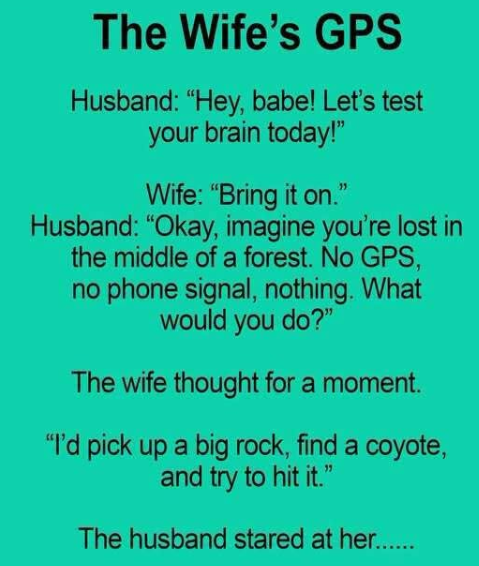
The yellow card had a question on it, but Paul had left no room for an answer. At eight that morning, Ruth found it among the library envelopes and held it away from the stack.
“You missed the back,” she said.
Paul looked up from the sheet of address labels. “I haven’t written on the back.”
“That’s what I mean. Where’s the answer?”
He took the card and turned it over. On the front he had written, in his neatest printing, “Lost deep in a forest. No phone, no GPS, no contact with anyone. How do you get home?”
“I thought I’d ask you that,” he said. “Not right this minute.”
Ruth slid an envelope across the table. “Are you planning to tell me the answer first?”
“That would spoil the test.”
She looked at the card again. “You want me to ask a question without telling you the answer?”
“I want to ask it. You’d be the one answering.”
“That’s a relief. I was already worried about the postage.”
She set a stamp crooked on an envelope. Paul reached for it, then left it alone when she raised an eyebrow.
The library benefit was on the second Saturday, two weeks away. Linda had asked for help with the mailings, and Paul hoped to contribute something more than a stack of sealed envelopes.
“I’ve been thinking about a short navigation activity,” he said. “People could take away something useful.”
“Such as a compass?”
“Such as a way to think before they start walking.”
Ruth gathered the finished envelopes. “Have you asked Linda whether she wants that?”
“Not yet. She said there was room for an activity.”
He straightened the corners of the address sheet before adding another label. The card lay beside his elbow, with the forest question facing Ruth.
“Could there be more than one answer?” she asked.
“There could be a few steps. I’d expect someone to look for landmarks, for one.”
Ruth tipped the card toward him. “Then perhaps you should leave some room for them.”
Paul put it in his shirt pocket before she could read the question again. He had not decided what he would do if her answer differed from his.
At ten, Paul held open Walter’s apartment door while Walter lifted one end of a box of donated books. The bottom bowed as they carried it across the floor.
“Set it down a minute,” Walter said. “That old dictionary weighs as much as the rest.”
Paul crouched and pushed the loose flap under the box. Walter kept a hand on the side while Paul pressed a strip of tape across the bottom.
“Linda said you were collecting ideas for the benefit,” Walter said.
“A few. Did she tell you about the open space on the program?”
“Only that she needs something to put in it.” Walter bent to pick up a paperback that had slipped free. “Could you make up a question about getting lost in the woods?”
Paul took the yellow card from his pocket. “I already have one.”
Walter accepted it and read the front. Paul watched his eyes move down the short lines, then watched him turn the card over.
“No answer?” Walter asked.
“I have one in mind. I didn’t put it there.”
“Good. A short question gives people a chance to get a word in.”
Paul held out his hand for the card. “I was thinking of using it to start a navigation lesson.”
Walter returned it. “You could start with it, certainly.”
“Have you and Linda settled on how much time there’ll be?”
“She’ll tell you what fits.” Walter lifted his end of the box again. “I’d keep the question short enough that people remember it.”
They carried the books to the door. Paul stepped backward into the hall and nearly bumped the box against the frame.
“Turn your end,” Walter said. “The dictionary’s making a run for it.”
The book slid forward as they tilted the box. Paul caught it against his coat, and Walter took it out and set it on top.
“There,” Walter said. “Now it can ride first class.”
Paul tucked the card back into his pocket. “Do you want me to give it to Linda?”
“Tell her you have a forest question. She’ll be glad to hear it.”
“And you don’t need my answer?”
Walter looked at him. “Not today.”