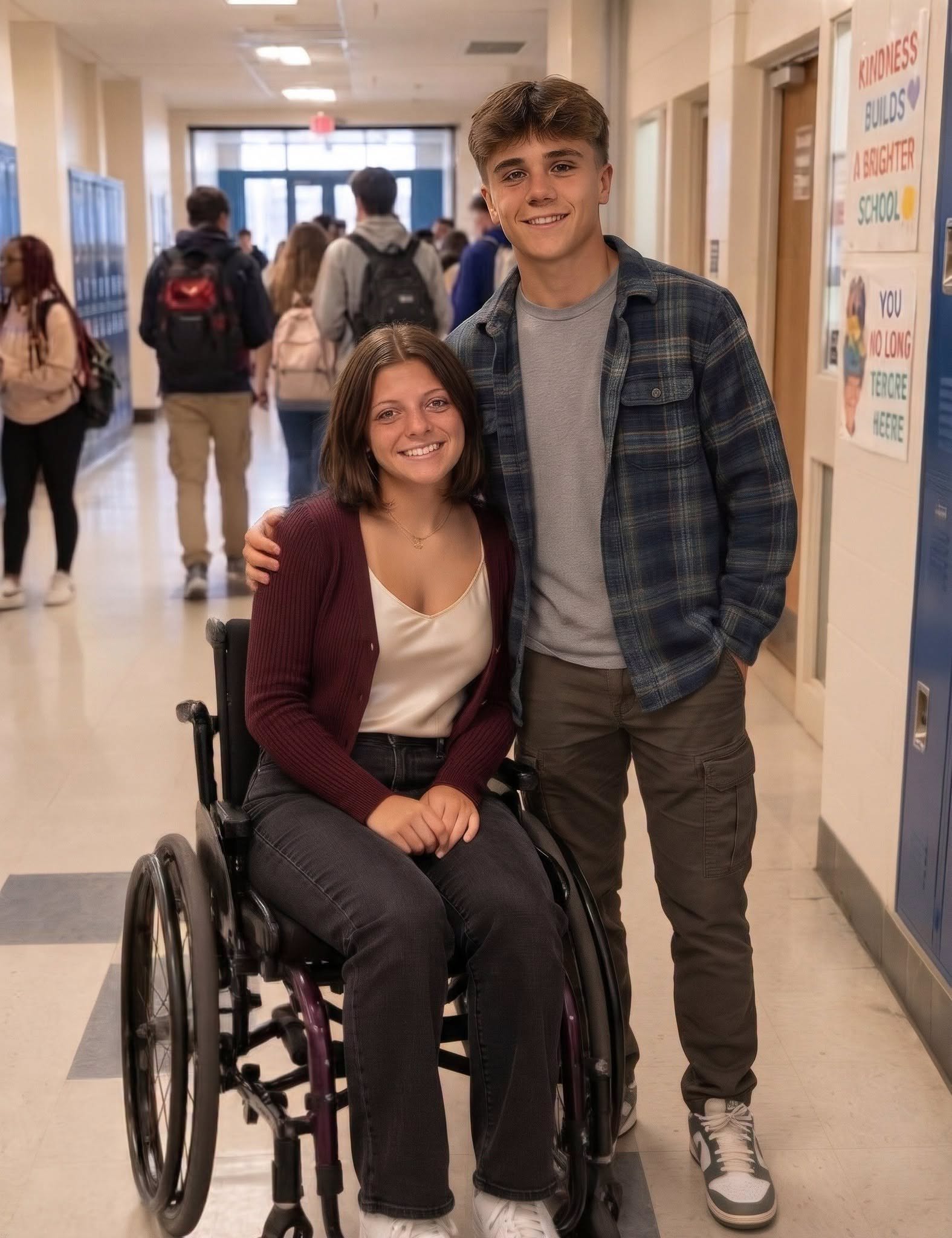
At exactly seven o’clock in the evening, someone knocked loudly on our front door. I remember the sound clearly because it seemed unusually serious. When I opened it, two police officers were standing outside. Their expressions were difficult to read, and before I could ask what had happened, I noticed my son Julian standing beside me. His face had gone pale, and his hands were trembling.
For a moment, I thought something terrible had happened.
I immediately began asking questions. Had Julian been involved in an accident? Had someone accused him of something? Why were two police officers standing at our door?
One of the officers calmly explained that they needed Julian to accompany them to the station. They did not provide many details, and my imagination immediately began filling in the blanks. Julian looked at me, but he seemed just as confused as I was.
What I did not know was that my son had done something extraordinary.
A few days earlier, Julian had discovered that one of his classmates, a girl named Maya, was facing a situation that most children her age could barely imagine. Her wheelchair was badly damaged, and its condition had become increasingly dangerous for her. Her family was struggling financially, and replacing it was becoming an almost impossible challenge.
For Maya, the wheelchair was not simply another possession. It was her independence. It allowed her to attend school, spend time with friends, move around her neighborhood, and participate in everyday activities that many people take for granted.
Without a properly functioning wheelchair, even the simplest parts of her daily routine had become difficult.
Julian had noticed what was happening. He saw how Maya struggled, how she sometimes remained on the sidelines while other children enjoyed activities, and how uncomfortable she became when people asked questions about her situation.
He could have felt sorry for her and moved on. Instead, he decided to do something.
Julian was only a teenager, but he understood that waiting for someone else to solve the problem might mean Maya would continue suffering for months. He began thinking about what he could contribute himself.
The answer was not easy.
He had spent years collecting things that meant a great deal to him. His guitar was one of his favorite possessions. He had spent countless hours practicing, learning songs, and improving his skills. His gaming console was another important part of his free time, something he enjoyed sharing with friends.
He also had savings that he had collected over time.
But Julian decided that helping Maya mattered more than keeping those possessions.
He sold his guitar, his gaming console, and several other belongings. He gathered every dollar he had saved and put the money toward helping Maya get the wheelchair she needed.
He did not organize a large public campaign or ask for recognition. He simply wanted to help a classmate who was struggling.
When Maya learned what Julian had done, she was overwhelmed. She had never expected another child to make such a personal sacrifice for her. Her family was equally surprised, especially when they realized how much Julian had given up.
But the story did not end there.
Maya’s father, Sergeant Rafael Medina, was a police officer who had spent years helping other people through difficult situations. He was accustomed to responding to emergencies, supporting families, and seeing the challenges that people faced behind closed doors.
Yet his own family had been dealing with a painful situation.
He had watched his daughter struggle with her failing wheelchair and had tried everything he could to find a solution. Like many parents, he wanted to provide everything Maya needed. But financial difficulties and the high cost of specialized equipment had made the situation increasingly complicated.
Rafael had never been comfortable asking others for help. He carried much of the burden privately, believing it was his responsibility to solve the problem himself.
When he learned what Julian had done, he was deeply affected.
He wanted to meet the boy personally and thank him, but he also felt that such an extraordinary act deserved to be recognized. He spoke with colleagues at the police department, and together they began organizing something special.
That was why two officers had arrived at our home.
They were not there to arrest Julian.
They had come to invite him to the police station for a surprise recognition ceremony.
As we arrived, I still had no idea what was waiting inside. Julian walked beside me, looking nervous and uncertain. When we entered the building, an officer guided us toward a large room used for department meetings.
The doors opened.
Inside stood approximately sixty police officers.
They were arranged in rows, standing quietly and waiting. For a moment, nobody spoke. Julian looked around, clearly unsure why so many officers had gathered.
Then Sergeant Rafael Medina stepped forward.
He introduced himself and began explaining why everyone had come together. He spoke about his daughter Maya, the difficulties she had experienced with her wheelchair, and the emotional weight his family had carried while trying to find a solution.
His voice remained steady at first.
Then he began describing Julian’s sacrifice.
He explained that this young boy had given up his guitar, his gaming console, and the money he had carefully saved, all because he wanted another child to have the freedom and independence she deserved.
Rafael then held up a handwritten note Julian had given to Maya.
The note was simple, written in a teenager’s handwriting, without elaborate words or dramatic promises. Its message expressed something that had touched the officer deeply: Julian did not want Maya to feel that she was alone, and he wanted her to have the opportunity to enjoy life like every other child.
As Rafael read the note, his voice began to break.
For a man who had spent years responding to difficult situations and helping others remain strong during emergencies, this moment became almost impossible to control. He paused, lowered the paper, and wiped away his tears.
He had spent so much time trying to protect his daughter that he had never expected a teenager outside his family to make such a meaningful sacrifice for her.
He approached Julian and embraced him.
The room remained silent.
Several officers were visibly emotional. Some lowered their heads, while others wiped their eyes. It was not the kind of ceremony they had expected to attend. They were not honoring someone for bravery in a dangerous operation or for years of distinguished service.
They were honoring a boy who had simply noticed someone else’s suffering and decided to help.
Then Rafael addressed Julian directly.
He thanked him for reminding everyone in the room that kindness does not depend on age, wealth, or professional status. He explained that his daughter had received more than financial assistance. She had received something equally important: the feeling that people cared about her and believed she deserved every opportunity to live a full life.
Julian stood quietly, visibly embarrassed by all the attention.
He had never expected a ceremony. He had not sold his belongings to become famous or receive praise. As far as he was concerned, he had simply done what anyone should do when someone needs help.
But the police department had another surprise.
Local businesses had heard about what Julian had done. Some had followed the story through community discussions, while others had been contacted by people who wanted to contribute. They decided that Julian should not have to lose everything he had worked for in order to help another person.
Several business owners joined together to replace the belongings he had sold.
His guitar was replaced. He received a new gaming console, and additional contributions helped restore the savings he had sacrificed.
When Julian discovered what the community had arranged, he was almost speechless. He had expected nothing in return, and seeing so many people come together for him was an experience he would never forget.
But what happened next made the story even more meaningful.
Instead of simply keeping the additional money and returning to his ordinary life, Julian decided to use the opportunity to help other children facing similar challenges.
With support from the community, he helped establish a small initiative called **Maya’s Wheels**.
The purpose was straightforward: to help children who needed wheelchairs and other essential mobility equipment but whose families could not afford the costs.
The initiative began with Maya’s situation, but its mission quickly became bigger than one family. People started discussing how other children might be helped, what equipment was needed, and how local businesses could contribute.
Julian wanted Maya to be the beginning of something that would continue helping people long after the original story had faded from public attention.
For Rafael, the experience changed something as well. He had spent years believing that asking for assistance was a sign that he had somehow failed his daughter. Julian’s actions helped him understand that accepting support does not make someone weaker. Sometimes, allowing other people to help is exactly what makes a difficult situation manageable.
And Maya received something that went beyond a replacement wheelchair. She gained a community that wanted to see her succeed, participate, and enjoy the same opportunities as other children.
As for me, I left the police station that evening with a completely different understanding of my son.
I had thought the officers were arriving to deliver terrible news. Instead, they had come to show us what one young person’s kindness could accomplish.
Julian had sold the things he loved because he believed Maya’s happiness and independence were more important. He never considered himself a hero, but his actions reminded an entire community of something that adults sometimes forget.
You do not need to be wealthy to make a difference. You do not need an important position, special connections, or years of experience. Sometimes, all it takes is noticing that someone is struggling and deciding not to look away.
The guitar could be replaced. The gaming console could be replaced. The money could eventually be earned again.
But the feeling Maya experienced when she realized that someone cared enough to sacrifice so much for her was something far more valuable.
And perhaps that was the greatest lesson of all: kindness has a way of spreading. One teenager helped one classmate, one father was reminded that he did not have to carry every burden alone, and an entire community discovered that it could do something meaningful together.
That evening, sixty police officers gathered to recognize Julian.
But the real achievement was not the ceremony, the applause, or the gifts he received.
It was the beginning of a movement that could help many more children find the independence, dignity, and freedom they deserve.