“Are you sure we’re ready to do this?” my brother asked as we pulled into Mom’s apartment complex.
“No,” I admitted. “But we have to start somewhere.”
Mom had died a week earlier.
We knew her health was getting worse, but neither of us expected to lose her so soon.
During her final days in the hospital, she’d still worried about us.
“Claire, don’t forget to eat something besides sandwiches,” she’d told me.
We’d laughed because even from a hospital bed, she couldn’t stop being our mother.
She’d also given us instructions about her apartment.
“The spare keys are in the kitchen drawer. And don’t throw away Grandma’s plates.”
I’d promised we’d take care of everything.
I just hadn’t expected to do it without her.
Finally, he picked up the empty boxes we’d brought for sorting her belongings.
“Come on.”
We climbed the stairs together.
Then we reached her floor.
And stopped.
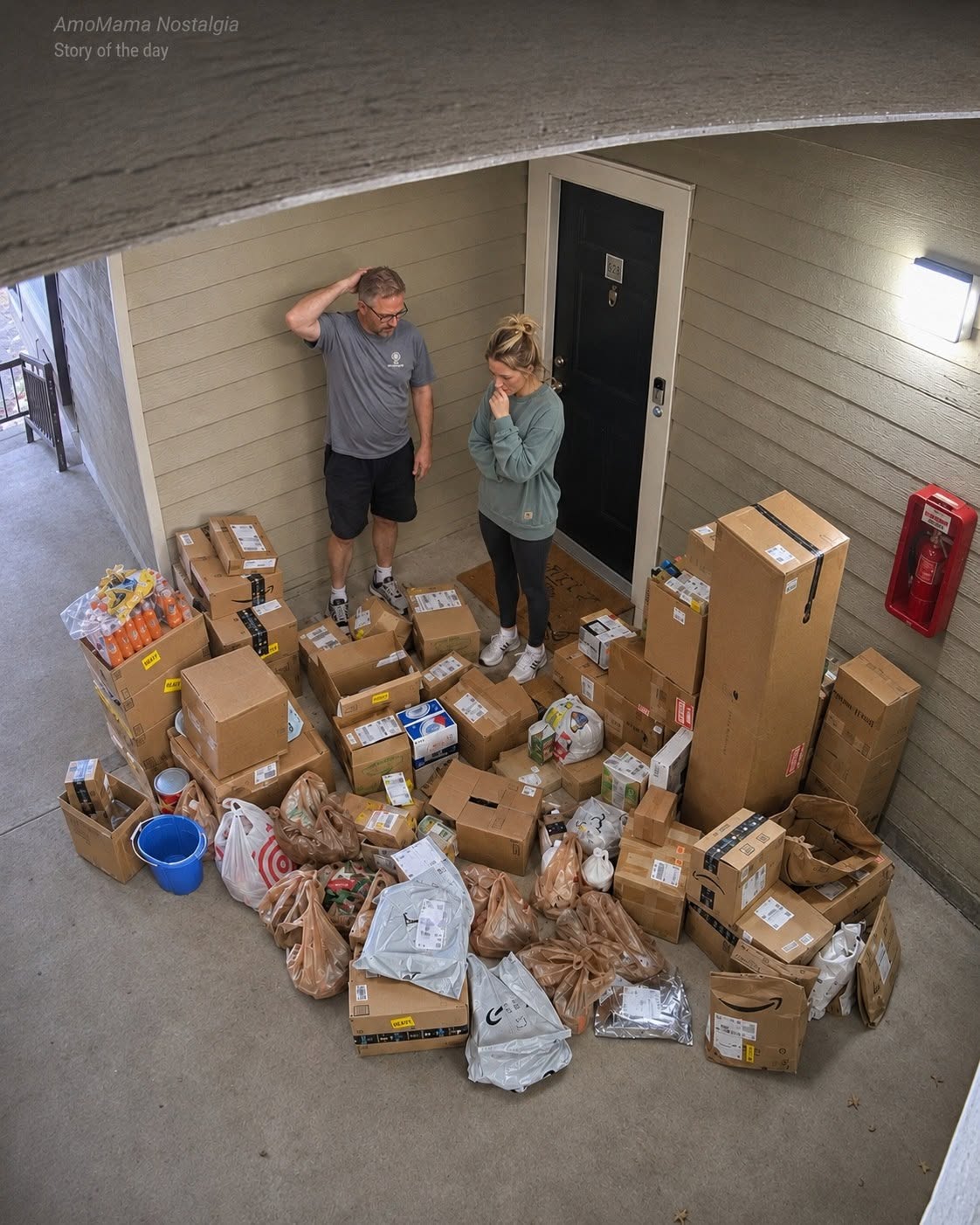
Boxes were stacked against the wall, shopping bags crowded the doorway, and smaller mailers were wedged between them.
There had to be 30 deliveries.
“What on earth?” Ben muttered.
Mom barely bought anything for herself.
She wore sweaters she’d knitted years earlier, kept furniture from our childhood, and used vintage dishes inherited from her grandmother.
“Maybe people sent sympathy gifts?” Ben suggested.
I examined the labels.
“No. They’re from stores.”
Almost every package had Mom’s name on it.
I pulled out her keys.
The nearest box was medium-sized. I tore through the tape and lifted the flaps.
Inside was a beautiful blue ceramic mixing bowl, wrapped carefully in paper.
Beneath it lay a birthday card.
My birthday was three weeks away.
I recognized Mom’s handwriting immediately.
But the envelope wasn’t sealed.
I slipped out the card.
“My darling Claire,”
“I hope I’m there to make your birthday pancakes. But if I’m not, I want you to have this.”
“You always loved the blue bowl we used when you were little. I broke it years ago and never found another quite like it.”
“Love, Mom.”
I couldn’t breathe.
Ben stepped closer.
“What is it?”
I showed him the card.
“She bought this for your birthday?”
I nodded, tears falling onto the paper.
“She knew,” I whispered.
“She knew what?”
I looked at the boxes surrounding us.
For several minutes, we sat on the hallway floor.
I held the bowl while Ben stared at the packages.
Mom had never told us she was preparing for the possibility of dying.
Whenever we visited the hospital, she’d talked about ordinary things.
The weather. Her neighbors. Whether Ben had fixed his kitchen faucet.
Now I wondered how much she’d been keeping from us.
“Should we open another?” Ben asked.
I looked at the birthday card.
“Maybe we shouldn’t. Some of these might be meant for later.”
We carried everything inside first.
Her reading glasses sat beside the couch. A half-finished sweater lay in her knitting basket.
On the kitchen counter stood her favorite coffee mug.
Seeing it nearly undid me.
Ben quietly moved the packages into the living room.
We counted 28.
A few delivery notices showed they’d been held and brought over that morning.
“She must’ve placed the orders before she went into the hospital,” Ben said.
I checked several shipping labels.
Some orders were nearly a month old.
Mom had been planning this longer than we’d realized.
Beside the spare keys was a folded sheet of paper titled, “Packages for Claire and Ben.”
Below it were dates, store names, and short descriptions.
“Claire’s birthday: blue bowl.”
“Ben’s birthday: woodworking tools.”
“Christmas: two packages.”
Ben stared at the second line.
“Woodworking tools?”
“You used to make furniture.”
“That was years ago.”
He’d once dreamed of opening a small workshop. He could turn discarded wood into beautiful tables and shelves.
He’d found another one, but it demanded long hours and left him exhausted.
His tools had been gathering dust ever since.
Mom used to ask about his projects.
He always told her he was too busy.
I looked at him.
He shook his head.
“She shouldn’t have spent money on me.”
That sounded exactly like Ben.
He’d been helping pay for Mom’s groceries during her illness, even when his own finances were tight.
“She wanted to,” I said.
We decided to separate the packages by their intended dates.
Some were easy to identify.
A set of baking pans for Christmas.
A warm scarf for Ben’s birthday.
A box of decorations for the holidays.
One package contained fabric, thread, and sewing patterns.
Another held a set of watercolor paints.
There was even a small wooden birdhouse kit.
“Did Mom suddenly develop 12 hobbies?” Ben asked.
I picked up the fabric.
My stomach tightened.
I knew that pattern.
When I was younger, I used to sew dresses from leftover fabric. Mom kept every crooked skirt and uneven blouse I made.
I’d wanted to study fashion design.
But after college, I took an office job because it paid steadily.
Then Mom got sick.
I began spending my evenings taking her to appointments and helping with errands.
My sewing machine disappeared into a closet.
“Claire?” Ben asked.
I showed him the fabric.
He smiled.
“The one with the crooked pocket?”
“She wore it for years.”
“She said the pocket was supposed to be crooked.”
I laughed, then began crying again.
As afternoon light faded, Ben found a small notebook on Mom’s bedside table.
It was filled with shopping lists and delivery dates.
But between them were observations about us.
“Ben says he’s fine, but he looks tired.”
“Claire hasn’t mentioned sewing in months.”
I read those lines several times.
Then I turned the page.
“Ask Ben about his workshop.”
“Find Claire’s old sketches.”
There were notes about our birthdays, favorite foods, and things we’d said during hospital visits. I remembered one afternoon when Mom had asked whether I was still drawing designs.
“Why not?”
“Life gets busy.”
She’d looked disappointed.
I’d assumed she was simply being sentimental.
Now I understood she’d been worried.
“She noticed everything.”
“Apparently.”
He turned another page.
Then his expression changed.
“What?” I asked.
“They’ve both been putting their lives on hold. I don’t want them doing that forever.”
I looked toward Mom’s empty bedroom.
She’d been the one suffering.
Yet she’d spent her remaining energy worrying about what her illness was doing to us.
Ben sat on the edge of the bed.
I waited.
“I turned down a better job last spring.”
“Why?”
“It was in another city. I couldn’t leave while Mom was sick.”
I stared at him.
“Neither did you when you stopped applying to design programs.”
My face grew warm.
“How did you know?”
“Mom told me you were thinking about going back to school.”
“I was. But then her appointments got more frequent.”
“I thought you were doing okay.”
“I thought the same about you.”
We’d spent months asking each other whether we needed help.
And we’d both answered no.
I suddenly remembered Mom telling me during one hospital visit, “You and Ben don’t have to protect each other from everything.”
Now the words felt different.
“She knew we were both pretending,” I said.
Ben nodded.
We found the letter that evening.
It was tucked inside Mom’s old recipe book, beneath the page for birthday pancakes.
Ben sat beside me at the kitchen table.
I opened it carefully.
“My dear Claire and Ben,”
“If you’re reading this, I hope you’re sitting together. And I hope you haven’t argued about who gets Grandma’s plates.”
Ben laughed softly.
“At first, I wanted to make sure you had presents for the birthdays and holidays I might miss.”
“But the more I thought about it, the more I realized presents weren’t what I wanted to leave you.”
“I wanted to remind you of the people you were before you became so busy taking care of me.”
I stopped reading.
Ben squeezed my hand.
“Claire, I still remember you sewing your first dress. You were so proud that you wore it to the grocery store, even though one sleeve was longer than the other.”
“Ben, I remember you making me that little wooden shelf. You were 14, and you insisted it was perfectly level. It wasn’t, but I kept it anyway.”
“I know you’ve both given up things because you wanted to be close to me.”
“I love you for that.”
“But please don’t spend the rest of your lives proving how much you loved me by refusing to move forward.”
Ben took the letter and read the final lines.
“You don’t have to keep every possession in this apartment. You don’t have to feel guilty when you laugh or celebrate.”
“And you don’t have to pretend you’re fine just because you don’t want to worry each other.”
“Take care of yourselves. Take care of each other.”
“I’ll always be your mom, whether you’re making pancakes in my kitchen or building a completely different life somewhere else.”
“Mom.”
Neither of us spoke for a while.
Then Ben said, “I thought leaving would mean abandoning her.”
“The job?”
“Even after she got sick, she kept telling me to apply for things. I thought she didn’t understand how serious it was.”
“She understood.”
“Better than I did.”
I glanced at the fabric on the table.
“I kept thinking I’d start sewing again when everything settled down.”
“I don’t know.”
He nodded.
“Me neither.”
For once, neither of us pretended to have an answer.
We simply sat together.
One line remained.
“Open together: last.”
We searched through the remaining packages until we found a large box marked with both our names.
Inside were pancake ingredients, two matching aprons, and a small framed photograph.
In the picture, Ben and I were children, standing beside Mom in her kitchen.
Ben was holding a wooden spoon like a sword.
Mom was laughing.
Underneath the photograph was another note.
“Remember Saturday mornings?”
“You two always fought over who got to stir the batter. Then you’d eat so many pancakes that neither of you wanted lunch.”
“And if you burn the first batch, blame Ben.”
He laughed.
“She never let that go.”
When he was nine, Ben had tried making breakfast without waking Mom.
He’d burned the pancakes and set off the smoke alarm.
I held up the aprons.
“Should we?”
Ben looked around the apartment.
“Right now?”
“All right.”
We found Mom’s old frying pan in the cupboard.
Ben measured the flour while I mixed the batter.
We argued about how much milk to add.
He insisted the pan wasn’t hot enough.
The first pancake burned.
We laughed so hard that I had to sit down.
For a few minutes, the kitchen felt almost familiar.
Then I glanced at Mom’s empty chair.
The laughter faded.
“I miss her,” he said.
“Me too.”
He set a plate in front of me.
“But I think she’d be happy we’re doing this.”
I looked at the photograph propped beside the stove.
“She always did.”
We ate our pancakes at her kitchen table.
And for the first time since the funeral, I managed to talk about Mom without feeling as though every memory was another goodbye.
Over the following weeks, we opened the packages on the dates she’d written.
On my birthday, I made pancakes in the blue bowl.
I took my sewing machine out of storage.
At first, I only repaired a torn shirt.
Then I started sketching again.
Ben cleaned his workshop and began restoring an old chair he’d been meaning to fix.
Neither of us made dramatic changes overnight.
But we stopped treating our own happiness as something we needed to postpone.
We also stopped telling each other we were fine when we weren’t.
One evening, Ben called while I was working on a dress.
“I’ve been thinking about applying for another job,” he said.
“Somewhere else?”
“Mom would tell you to try.”
“I know.”
He paused.
“What are you making?”
I looked at the yellow floral fabric spread across my table.
“Is the pocket going to be crooked?”
“Only if you want me to hang up.”
And I did, too.
Mom had left behind 28 packages.
But every time Ben and I opened another one, I understood her message a little better.
She hadn’t wanted us to spend our lives holding on to everything she’d left behind.
She wanted us to keep making things, making memories, and showing up for each other.
And somehow, even after she was gone, she’d found one last way to remind us how to do that.
So here’s the real question: If you discovered that your late mother had secretly prepared gifts to help you pursue the dreams you’d given up, would you feel comforted by her thoughtfulness or heartbroken that she never told you what she was planning?
If you enjoyed reading this story, here’s another one you might like: A woman became suspicious after six housekeepers quit working for her 75-year-old mother, all refusing to explain why. So her sister went undercover as the next cleaner, only to discover something upstairs that revealed their mother had been hiding a secret for years.