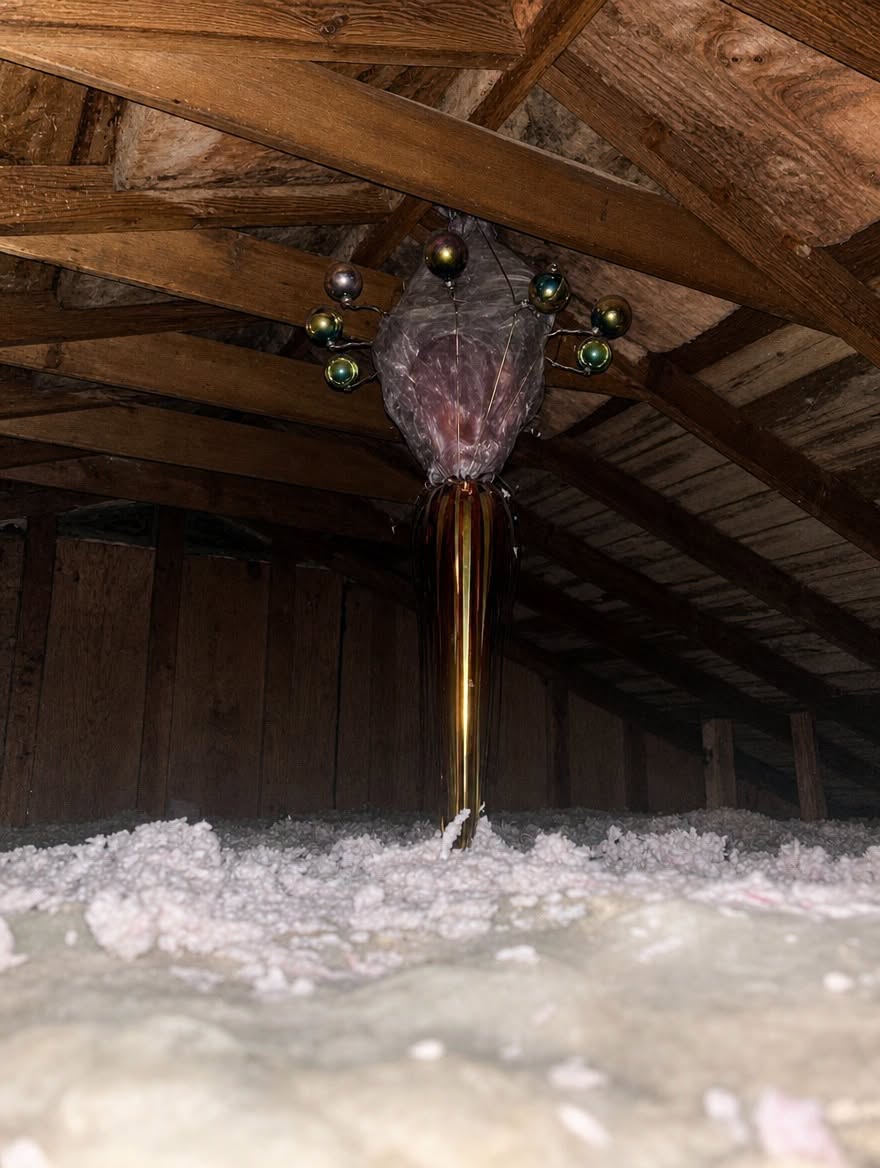
Imagine walking into a dusty attic, surrounded by forgotten boxes, old furniture, and belongings that haven’t been touched in decades.
As you look around, something unusual catches your attention.
Hanging from the ceiling is a strange arrangement of twisted wires, faded ornaments, and fluffy material.
At first, it looks almost unsettling.
You can’t immediately tell what it is or why someone would have left it hanging there.
It might resemble an abandoned craft project, a peculiar homemade device, or something from an old horror movie.
But the truth behind this mysterious attic discovery is far more heartwarming than frightening.
The unusual object is actually a handmade Christmas chandelier, created using ordinary wire clothes hangers, vintage ornaments, tinsel, and decorative angel hair.
What initially appears to be a collection of forgotten household materials turns out to be a charming reminder of an era when people transformed simple objects into festive decorations.
And the story behind it reveals something special about creativity, family traditions, and the memories preserved in everyday belongings.
The Mysterious Object That Looked Out of Place
Attics have a way of making ordinary things appear unusual.
The lighting is often dim.
Dust covers surfaces that haven’t been disturbed for years.
Old clothing hangs from hooks, boxes are stacked in corners, and unfamiliar shapes emerge from the shadows.
Under these conditions, even the most harmless object can look suspicious.
That was certainly the case with this unusual Christmas decoration.
The object consisted of a circular arrangement of metal wires, ornaments, and soft decorative material.
Years of storage had made its appearance even stranger.
Without knowing its purpose, someone discovering it for the first time might struggle to identify it.
But once the construction becomes clear, the mystery disappears.
What looked like an odd attic contraption was actually a homemade holiday decoration.
Someone had created it to bring a little extra sparkle to Christmas celebrations.
What Exactly Was Hanging in the Attic?
The object was a handmade Christmas chandelier.
Unlike the traditional chandeliers used for lighting, this one was designed purely for decoration.
Its structure was created from wire clothes hangers.
The hangers were connected to form a suspended framework, with their hooks providing convenient places to attach ornaments.
Decorative tinsel and angel hair were added to give the arrangement a festive appearance.
The result was a hanging Christmas display that could catch the light and add visual interest to a room.
Although its construction was relatively simple, the finished decoration likely looked quite different when it was first made.
The ornaments may have been brighter.
The tinsel may have sparkled more clearly.
The angel hair may have appeared soft and delicate rather than dusty and tangled.
What survives today is a weathered reminder of someone’s creativity.
The Surprising Role of Ordinary Wire Clothes Hangers
One of the most interesting details about this decoration is the material used to construct it.
The frame wasn’t made from expensive supplies or specialized equipment.
It was assembled using ordinary wire clothes hangers.
These everyday household items were inexpensive, widely available, and flexible enough to be adapted for creative projects.
Someone recognized that their shape could serve a purpose beyond hanging clothing.
By connecting several hangers, they created a structure capable of supporting Christmas ornaments.
The hooks became attachment points.
The metal framework provided the basic shape.
And decorative materials transformed the ordinary wire into something festive.
This kind of resourcefulness was an important part of many traditional holiday crafts.
Instead of purchasing an elaborate decoration, people could create something distinctive using materials they already owned.
How a Few Household Items Became Christmas Décor
The charm of this homemade chandelier comes from its simplicity.
Its materials were familiar objects that could easily be found around the house.
Wire clothes hangers formed the structure.
Old Christmas ornaments provided color and sparkle.
Tinsel added a shimmering effect.
Angel hair gave the decoration a soft, snowy appearance.
Together, these ordinary materials became something much more interesting.
The creator didn’t need a professional design background or expensive decorative supplies.
All that was required was an idea and the willingness to experiment.
The finished chandelier may not have been perfectly symmetrical.
Some ornaments might have hung lower than others.
The wire frame may have been slightly uneven.
But those imperfections were part of what made it unique.
It was a decoration created by hand, not a mass-produced item.
What Was Angel Hair Christmas Decoration?
One of the most distinctive materials used in the attic chandelier was angel hair.
For people familiar with vintage Christmas decorations, the term may bring back memories of soft, wispy material placed around holiday displays.
Angel hair was used to create a delicate, frosted appearance.
It could make Christmas trees and other decorations look snowy, luminous, or almost cloudlike.
When combined with ornaments and tinsel, it added texture and helped reflect nearby light.
This made it especially appealing for festive arrangements.
The material was associated with a style of Christmas decorating that emphasized sparkle, shimmer, and imaginative presentation.
Today, older examples can look unfamiliar, especially when they have been stored for many years.
It’s also important to remember that some historical angel hair products were made from materials, including glass fibers, that can irritate the skin and respiratory system.
Unknown vintage decorative fibers should therefore be handled cautiously rather than pulled apart or disturbed unnecessarily.
Why the Chandelier Probably Looked Beautiful When It Was New
It’s easy to judge an old decoration by its present condition.
After years in an attic, even a once-beautiful object may appear worn or unusual.
Dust can dull shiny surfaces.
Decorative fibers may become tangled.
Ornaments may fade.
Tinsel can lose some of its original sparkle.
But imagine the chandelier when it was first displayed.
It may have hung in a living room or near a family Christmas tree.
Light from lamps or holiday decorations could have reflected off its ornaments.
The angel hair may have created a soft, frosted effect.
The tinsel could have added flashes of silver or other festive colors.
What looks strange today may once have been one of the most eye-catching decorations in the room.
The passage of time has changed its appearance, but not the creativity behind it.
Christmas Decorations Weren’t Always Store-Bought
Modern holiday decorating offers nearly endless options.
Stores sell coordinated ornament collections, artificial trees, decorative lighting, wreaths, and elaborate seasonal displays.
Online shopping makes it possible to purchase almost any style imaginable.
But many families have also maintained traditions of making decorations themselves.
Homemade ornaments were often created from inexpensive or leftover materials.
Paper, ribbon, fabric, cardboard, popcorn, and household objects could all become part of a Christmas display.
These projects offered an opportunity to decorate without spending much money.
They also allowed families to create something personal.
A handmade decoration didn’t need to match a particular color scheme or follow a fashionable trend.
Its value came from the time, thought, and effort involved in making it.
The attic chandelier reflects this tradition.
The Creativity Behind Vintage Holiday Crafts
There’s something particularly appealing about discovering a handmade object that was created without elaborate materials.
It demonstrates how imagination can transform ordinary things.
A wire hanger is usually associated with a closet.
An old ornament might seem too worn to display on a Christmas tree.
A small amount of leftover tinsel may appear insignificant.
But someone saw these items as possibilities rather than clutter.
By combining them, they created an entirely new decoration.
This approach to crafting encourages experimentation.
It doesn’t require perfection.
It allows the maker to adapt materials and develop something original.
Vintage holiday crafts often reflect this practical creativity.
They show how people found ways to make their homes festive using whatever was available.
Why Handmade Christmas Decorations Feel So Personal
A store-bought ornament can certainly become meaningful.
Families often associate purchased decorations with important events, vacations, or special occasions.
But handmade ornaments can carry an additional connection.
Someone spent time creating them.
Perhaps a parent made the decoration for a family gathering.
Maybe a grandparent designed it as a holiday project.
It could have been assembled by several family members working together.
Even when the original maker is unknown, the object invites these questions.
Who chose the ornaments?
Why were those particular colors used?
How long did the project take?
Where was it displayed?
Was it brought out every Christmas?
These unanswered questions are part of what makes old handmade decorations fascinating.
They preserve traces of people and moments that might otherwise be forgotten.
The Family Traditions Hidden in Old Decorations
For many households, preparing for Christmas is about more than decorating.
It’s a collection of familiar activities that return each year.
Families unpack ornaments.
Children help decorate the tree.
Old decorations are placed in their usual locations.
Favorite holiday songs play in the background.
Recipes are prepared.
Stories are shared.
Over time, these routines become traditions.
A handmade Christmas chandelier may once have been part of such a ritual.
Perhaps it was carefully removed from storage every December.
Maybe someone always hung it in the same room.
It could have been admired by visiting relatives or remembered by children who grew up in the house.
Eventually, the decoration was put away.
Years passed.
And the object remained in the attic, preserving a small part of those celebrations.
Why Imperfect Decorations Can Be the Most Meaningful
Today, beautifully coordinated Christmas decorations are easy to find.
Photographs of perfectly styled trees and elegant holiday interiors appear everywhere.
Matching ornaments, carefully arranged ribbons, and balanced color palettes can create impressive displays.
But perfection isn’t what makes every decoration special.
Sometimes, the most memorable objects are the ones that look slightly unusual.
A handmade ornament may have crooked edges.
A painted decoration may contain visible brushstrokes.
A homemade chandelier may have unevenly spaced ornaments.
These details reveal that a real person made the object.
They show the choices, adjustments, and imperfections involved in the creative process.
Instead of reducing its charm, those qualities can make it more personal.
The attic chandelier is a perfect example.
Its irregular appearance is part of its story.
From Forgotten Clutter to a Meaningful Discovery
Imagine finding this chandelier without knowing its original purpose.
At first, you might see only a tangled arrangement of wire and decorations.
You might assume it was a failed craft project.
Perhaps you’d consider throwing it away while clearing the attic.
But once you recognize it as a handmade Christmas chandelier, your perspective changes.
The object is no longer meaningless clutter.
It becomes evidence of someone’s creativity.
It may have been part of family celebrations decades earlier.
It might represent a holiday tradition that disappeared as people moved away or the home changed owners.
Even if the exact history remains unknown, the decoration gains significance.
Understanding an object’s purpose can completely transform the way we see it.
Why Attics Are Full of Forgotten Stories
Attics often become storage spaces for belongings that no longer fit into everyday life.
Old furniture is moved upstairs.
Seasonal decorations are packed into boxes.
Photographs, clothing, toys, and household items are stored for future use.
Over time, people may forget what they kept.
Some objects remain untouched for decades.
When they’re rediscovered, they can reveal surprising details about the past.
An old photograph may show a family member as a child.
A handwritten recipe can preserve someone’s favorite meal.
A vintage toy may recall an earlier generation.
And an unusual Christmas decoration can reveal how people once celebrated the holidays.
These discoveries remind us that history isn’t found only in museums.
Sometimes, it is sitting quietly in our own homes.
The Emotional Value of Ordinary Objects
Not every meaningful antique has significant monetary value.
Some of the most treasured belongings are inexpensive objects connected to personal memories.
A handmade ornament may be worth very little to a collector.
But to someone who remembers a parent creating it, the sentimental value can be enormous.
Objects can become reminders of relationships, traditions, and experiences.
They provide a physical connection to moments that cannot be repeated.
The attic chandelier may not be rare or valuable in a commercial sense.
Its importance lies in the story it suggests.
Someone wanted to make Christmas more beautiful.
They used materials they had available.
They created something with their own hands.
And that decoration survived long enough to be discovered years later.
How Homemade Christmas Projects Brought Families Together
Holiday crafts have long provided opportunities for families to spend time together.
Children might make paper chains or colorful ornaments.
Parents could help assemble decorations.
Grandparents might share ideas from previous generations.
These activities weren’t necessarily expensive or complicated.
Their appeal came from participation.
Making something together created memories.
The finished decorations could then become reminders of those shared experiences.
Even simple projects might be repeated year after year.
The Christmas chandelier could have originated from a similar tradition.
Although its exact history is unknown, its construction reflects the kind of imaginative household crafting that many families enjoyed.
Why Vintage Christmas Decorations Inspire Nostalgia
Nostalgia often begins with familiar sights, sounds, and textures.
A particular ornament may remind someone of childhood.
The smell of an old storage box might bring back memories of decorating for Christmas.
A strand of vintage tinsel can recall the holiday displays of earlier decades.
Handmade decorations are especially powerful because they often feel unique.
They don’t look exactly like anything available in stores.
Their shapes, colors, and materials may reflect the tastes of a particular period.
The attic chandelier combines several nostalgic elements.
Wire hangers, old ornaments, tinsel, and angel hair all contribute to its vintage appearance.
Together, they create an object that feels connected to another era.
The Appeal of Unusual Vintage Christmas Décor
Vintage holiday decorations attract interest for many reasons.
Some people enjoy their distinctive designs.
Others appreciate the craftsmanship or historical materials.
Collectors may seek ornaments associated with particular decades or manufacturers.
Handmade decorations offer something different.
They often lack labels or documented origins.
Their appearance may be unusual.
And no two examples are necessarily identical.
This individuality can make them especially interesting.
A homemade chandelier constructed from wire hangers may not resemble conventional Christmas décor.
But its unusual design is precisely what makes it memorable.
It shows how creative people could be with everyday materials.
How Time Changes the Appearance of Decorations
Objects stored for many years can undergo significant changes.
Dust accumulates.
Colors fade.
Metal may corrode.
Decorative materials can become brittle or tangled.
These changes can make an old item difficult to recognize.
A festive decoration that once appeared bright and cheerful may eventually look dark and mysterious.
This helps explain the initial reaction to the attic chandelier.
Its original appearance had been altered by time and storage conditions.
Without knowing its purpose, someone might interpret the unfamiliar shape as something strange or unsettling.
But identifying the materials and construction reveals its intended function.
The mystery becomes a story about holiday creativity rather than anything frightening.
Should You Keep an Old Handmade Decoration?
Discovering an unusual vintage decoration can raise questions about whether it should be preserved.
The answer depends on its condition, personal significance, and potential safety concerns.
If the object has sentimental value, keeping it may be worthwhile.
Photographing it can also help preserve its appearance and story.
If possible, asking relatives about its history may reveal who made it and when it was used.
However, old decorations should be handled carefully.
Fragile ornaments can break.
Aged metal may have sharp edges.
Unknown fibers, including certain vintage angel hair materials, may present irritation or other hazards.
Before cleaning, restoring, or displaying an unfamiliar decoration, it is sensible to consider the materials involved.
Preservation should protect both the object and the people handling it.
The Difference Between Handmade and Mass-Produced Decorations
Mass-produced Christmas decorations offer convenience and consistency.
They are available in many styles, colors, and materials.
Consumers can easily create coordinated displays.
Handmade decorations, however, offer individuality.
Their designs reflect the imagination and preferences of the maker.
They may incorporate materials that were already available at home.
They can also preserve memories of the time spent creating them.
Neither approach is inherently better.
Many families enjoy combining purchased ornaments with handmade keepsakes.
The contrast simply highlights why an old homemade chandelier can feel so distinctive.
It represents a personal creative decision rather than a standardized product.
Why We Shouldn’t Dismiss Old Objects Too Quickly
When sorting through old belongings, it can be tempting to discard anything unfamiliar.
An object may appear broken, outdated, or useless.
But sometimes, understanding its purpose reveals unexpected significance.
A strange piece of metal might be a historical tool.
An unusual wooden object could be part of an old household device.
A collection of wire and ornaments may turn out to be a Christmas chandelier.
This doesn’t mean every old item must be saved.
But taking a moment to identify something before throwing it away can be worthwhile.
Researching an object’s history may reveal connections to earlier generations or forgotten traditions.
The attic discovery demonstrates how easily something meaningful can be mistaken for junk.
The Beauty of Creating Something From Almost Nothing
One of the most appealing lessons from the Christmas chandelier is that creativity doesn’t require expensive materials.
The original maker used familiar household objects.
There was no need for an elaborate design kit.
No need for perfectly matched ornaments.
No requirement that the finished result resemble something from a store.
The goal was simply to make something festive.
That approach remains relevant today.
Creative projects can begin with materials people already own.
Old decorations can inspire new ideas.
Simple household items can sometimes be repurposed for artistic purposes.
The value lies in imagination and effort rather than cost.
The chandelier is a reminder that even modest materials can become something memorable.
What This Discovery Tells Us About Christmas Traditions
Christmas traditions often change as generations pass.
Decorating styles evolve.
Families move to new homes.
Children grow older.
Some traditions disappear, while others continue in different forms.
Objects can preserve traces of these changes.
An old handmade decoration may reflect the preferences and resources of the people who created it.
It can also reveal how families celebrated before modern decorating trends became widespread.
The attic chandelier offers a small glimpse into that history.
Although we don’t know exactly who made it or how many years it was displayed, its construction suggests a personal approach to holiday decorating.
Someone took the time to create something special.
That simple act is what gives the object its charm.
A Decoration That Became a Piece of Family History
Perhaps the most touching part of this discovery is the possibility that the chandelier once held a special place in someone’s home.
It may have been displayed during Christmas gatherings.
Children might have admired its sparkling ornaments.
Relatives could have complimented its unusual design.
After the holiday season, someone carefully stored it away.
Over the years, the people connected to those memories may have moved on.
The decoration remained.
Eventually, it was rediscovered by someone who didn’t recognize it.
The original story may never be fully known.
But the object still provides evidence of the creativity and care that went into making it.
That is how ordinary belongings can become pieces of personal history.
Final Thoughts: The Strange Attic Find That Turned Out to Be Something Special
What initially appeared to be a creepy object hanging in a dusty attic was actually a handmade Christmas chandelier.
Created from wire clothes hangers, ornaments, tinsel, and angel hair, the decoration represented a simple but imaginative approach to holiday decorating.
Its unusual appearance was the result of both its handmade construction and the years it spent in storage.
Once its purpose became clear, the mystery gave way to nostalgia.
The chandelier became a reminder of family traditions, creative projects, and the sentimental value of ordinary belongings.
Sometimes, the objects that look the strangest are the ones with the most meaningful stories behind them.
This old decoration didn’t need to be expensive, perfectly symmetrical, or professionally manufactured.
Someone simply wanted to make Christmas a little more festive.
They used what they had, created something unique, and eventually stored it away.
Years later, their work was still there, waiting to be discovered.
The next time you find an unfamiliar object in an attic, basement, or old storage box, consider looking a little closer before dismissing it.
What appears to be forgotten clutter may actually be a small piece of someone’s cherished past.
And sometimes, all it takes is a few wire hangers and a little imagination to create something worth remembering for generations.