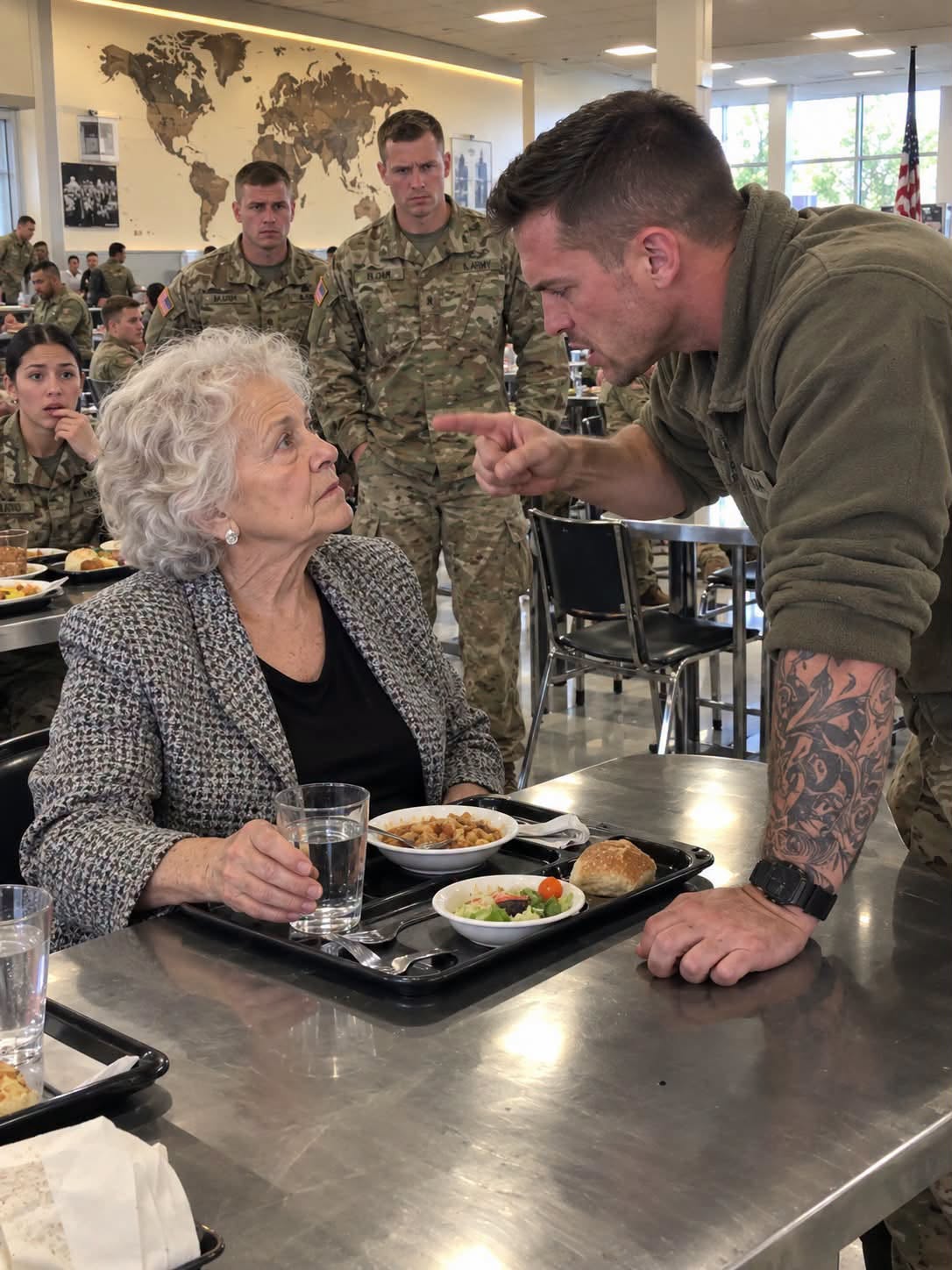
“Hey, Grandma. What was your rank back in the Stone Age?”
I didn’t look up. I’d driven forty minutes for that chili.
“I’m talking to you, ma’am.”
There were three of them standing over my table. The one doing the talking was maybe twenty-seven. He had a neck like a fence post and arms to match, and a voice that was used to being listened to.
The name tape on his chest said REESE. Three chevrons and a rocker. A staff sergeant.
My name is Quinn Braddock. I’m eighty-one years old. I live by myself in Clarksville, Tennessee, in a yellow house with too many stairs. I was a school nurse at Burt Elementary for thirty-one years.
Before that, a long time before that, I was something else.
That Thursday in October, I was sitting in the big dining facility at Fort Campbell, Kentucky. I had on my good gray wool coat and my church shoes. Every other person in that room was wearing camouflage and was young enough to be my grandchild.
“This is a military installation,” Sergeant Reese said. “You need a pass to be in here. Or did you just wander over from the old folks’ home for a free lunch?”
His two friends laughed.
The room started to change. You know how it goes. The talking thins out. You start to hear forks scraping on trays. People are listening, and trying to look like they aren’t.
I set my spoon down beside the bowl.
That seemed to make him angrier. He set his tray on the next table and put both of his hands flat on mine. He had a tattoo of an eagle on his right forearm.
“Look at me when I’m talking to you. We’ve got standards here. We don’t let just anybody stroll in and take up a table in my dining facility. So I’ll ask you again. Who are you, and what are you doing on my post?”
A young private at the next table looked up. She couldn’t have been twenty. She opened her mouth to say something. Then she looked at his stripes and closed it again.
I finally turned my head and looked at him.
He had a good face under all that meanness. He looked like a boy who’d been told his whole life he was the strongest one in the room, and never once had a reason to doubt it.
I looked at his name tape. I looked at the patch on his left shoulder.
Then I looked at the little enameled crest pinned above his right breast pocket. The one that tells you which battalion a soldier belongs to.
A blue shield with a white heron on it, wings spread wide.
I didn’t say a word. I picked up my water glass.
“What, you deaf?” one of the others said.
“I asked you for ID,” Sergeant Reese said. He snapped his fingers twice, right in front of my face. “Now. Let’s see it.”
He had no right to ask. A sergeant can’t demand identification from a visitor in the chow line. That’s what the military police are for. Everybody in that room knew it.
I had a visitor’s pass. It was in my purse, on a blue lanyard, with my picture on it, issued that morning at the Gate 4 visitor center.
I didn’t take it out.
I have a stubborn streak that my late husband, Walt, used to call the eighth wonder of the world. I hadn’t come all that way to show my papers to a boy.
I took a sip of water. My hand was steady. It’s the one part of me that still is.
His face had gone red. He’d started this in front of two hundred soldiers, and it wasn’t going the way he’d planned.
“That’s it,” he said. “You and me are taking a walk to the gate. Get up.”
I didn’t get up.
He straightened up. He looked me over, from my white hair down to my church shoes, hunting for something else to use against me.
And he found it.
On the collar of my gray coat, there’s a pin. It’s small. The brass has gone dark with age. The blue enamel is chipped on one corner.
It’s a blue shield with a white heron, wings spread wide.
It’s the same as the one on his chest. Mine’s just fifty-six years older.
He stared at it.
Then he jabbed his finger at it, an inch from my throat.
“Where did you get that?”
I set down my glass.
“That’s my battalion’s crest,” he said. His voice was shaking now. With anger. “Men bled for that. Men died for that. You don’t buy it at some flea market in Hopkinsville and pin it on your coat to get a free lunch. Take it off.”
“No,” I said.
It was the first word I’d spoken to him.
“Take it off. Or I’ll take it off for you.”
The young private at the next table stood up. I shook my head at her, just a little, and she stopped.
I looked up at that young man. Then I looked past his shoulder. At the wall over the serving line.
There are words painted on that wall. Blue letters, a foot high, across thirty feet of cinder block. He’d eaten his lunch underneath them every day for three years.
“Sergeant,” I said. “Before you put your hands on me, I’d like you to turn around and read me what it says on that wall.”
He didn’t move for a second.
“I know what it says,” he said.
“Then it won’t take you long. Read it to me. Out loud.”
The room was so quiet now you could hear the steam table hissing.
Something in my voice must have reached him. Because slowly, Staff Sergeant Reese turned around.
And he read it.
“We Carry Our Own.”
That’s the battalion motto. Every soldier in that unit learns it on his first day.
“Keep going,” I said.
Underneath the motto, in smaller blue letters, there was a second line. Most soldiers never bother to read it. It’s just part of the wall. Like a fire extinguisher. Like the clock.
He read it slowly. I watched his lips move.
“This dining facility is dedicated to First Lieutenant Quinn Hollis, Army Nurse Corps, who carried forty-one of ours home. May 1969.”
He stopped.
He stood there with his back to me for a long time.
Then, very slowly, Staff Sergeant Reese turned around and looked down at the woman in the gray coat.
“Ma’am,” he said. His voice had gone small. “What did you say your name was?”
“I didn’t,” I said. “You never asked. You asked my rank.”
I folded my hands on the table.
“It was first lieutenant,” I said. “And my maiden name was Hollis.”
You could have heard a pin drop in that dining hall.
Sergeant Reese’s face went from red to white so fast I thought he might faint.
His two friends had backed up about three steps. One of them was staring at the wall like he’d never seen it before in his life.
And from the back of the room, near the double doors, I heard a deep voice.
“Staff Sergeant Reese.”
The whole room turned.
A tall man in his fifties was walking down the center aisle between the tables. Gray at the temples. Four stripes, three rockers and a star in the middle on the front of his uniform. The command sergeant major of the battalion. The senior enlisted man in the whole unit.
Beside him walked a lieutenant colonel. The battalion commander. A wiry man named Gerald Ortiz, with a clipboard under his arm.
They’d come to meet me. We had a one o’clock appointment. I’d gotten there early for the chili.
Command Sergeant Major Darnell Hayes stopped beside my table. He looked at Reese. Then he looked at me.
Then he did something I’ll never forget.
He came to attention. Right there between the tables. Heels together. Shoulders back.
And he saluted me.
“Ma’am,” he said. “Welcome home to the Herons.”
Every soldier in that room, two hundred of them, stood up at once. Chairs scraping on the linoleum. Trays rattling.
The young private at the next table was crying.
Sergeant Reese stood frozen beside my chair. He didn’t know what to do with his hands.
I stood up. It took me a minute. My knees aren’t what they were in 1969.
I returned the salute. Not as crisp as it used to be. But I still remembered how.
“At ease, Sergeant Major,” I said. “Please. Everybody sit down. Your chili’s getting cold.”
Nobody sat down.
Lieutenant Colonel Ortiz stepped forward and shook my hand with both of his.
“Mrs. Braddock,” he said. “I’m so sorry. We were coming to get you at the visitor center. You beat us here.”
“It’s Chili Thursday,” I said. “I wasn’t going to miss it.”
Then he turned to Sergeant Reese.
He didn’t raise his voice. He didn’t have to.
“Staff Sergeant,” he said. “My office. Thirteen-thirty. Bring your first sergeant.”
“Roger, sir,” Reese said. His voice cracked on it.
He looked at me. His eyes were wet.
“Ma’am,” he said. “I’m…”
“Not now, son,” I said quietly. “You go on. We’ll talk later.”
He walked out of that dining hall with two hundred soldiers watching him go, and the double doors swung shut behind him.
I need to tell you how I got that pin. And how my name got on that wall.
In the summer of 1968, I was twenty-four years old, fresh out of nursing school at Vanderbilt, working the night shift in the emergency room at Nashville General.
My little brother, Danny, was nineteen. He’d been drafted in January. He was a rifleman. In a battalion whose crest was a blue shield with a white heron.
In June of 1968, I got a letter from Danny. Two pages, in pencil. He said it was hot. He said the food was terrible. He said there was a medic in his platoon named Ray who could make anybody laugh, even in the rain.
At the bottom, he wrote, “Don’t worry about me, Quinnie. I’m careful.”
Three weeks later, two officers came to my parents’ farmhouse outside Ashland City.
Danny stepped on a mine during a patrol in the A Shau Valley. He died on a medevac helicopter on the way to the hospital. Twenty minutes from help.
Twenty minutes.
I couldn’t stop thinking about that. If somebody had been on that helicopter who knew what to do. If somebody had been there to hold pressure. Twenty minutes.
Two weeks after Danny’s funeral, I walked into the Army recruiting office on Broadway in Nashville and asked to join the Army Nurse Corps.
“You know where they’ll send you,” the recruiter said.
“I know exactly where they’ll send me,” I said. “That’s why I’m here.”
In January of 1969, I landed in Vietnam. They assigned me to the 85th Evacuation Hospital at Phu Bai.
Most of our wounded came in from the A Shau Valley.
Most of them were Herons.
I asked to work the receiving ward. That’s where the helicopters came in. That’s where the soldiers came off the stretchers, still in their muddy fatigues, still bleeding, still scared.
I worked twelve-hour shifts. Sometimes eighteen. Sometimes thirty-six, when the casualties came in so fast we couldn’t stop.
And every time a helicopter landed, before I looked at a single wound, I looked at the crest on their collar.
When I saw that white heron, I worked harder.
I never told anybody why. I don’t think I even knew, at first. I just knew that every one of those boys was somebody’s Danny.
In May of 1969, the Herons were sent up a mountain in the A Shau Valley that the soldiers called Hill 937.
You might have heard of it. History remembers it by a different name.
For ten days, the Herons and the other battalions fought their way up that mountain. Rain. Mud. Bunkers. Machine guns. It was the worst fighting I ever saw come through our doors.
On May 18th, the helicopters started landing at Phu Bai at five in the morning.
They didn’t stop for nineteen hours.
We had six surgeons. We had eleven nurses. We had two hundred and twelve wounded men come through receiving that day.
Forty-one of them were Herons.
At about two in the afternoon, the North Vietnamese started shelling the base. Rockets. They hit the edge of the airfield. Then the motor pool. Then a supply tent about a hundred yards from receiving.
The sirens went off. Everybody was supposed to go to the bunkers.
But there was a medevac helicopter sitting on the landing pad with eight wounded Herons still on it. The crew chief was hit. The pilot was screaming over the noise for somebody to help get them off before the next rocket came in.
I ran out there.
I didn’t think about it. If I’d thought about it, I probably wouldn’t have gone.
Two medics came with me. A big kid from Alabama named Leon and a skinny one from Pittsburgh named Sal.
We pulled eight men off that helicopter and onto stretchers and dragged them across the landing pad to the receiving bunker while the rockets came in.
The last rocket landed about forty feet from us.
A piece of shrapnel went through my left shoulder. I didn’t even feel it until I got the last stretcher through the door. Then I looked down and saw my blouse was red.
I had Leon tape a pressure bandage on it. And I went back to work.
I worked until four in the morning. Nineteen hours straight, with a hole in my shoulder.
Forty-one Herons came through my receiving ward on May 18th, 1969.
All forty-one of them went home alive.
Not one died on my watch.
Not one twenty minutes from help
Two weeks later, the battalion commander of the Herons came to Phu Bai.
Lieutenant Colonel Harold Vance. A tough old soldier from West Virginia with a face like a walnut.
He found me in the nurses’ hooch with my arm in a sling. He’d heard about the helicopter. He’d heard about the forty-one.
He didn’t say much. He wasn’t a talker.
He just took the little brass crest off his own collar. A blue shield with a white heron.
And he pinned it on mine.
“You’re one of ours now, Lieutenant,” he said. “The Herons carry their own. And you carried forty-one of them.”
Then he saluted me. A lieutenant colonel. Saluting a twenty-four-year-old first lieutenant nurse with her arm in a sling.
I didn’t know what to say.
So I told him about Danny. About my little brother who died twenty minutes from help.
Colonel Vance listened. Then he put his big hand on my good shoulder.
“Then you got him home, Lieutenant,” he said. “Forty-one times.”
I’ve worn that pin every day since. On my nurse’s uniform at Burt Elementary for thirty-one years. On my coat to church. On my wedding dress in 1974, pinned right inside the collar where nobody could see it.
I got a Bronze Star for May 18th. And a Purple Heart for the shoulder.
They’re in a cigar box in my bedroom closet. I don’t look at them much.
The pin is the only one I wear.
When I came home in 1970, nobody threw me a parade. Nobody threw anybody a parade in those days.
I married Walt Braddock in 1974. A good, quiet man who taught shop class at Clarksville High. I changed my name. I went to work as a school nurse. I raised two daughters. I put on bandages and checked for lice and called parents when kids threw up in the lunchroom.
Nobody at Burt Elementary ever knew what I’d done in Vietnam.
But the Herons never forgot.
In 1998, the battalion built a new dining facility at Fort Campbell. Somebody on the staff dug through the old unit history and found May 18th, 1969. And a name.
They painted it on the wall.
They invited me to the dedication. I went. I cried through the whole thing.
And every Chili Thursday since then, I’ve driven forty minutes up Fort Campbell Boulevard to eat lunch with the Herons.
For twenty-six years.
That young sergeant had eaten his lunch under my name for three years. And never once read it.
At one o’clock, after the dining hall cleared out, I sat down with Lieutenant Colonel Ortiz and Command Sergeant Major Hayes in the battalion headquarters conference room.
There was a framed photograph on the wall of that room. Black and white. Thirty young soldiers on a hillside, mud up to their knees, grinning at the camera.
Danny’s not in it. He died a year before it was taken.
But Leon and Sal from the helicopter are. Third row, left side.
We weren’t there to talk about Sergeant Reese. We were there for business.
Lieutenant Colonel Ortiz slid a folder across the table to me.
“Mrs. Braddock,” he said. “The bank sent over the annual statement for the Heron Family Fund. It’s all there.”
I put on my reading glasses.
You see, after Walt died in 2009, I did something with the money he left me.
I’d been thinking about it ever since 2003, when the Herons deployed to Iraq. Then again in 2008, when they went to Afghanistan.
The battalion lost fourteen soldiers between 2003 and 2012.
Fourteen families. Fourteen sets of kids without a daddy. Or a mama.
The Army gives the families a death benefit. And life insurance. But I knew from my own mama and daddy, after Danny, that money runs out. Grief doesn’t.
So in 2009, I sold the forty acres of farmland Walt and I had outside Ashland City, the land my daddy left me. $340,000. And I took Walt’s life insurance. $150,000.
I went to the trust department at First Federal Bank in Clarksville. A smart young woman there named Paula Jennings helped me set up an irrevocable trust.
The Heron Family Fund.
The rules were simple. Any family who lost a Heron soldier in service could get help. Monthly rent or mortgage payments for up to three years. Tuition for a surviving spouse to go back to school. College money for the children.
No names on anything. No thank-you letters. I didn’t want any of that.
The bank paid the money. The families just got a letter on First Federal letterhead that said “From the Herons. We carry our own.”
Nobody knew where it came from except Paula, the battalion commander and the sergeant major.
That was the way I wanted it.
The statement in the folder showed the fund had grown to $612,000. It had paid out $1.14 million over sixteen years. To fourteen families.
Lieutenant Colonel Ortiz cleared his throat.
“Ma’am,” he said. “There’s something you should know. About Staff Sergeant Reese.”
I looked up over my glasses.
“His full name is Tyler James Reese,” Command Sergeant Major Hayes said quietly. He slid another sheet of paper across the table.
It was a page from the fund’s records. From 2008.
“His father was Staff Sergeant Michael Reese,” the sergeant major said. “A Heron. Killed by an IED in Kandahar Province, August 2008. Tyler was eleven years old.”
I stared at the page.
I remembered that name. I remembered the letter from Paula at the bank.
Michael Reese. Widow, Angela. Two sons, Tyler, eleven, and Brandon, seven. Renting a duplex in Oak Grove. Angela wanted to go back to school to become a respiratory therapist.
The Heron Family Fund paid their rent for three years. $850 a month.
It paid Angela’s tuition at Austin Peay State University. $19,000.
And when Tyler graduated from Clarksville High School in 2015, it paid for his first two years at Middle Tennessee State. Before he decided to drop out and enlist in his daddy’s old battalion.
I set down the paper.
“That boy,” I said quietly, “doesn’t know.”
“No, ma’am,” the sergeant major said. “None of them know where it comes from. That’s how you wanted it.”
Lieutenant Colonel Ortiz leaned back in his chair.
“Ma’am, I want to be straight with you about what happens next,” he said. “Staff Sergeant Reese had no authority to demand your identification. He used disrespectful language in front of junior soldiers. He threatened to physically remove an item from your clothing. That’s conduct unbecoming a noncommissioned officer.”
“What are you going to do to him?”
“At minimum, a formal written counseling in his file. Possibly a letter of reprimand. He’s up for promotion to sergeant first class in February. This could end that.” He paused. “That’s my decision to make. But I wanted to hear from you first.”
I looked out the window of that conference room. Across the parade field, I could see the dining facility. The blue letters on the wall inside.
“Colonel,” I said. “Did you know that boy’s daddy?”
“No, ma’am. Before my time.”
“I did,” I said. “Not well. I met him once. In 2006. At a Heron Family Day picnic out at the lake. He brought his two little boys. The older one had on a T-shirt three sizes too big, with the heron on it.” I smiled. “He kept trying to salute everybody. His daddy was so proud of him he could hardly stand it.”
I took off my reading glasses and folded them.
“That boy lost his daddy at eleven,” I said. “He’s been trying to be the strongest one in every room ever since. Because somebody told him that’s what his daddy would want. And nobody ever told him different.”
“That doesn’t excuse what he did, ma’am.”
“No,” I said. “It doesn’t. And I want him counseled. I want him to know exactly what he did wrong. In writing. In his file.” I looked at the colonel. “But I’d ask you not to end his career over it. Not over me.”
The colonel and the sergeant major looked at each other.
“Then what would you like, Mrs. Braddock?” the sergeant major asked.
I thought about it.
“I’d like to talk to him,” I said. “Alone. Before you decide.”
At one-thirty, there was a knock on the conference room door.
Staff Sergeant Tyler Reese stood in the doorway. His first sergeant, a stocky woman named First Sergeant Lopez, stood behind him.
He came in and stood at attention in front of the table. Eyes straight ahead. His jaw was tight. His hands were shaking a little at his sides.
“Sergeant Reese reporting as ordered, sir.”
“At ease, Staff Sergeant,” Lieutenant Colonel Ortiz said. He stood up. So did the sergeant major and First Sergeant Lopez. “Mrs. Braddock would like a word with you. Alone.”
They walked out and closed the door behind them.
And then it was just me and that big young man, standing in a conference room under a photograph of the Herons in 1969.