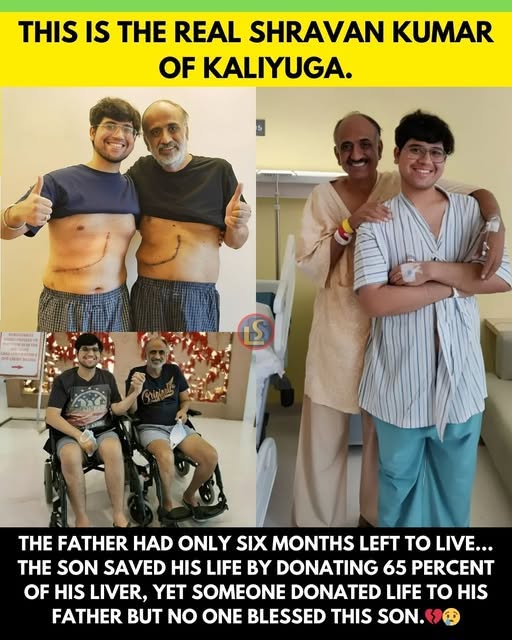
A Son Donated Part of His Liver to Save His Father — But the Tragic Outcome Left His Family Heartbroken
He wanted to give his father another chance at life. He never imagined that his own life would be lost in the process. What began as an extraordinary act of love reportedly ended in a heartbreaking tragedy that left a family struggling to comprehend what had happened.
Some acts of love are difficult to put into words. For one young man, the decision to donate part of his liver to his seriously ill father was more than a medical choice. It was an opportunity to save the life of the person who had raised him and given him so much.
According to reports about the case, Kamran Leghari, a 24-year-old electrical engineer from Pakistan, volunteered to donate part of his liver after his father, Mujahid Leghari, developed severe liver disease and needed a transplant.
As his father’s condition worsened, the family faced an increasingly difficult situation. A liver transplant offered hope, but finding a suitable donor and completing the complicated procedure involved significant challenges.
For Kamran, the decision was deeply personal. He reportedly agreed to become a living donor, accepting the risks of major surgery because he wanted his father to have another chance at life.
A Son Makes an Extraordinary Sacrifice
Living-donor liver transplantation allows a healthy person to donate a portion of their liver to someone whose liver is failing. Because the liver can regenerate, both the donor’s remaining liver and the transplanted portion can grow over time.
However, the operation is still major surgery, and donors must undergo extensive medical and psychological evaluations before they can proceed.
In Kamran’s case, reports indicate that he underwent surgery to donate part of his liver to his father. The transplant was initially described as successful, giving the family reason to hope that the worst was behind them.
For a brief period, the procedure appeared to have achieved what Kamran had wanted most: helping his father survive.
But the outcome reportedly took a devastating turn.
The News No Family Wants to Hear
According to published accounts, Kamran suffered serious complications following the donation and died after the procedure.
The reported tragedy transformed what should have been a moment of relief into a period of profound grief. His father had received the organ he needed, but the family was now facing the loss of the son who had volunteered to help him.
The emotional consequences were especially painful because the operation had been undertaken with the hope that father and son would recover and return to their lives together.
Instead, the family was confronted with an outcome that no one would have wanted.
Reports also stated that Kamran’s father remained under medical care after the transplant and had not initially been informed of his son’s death because of concerns about his condition.
The precise medical circumstances surrounding the reported death have not been independently established by the sources reviewed.
A Father’s Gratitude and a Family’s Grief
For a parent, the thought of losing a child is almost impossible to imagine. The situation described in these reports carries an additional layer of heartbreak: the father’s treatment depended on a sacrifice made by his own son.
The family was left to navigate two profoundly difficult realities at once. One loved one needed to recover from a serious illness, while another had reportedly died following an operation intended to save him.
Stories like this reveal the emotional complexity of living organ donation. They show the extraordinary generosity of donors while also reminding the public that the procedure carries real medical risks.
Why Living Liver Donation Requires Careful Evaluation
Living liver donation has helped many patients receive transplants when a suitable deceased-donor organ was not available in time. Many donors recover and return to their usual activities.
Nevertheless, donation is never risk-free. Potential complications include bleeding, infection, bile leakage, blood clots, and liver-related complications. In rare cases, a donor can die.
For this reason, transplant teams carefully evaluate the donor’s health, explain potential risks, and ensure that the decision is voluntary. Donors should never feel pressured to undergo surgery, even when the recipient is a close family member.
The tragic outcome described in Kamran’s case, if accurately reported, illustrates why donor safety must remain a central priority throughout the transplant process.
A Story That Raises Difficult Questions
How does a family move forward after such a devastating loss? How can relatives support a recovering patient while coping with their own grief? And how can medical teams ensure that prospective donors fully understand the risks involved?
There are no easy answers to these questions.
What remains clear from the reported account is that the decision to donate came with enormous personal significance. Kamran reportedly wanted to give his father a chance to live, and the outcome left the family facing a loss they could never have anticipated.
His story is a reminder that behind every transplant are real people, families, hopes, and difficult decisions.
The most important lesson is not that people should be afraid of organ donation, but that every donor deserves careful medical evaluation, honest information, and protection throughout the process.
Living donation continues to save lives, and the generosity of donors deserves recognition. At the same time, their safety and well-being must never be overlooked.
Editor’s note: This article is based on published reports about the case. Some details could not be independently verified. It should not be interpreted as evidence that living liver donation generally leads to such outcomes.