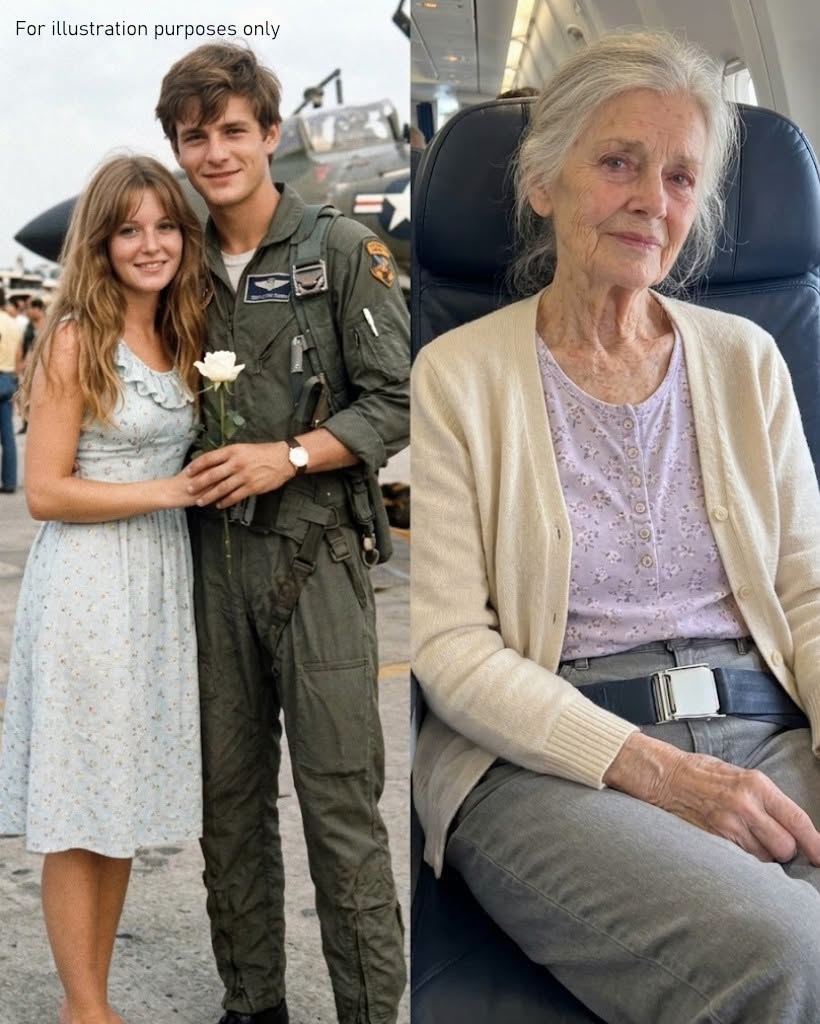
My College Sweetheart Vanished During the War 55 Years Ago — On My Annual Flight to His Memorial, the Captain Suddenly Called My Name Over the Speaker
For 55 years, I had lived with the same unanswered question: What happened to the man I was supposed to spend my life with?
His name was Daniel, and he was my college sweetheart. We met in the autumn of 1969, when we were both young enough to believe that love could survive anything. He had a crooked smile, a habit of tapping his fingers when he was thinking, and a way of making even the most ordinary day feel unforgettable.
We spent our afternoons studying together in the university library, sharing inexpensive dinners, and talking about the future as though it were something we could design ourselves.
Daniel wanted to become a teacher. I dreamed of becoming a writer. We planned to marry after graduation, find a small house near the coast, and fill it with books, music, and children.
Then the war took him away.
He received his orders in the spring. I remember standing outside the university gates as he held both my hands and promised he would come back.
“Don’t put your life on hold for me,” he whispered.
I was offended by the words then. I thought he was asking me to prepare for a future without him.
I didn’t understand that he was afraid he might never return.
For months, we exchanged letters. His handwriting grew smaller as his days became busier, but every envelope felt like proof that the world was still holding together.
Then, one morning, the letters stopped.
I wrote to his unit. I contacted officials. I waited for someone to tell me where he was, whether he had been injured, or whether he was still alive.
Eventually, I received a brief notification stating that Daniel had been reported missing during the war.
There was no confirmed date of death. No grave I could visit. No final letter explaining what had happened.
Just the word missing.
And so, I waited.
Life continued, as it does even when your heart refuses to move forward. I built a career, cared for my family, and learned how to smile at weddings and birthday parties. I grew older, my hair turned silver, and the world changed in ways Daniel and I had once discussed over coffee.
But every year, on the anniversary of his disappearance, I traveled to a memorial dedicated to those who had never returned.
I always took the same flight.
I always carried the same photograph of us, taken on the university steps shortly before he left.
And every year, I whispered the same words at the memorial.
“I haven’t forgotten you, Daniel.”
I was 74 years old when everything changed.
The Announcement That Stopped My Heart
That morning, the flight was nearly full. I settled into my window seat, placed my handbag beneath the seat in front of me, and carefully tucked Daniel’s photograph into the pocket of my coat.
I had made this journey so many times that I knew every part of it by heart.
The gentle rumble of the engines. The flight attendants checking the overhead compartments. The quiet conversations fading as the aircraft prepared for departure.
I was looking out at the runway when the captain’s voice came over the speakers.
“Ladies and gentlemen, we have a special announcement before we begin our journey.”
I barely looked up.
Then he said my name.
Not my surname alone. My full name.
I froze.
The captain continued, his voice suddenly softer.
“Ma’am, if you’re seated in row 18, seat A, would you please remain seated for a moment? Someone has asked us to deliver a message to you before we depart.”
My fingers tightened around the armrests.
I looked around, expecting to see a flight attendant approaching with some sort of explanation. A mistake, perhaps. A passenger with the same name.
Then I noticed the young flight attendant standing beside my row.
She was holding a small, cream-colored envelope.
“Are you Eleanor?” she asked quietly.
I nodded, unable to speak.
She handed me the envelope.
My name was written across the front in dark blue ink.
I knew that handwriting.
Even after 55 years, I knew it.
The letters leaned slightly to the right. The capital D had a distinctive loop. The final stroke always curved upward, as though the writer had been reluctant to lift his pen.
I had seen that handwriting on hundreds of letters.
Daniel’s letters.
My breath caught in my throat.
“This can’t be,” I whispered.
The flight attendant knelt beside my seat.
“Someone contacted the airline and asked us to make sure you received this today. I was told it was very important.”
My hands trembled as I turned the envelope over.
There was no return address.
Only six words written beneath my name.
You deserve to know the truth.
The Letter Inside
I opened the envelope carefully, afraid that if I moved too quickly, the moment would disappear.
Inside was a single sheet of paper and a small photograph.
The photograph showed a man standing in front of a modest house. He was older, with gray hair and deep lines around his eyes.
But there was something unmistakable about his smile.
I turned the photograph over.
On the back were four words.
I never stopped remembering.
My eyes filled with tears.
The letter began with a sentence that made the cabin seem to fall completely silent.
“Dear Eleanor, if you are reading this, then I have finally found the courage to tell you what happened.”
I read the next lines slowly, my heart pounding.
The letter explained that the writer had known Daniel during the war. He described an incident that had never appeared in the official reports, a disappearance that had left several questions unanswered.
According to the letter, Daniel’s final days had not unfolded the way I had been led to believe.
There was more information, the writer said. Documents. Names. A place where Daniel had been seen after his unit lost contact with him.
And there was one final sentence.
“Eleanor, the reason you never received another letter was not what you were told.”
I stopped reading.
For 55 years, I had imagined a thousand possible explanations for Daniel’s disappearance. I had wondered whether he had suffered, whether he had called my name, whether he had thought of me during his final moments.
Now, for the first time, someone was telling me that the story I had lived with might not have been the whole truth.
I pressed the letter against my chest and closed my eyes.
The captain’s voice came over the speaker once more.
“Eleanor, there is someone waiting for you when we land. He has asked us to tell you that you no longer have to make this journey alone.”
I looked again at the photograph.
And for the first time in 55 years, I wondered whether I was flying toward a memorial to say goodbye—or toward the answer that had been missing from my life all along.
I folded the letter carefully and placed it beside Daniel’s photograph.
Outside the window, the aircraft began moving toward the runway.
I had spent more than half a century learning how to live without answers.
Now, somewhere at the end of that flight, the truth was waiting.
And whatever it was, I knew I was finally ready to hear it.