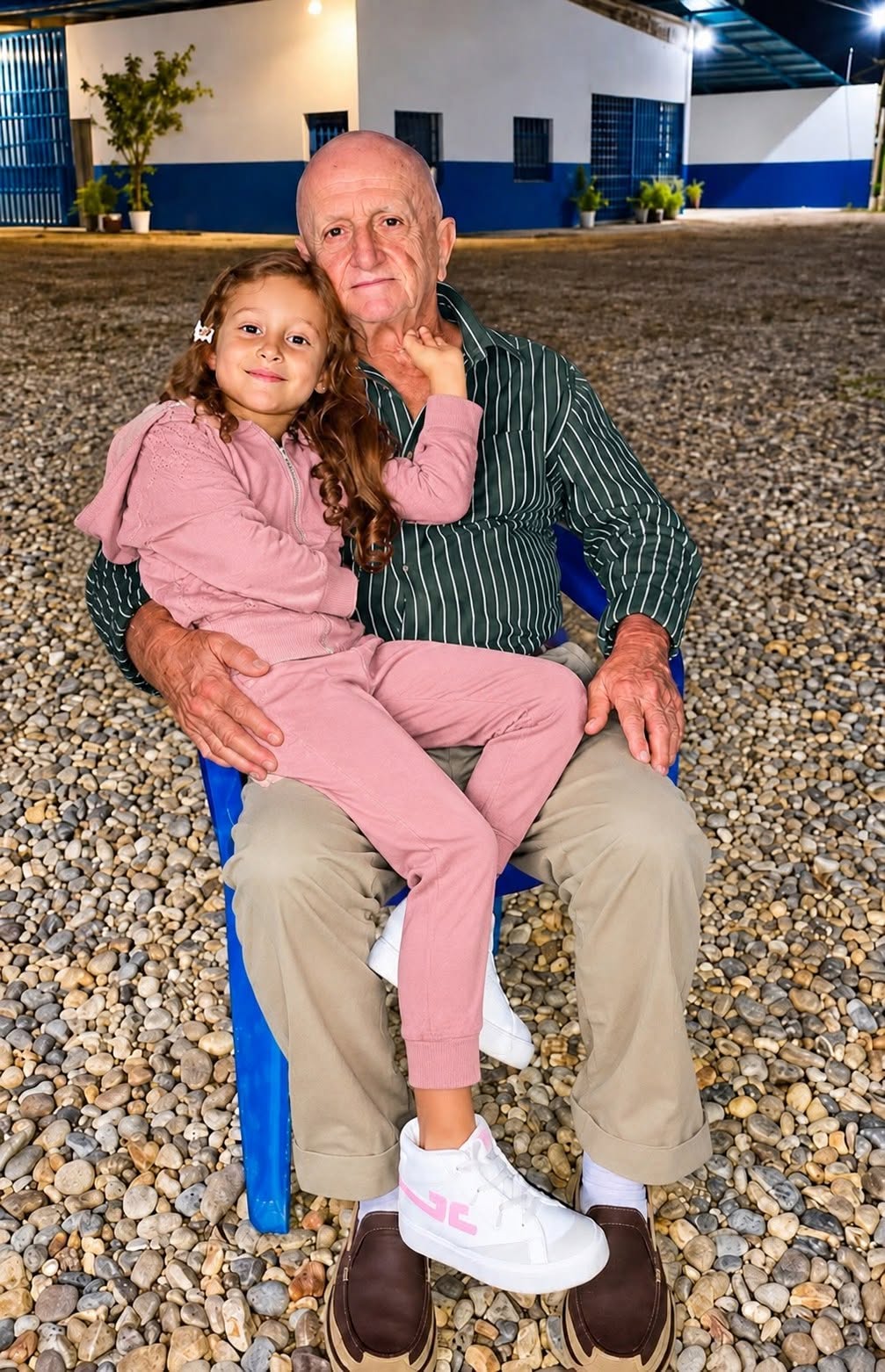
The rhythmic, rhythmic thump-thump-thump of my chef’s knife against the heavy wooden cutting board was usually a soothing sound to me after a grueling nine-hour shift at the office. It was a mundane Wednesday evening. The kitchen smelled of simmering garlic, roasted chicken, and the faint, sweet aroma of chopped carrots. Outside, the autumn rain was softly tapping against the glass panes, creating a cozy cocoon inside our suburban home.
Sitting at the nearby breakfast nook was my six-year-old daughter, Lily. She was entirely absorbed in her own little world, her small fingers tightly gripping a purple crayon as she meticulously colored within the lines of her drawing pad.
“Mommy?” she asked, not looking up from her masterpiece.
“Yes, sweetie?” I replied, continuing to slice the vegetables for dinner.
“Every time Grandpa gives me a bath, he asks me to play a special secret game. I have to close my eyes really, really tight. And while they’re closed, he does something I can’t see.”
The knife came down hard, biting deep into the cutting board, stopping just millimeters from my thumb.
The warmth of the kitchen evaporated instantly, replaced by a suffocating, icy silence. The comforting sound of the rain outside suddenly felt distant, drowned out by the heavy, erratic thudding of my own heart against my ribs. I stood completely frozen, my hand still clutching the handle of the knife, staring blankly at the wall in front of me.
I must have misheard her, I thought frantically, trying to force air back into my lungs. She’s six. Children mix up words all the time. She’s talking about shampoo. Or a magic trick. Or a game of peek-a-boo.
Slowly, deliberately, I set the knife down on the counter. I wiped my hands on my apron, making sure my movements were calm so as not to alarm her. I walked over to the table and pulled out the small wooden chair beside her, sinking into it as my knees threatened to give out.
“Lily, sweetie,” I began, forcing my voice into a gentle, playful pitch despite the lump growing in my throat. “What kind of game does Grandpa play?”
Lily paused her coloring, tilting her head thoughtfully. “He says it’s the Magic Princess game. He tells me that true magic only works if I keep my eyes squeezed shut. If I open them even a little bit, the spell breaks.”
“And… what happens after you close your eyes?” I asked, my palms sweating.
Lily shrugged her tiny shoulders, her innocence standing in horrific contrast to the dark, terrifying thoughts rushing through my mind. “I don’t know, Mommy. My eyes are closed! I just hear funny water noises and then Grandpa says ‘Ta-da!’ but I’m not allowed to look until he tells me.”
A cold sweat broke out across the back of my neck. In today’s world, every parent’s worst nightmare is the idea that the people they trust most could harbor dark, hidden side. But this was my father. George. A seventy-six-year-old retired carpenter who wore faded flannel shirts, smelled like peppermint and pine wood, and had dedicated every single day of his retirement to helping me raise Lily.
When my husband, Daniel, was promoted to senior structural engineer, his hours doubled, leaving him coming home long after Lily was already asleep. My father had stepped up without hesitation. Twice a week, he would pick Lily up from school, make her favorite macaroni and cheese, read her storybooks in voices that made her double over with laughter, and help with her bedtime routine. He was her hero. He was my rock.
How could I even entertain such a thought? I scolded myself. It’s Dad. The man who carried me on his shoulders at the zoo. The man who worked night shifts for five years straight so I could go to college debt-free.
“Lily,” I said softly, reaching out to gently touch her hands. “Does Grandpa ever touch you in a way that makes you feel bad, or uncomfortable, or scared?”
Lily looked at me, her big blue eyes wide with genuine confusion. “No, Mommy! Grandpa is funny. He makes funny noises during the game. It’s funny, not scary.”
“Did… did Grandpa tell you not to tell me about this game?” I asked, holding my breath.
Lily bit her bottom lip, shifting uncomfortably in her chair. That brief, hesitant silence felt like an eternity stretching out before me, twisting my stomach into painful knots.
“Well…” Lily whispered, leaning in closer as if sharing a deep secret. “He said if I tell you everything, the game won’t be fun or surprising anymore. He said it’s our special secret.”
My blood ran completely cold. Special secret. The exact words every safety pamphlet, every parenting book, every news horror story warned you about.
“Mommy? Why are you looking at me like that? Are you mad?” Lily asked, her voice quivering slightly.
I snapped out of my trance, forcing a warm, reassuring smile onto my face, though I felt like I was breaking apart inside. “No, sweetie. Mommy isn’t mad at all. You did a wonderful job telling me. You can always tell Mommy anything, okay?”
“Okay,” she said brightly, instantly returning to her coloring book as if the conversation had meant nothing at all to her.
For her, it was just a casual chat. For me, it was the beginning of a living nightmare.
That night, I couldn’t sleep. I lay awake beside Daniel, listening to his steady breathing while my mind churned out horrific scenarios. When he finally woke up at dawn, I dragged him into the kitchen and told him everything Lily had said. Daniel listened in stunned silence, his face pale, his brow furrowed deeply.
“Sarah, it’s your father,” Daniel whispered, grabbing my trembling hands. “He loves Lily more than life itself. There has to be an explanation.”
“I know! I know!” I sobbed softly, hiding my face in my hands. “I feel sick just thinking about it! But what if we’re wrong? What if we’re ignoring red flags just because he’s family? I can’t live with the uncertainty, Daniel. I can’t.”
“So what do we do?” Daniel asked softly.
I looked at the kitchen clock. It was Thursday. My father was scheduled to come over at 5:00 PM to watch Lily while I caught up on my work presentations.
“Tonight,” I said, my voice hardening with grim determination. “Tonight, I’m going to watch them. And if anything – anything looks wrong, I’m putting an end to this.”
Thursday afternoon passed in a blur of agonizing anxiety. Every tick of the living room clock sounded like a countdown to an inevitable explosion. When the doorbell finally rang at precisely 5:00 PM, my heart violently leaped into my throat.
I opened the door to reveal my father standing on the porch, wiping his rain-soaked boots on the mat. He was wearing his usual tan jacket, a woolen flat cap, and a bright smile that crinkled the deep lines around his warm brown eyes.
“Hey there, kiddo!” he cheered, stamping his feet. He reached into his coat pocket and pulled out a small, shiny red apple. “Look what I found on the big tree down by the park, Lily-pad!”
Lily came running from the living room with an ecstatic scream, throwing her arms around his knees. “Grandpa!”
Watching them hug, watching the pure, unadulterated adoration on my daughter’s face and the tender, gentle way my father patted her hair, I felt an overpowering surge of shame. How could I suspect this man? How could I be so paranoid? But then, the dark whisper of doubt returned: Predators are masters of disguise. You have to be sure.
Throughout dinner, I barely touched my food. I watched my father’s every movement like a hawk. I noticed things I hadn’t paid much attention to before. His right hand trembled slightly as he lifted his water glass. When he dropped a fork, he chuckled it off, calling himself “an old clumsy ox.” At the time, I paid it no mind. Now, every small detail felt magnified, sinister, loaded with hidden meaning.
“Alright, princess!” my father announced around 6:30 PM, pushing his chair back. “Time for bath time before your bedtime story. Sarah, you go finish those computer reports of yours. I’ve got everything under control.”
“Thanks, Dad,” I managed to say, my throat dry as sandpaper.
I sat at the dining table with my laptop open, but I didn’t type a single word. I listened intently as their footsteps receded down the hallway toward the main bathroom. I heard the bathroom door creak shut. Then came the sound of running water as the tub filled up.
Ten minutes passed. Then fifteen.
My mind was a chaotic storm of panic. What was happening in there right now? Was he telling her to close her eyes? Was he doing something unspeakable? I couldn’t sit still any longer. The agonizing torture of not knowing was tearing my mind apart.
I kicked my chair back, kicked off my shoes so my footsteps would be completely silent, and crept down the carpeted hallway.
The bathroom door was pulled almost all the way shut, leaving only a tiny, quarter-inch crack of light spilling onto the dark hallway floor. Warm, lavender-scented steam drifted out through the gap, bringing with it the muffled sounds of splashing water.
I pressed my ear against the cool wood of the door, holding my breath so hard my chest ached.
“Okay, Lily-pad,” I heard my father’s voice say from inside. His tone was low, strangely strained. “You know the rule. It’s time for the magic game. Squeeze those eyes tight! No peeking allowed!”
“Eyes closed tight, Grandpa!” Lily’s cheerful voice replied.
Then, total silence descended inside the room.
No splashing. No talking. Just a heavy, suffocating quiet that lasted for five agonizing seconds.
That’s it, my brain screamed. I’m stopping this NOW.
Fear, rage, and a fierce maternal instinct flooded my veins, blinding my judgment. I didn’t knock. I didn’t call out. I grabbed the brass door handle, twisted it violently, and slammed the bathroom door wide open!
“STOP!” I screamed, lunging into the room.
The heavy door slammed against the tiled wall with a deafening bang. Warm steam billowed out into the hallway, momentarily obscuring my vision. My heart was pounding so hard I could hear the blood rushing in my ears. I braced myself for the most horrific sight of my life.
The steam cleared.
My breath caught violently in my throat, and I froze in absolute, utter shock.
My father was kneeling on the hard, cold bathmat beside the tub, wearing an oversized plastic apron over his flannel shirt. His face was pale, beads of sweat dripping down his forehead, and his entire body was trembling violently with physical exertion.
In his right hand, he wasn’t holding anything sinister. He was holding a small, pink, plastic watering can—the kind children use to water flowers in the garden.
Sitting in the tub was Lily, covered up to her chest in fluffy white bubble bath. On her head was a brightly colored yellow plastic visor—a shampoo cap designed to protect a child’s eyes and face from rinsing water. Her eyes were squeezed shut, and she was giggling, completely unbothered.
My father was using the small, lightweight watering can to very carefully, very slowly pour tiny, gentle trickles of warm water over the back of her head, rinsing out the soap without letting a single drop touch her face.
“One… two… three… and the magic spell is done! Open your eyes, Princess!” my father panted, his voice shaking terribly.
Lily opened her eyes, clapping her soapy hands together happily. “Yay! I did it! I didn’t peek!”
Then, both of them turned to look at the doorway, where I stood panting, disheveled, and pale as a ghost, clutching the doorframe for support.
“Sarah?” my father asked, his brow furrowed in utter bewilderment. He looked at my terrified expression, then down at the plastic door handle I had nearly ripped off the wall. “Sweetheart… what’s wrong? Is there a fire?”
I stared at the pink plastic watering can. I stared at the yellow shampoo visor. I stared at my father’s trembling, sweat-slicked hands.
The crushing weight of reality hit me with the force of a freight train.
Lily had always thrown violent, screaming tantrums whenever water got into her eyes during baths. My father hadn’t been playing some twisted secret game. He had invented a clever, playful trick to make gội đầu fun for her. He had bought the little visor, used the lightweight watering can because it was easier for him to control than the heavy, high-pressure handheld showerhead, and told her to keep her eyes closed to make her feel like a princess receiving a “magical crown.”
And the “secret”? He had asked her not to tell me simply because he wanted it to be a fun surprise for me—to show me that he had finally solved her fear of bath time.
“I… I…” I stammered, the words catching in my dry throat.
A wave of overwhelming, sickening guilt washed over me, so intense it made my stomach drop. I had just stormed into a bathroom, suspecting my own loving, selfless father of the most despicable crime imaginable, only to find him kneeling in pain, trying his absolute best to make my daughter laugh.
“I just… I heard a noise,” I lied desperately, tears immediately welling up in my eyes and spilling over my cheeks. “I thought… I thought Lily slipped.”
“Oh, no, mommy! I’m okay!” Lily chirped happily, splashing in the bubbles. “Grandpa showed me the magic water!”
My father looked at me closely. For a brief second, I saw a flicker of profound hurt in his eyes—as if he somehow sensed the dark nature of what I had really been thinking. But just as quickly, he masked it with a soft, forgiving smile.
“We’re all safe here, Sarah,” he said softly, his voice full of a quiet, heavy tenderness. “Just taking care of our girl.”
I turned around and ran into the hallway, leaning against the wall as heavy, silent sobs wracked my body. I felt like the worst daughter in the world. I resolved right then and there to apologize to him, to make it up to him, to never doubt him again.
I waited until he finished dressing Lily, tucking her into bed, and reading her a bedtime story about a brave little dragon. Once Lily was fast asleep, my father walked down the hallway, putting on his tan jacket to leave.
“Dad, wait,” I said, stepping into the living room. “Let me walk you to your car.”
“It’s alright, sweetheart, it’s raining,” he said gently, reaching into his coat pocket to pull out his car keys.
As he pulled his hand out, his fingers twitched violently. He lost his grip on the keys. They fell to the hardwood floor, along with a small, gray plastic container that tumbled out of his deep jacket pocket.
The plastic container popped open upon impact with the floor.
Dozens of prescription pill bottles rolled across the floorboards, along with a folded piece of white paper bearing an official medical letterhead.
My father froze. He frantically dropped down to try to gather the papers, but his legs buckled under him, and he sank heavily onto his knees.
“Dad!” I cried out, rushing forward to help him.
My eyes instinctively dropped to the white paper laying open on the floor right beside my foot. At the top of the page, in bold, stark black letters, were the words: DEPARTMENT OF NEUROLOGY – DIAGNOSTIC SUMMARY.
And right beneath it was my father’s full name, followed by a diagnosis that caused my heart to completely stop beating.
My eyes scanned the medical document, drinking in terms that sounded horrifyingly clinical and final: Progressive Neurodegenerative Motor Dysfunction. Amyotrophic Lateral Sclerosis (ALS) – Early-to-Intermediate Stage.
The world seemed to spin on its axis. The comfortable living room, the quiet rain outside, the warm lamps—everything melted away until there was only the paper in my hand and my father kneeling on the floor, his head bowed in deep shame.
“Dad…” I whispered, my voice breaking into a thousand pieces. “What… what is this?”
He didn’t look up at me. His hands, resting on his thighs, were shaking uncontrollably now. The tremor wasn’t just a minor sign of old age; it was a violent, visible spasm of nerves slowly dying beneath his skin.
“Please don’t be mad, Sarah,” he said, his voice barely audible above the sound of the rain. “I didn’t want you to know.”
“Didn’t want me to know?!” I gasped, dropping to my knees beside him on the floor, grabbing his shoulders. “Dad! This paper says you were diagnosed eight months ago! Eight months! Why didn’t you tell me? Why didn’t you tell Daniel? Why have you been suffering through this all alone?”
Tears finally overflowed from his faded brown eyes, trailing down the deep furrows of his weathered cheeks. “Because you were already drowning, Sarah,” he whispered, looking at me with an intensity that broke my heart into a million pieces. “You and Daniel were working eighty hours a week trying to pay off your mortgage and save for Lily’s future. You were stressed, exhausted, barely sleeping. If I told you I was dying, what would you have done?”
“I would have taken care of you!” I yelled, sobbing hysterically now. “Because you’re my father!”
“And you would have quit your job,” he said gently, shaking his head. “You would have put your entire life on hold. You would have spent every waking moment worrying about me, watching me deteriorate day by day. I couldn’t do that to you. I wouldn’t do that to you.”
He slowly picked up one of the prescription pill bottles from the floor, staring at the label with a look of quiet resignation.
“When the doctor told me the news eight months ago, he said I had a year, maybe two, before my muscles completely gave out,” my father continued softly. “I sat in my car in the hospital parking lot and cried for three hours. Not because I was afraid of dying—I’ve lived a long, good life, Sarah. I cried because I was afraid I wouldn’t get to see Lily grow up. I was afraid I’d become a helpless burden to the daughter I swore to protect.”
He looked at his shaking hands, a bitter, sad smile touching his lips.
“A few months ago, my hands started losing strength. I dropped a heavy glass mug in the kitchen and it shattered. That’s when I realized I couldn’t hold the heavy showerhead to wash Lily’s hair anymore. My hands would shake so bad I was terrified I’d slip, drop it on her head, or accidentally burn her with hot water. But I didn’t want to stop giving her baths. Those evenings with her… they were the only time I forgot that my body was breaking down.”
He lifted his eyes to meet mine, and the pure, unselfish love shining in them made me feel smaller than an ant.
“So I bought that little plastic watering can,” he explained quietly. “It was light. Even with my weak hands, I could hold it steady. And I got the plastic visor so no water would splash into her face if my hand twitched. I made up the ‘magic game’ so she’d keep her eyes closed… because I didn’t want her to see her Grandpa’s hands shaking like a leaf. I didn’t want her to be scared of me.”
Every single word he spoke was a physical blow to my soul.
I remembered my monstrous thoughts from just an hour ago. I remembered sneaking down the hallway, suspecting him of evil, dark perversion. Meanwhile, this noble, dying man was silently battling a horrific, fatal disease, using every ounce of his failing physical strength to shield my daughter from fear and shield me from grief.
I threw my arms around his neck, burying my face in his shoulder, sobbing so hard I could barely breathe. “I’m so sorry, Dad! I’m so, so sorry! Please forgive me!”
He wrapped his arms around me, holding me tight, patting my back just as he had done when I was a little girl afraid of the dark. “There’s nothing to forgive, sweetheart. Nothing at all.”
When Daniel came home an hour later, we sat down around the kitchen table. We laid out all of my father’s medical records, his medication schedules, and his doctor’s contact details. There were no more secrets. We cried together, but through the tears, a fierce sense of unity took hold.
We made a plan. We would hire a specialized physical therapist. We would adapt the house. We would make every single remaining day of his life comfortable, filled with dignity, joy, and love.
For the next four months, our home became a haven of shared warmth. Daniel built a custom wooden ramp over the porch steps. I reduced my working hours to work entirely from home so I could prepare my father’s meals and manage his physical therapy exercises. Lily became his official “assistant,” proudly carrying his water glasses, bringing him his reading glasses, and sitting beside his armchair for hours as he dictated stories for her to draw.
His physical health was declining—his legs were growing weaker, requiring him to use a cane, and then a wheelchair—but his spirit was radiant. Our family was closer than it had ever been.
Until one freezing afternoon in late January.
I was up in the attic, searching through old storage boxes to find a thick winter blanket for my father’s bed. Deep in the corner of the attic, behind a dusty stack of framed paintings, I knocked over an old, heavy iron trunk that had belonged to my father for as long as I could remember.
The lock on the trunk was rusted, and the impact against the floor caused the lid to pop open.
Curious, I knelt down and lifted the heavy iron lid. Inside were old military medals, photographs from the 1970s, and a thick, leather-bound binder wrapped in faded velvet cloth.
I picked up the binder and opened it. Inside were official court documents, adoption papers, and a police report dated thirty-two years ago.
As I read the names printed on the top of the official court seal, my breath caught in my throat.
The document was an Order of Absolute Adoption.
And according to the legal papers in my hands, George Miller was not my biological father.
My fingers trembled violently as I turned the yellowed pages of the legal file. The dusty attic air suddenly felt thick, suffocating, as if thirty years of buried history were crashing down around me all at once.
The court documents detailed a terrifying event from the winter of 1994.
My biological mother, a woman named Elena, had died in a tragic house fire when I was just fourteen months old. My biological father, overwhelmed by severe clinical depression, substance abuse, and absolute financial ruin following her death, had abandoned me at a local state shelter and permanently revoked his parental rights before disappearing entirely.
And then came the name: George Miller.
George had been my biological mother’s childhood friend and neighbor. He was thirty-four years old at the time, unmarried, working two jobs as a carpenter and a night-shift mechanic. When he learned that Elena’s baby girl had been left in state custody, he spent his entire life savings on legal fees to fight the state for custody.
There was a personal letter attached to the back of the adoption papers, written in my father’s distinct, neat cursive handwriting, addressed to the family court judge:
“Your Honor,
I know on paper I am not the ideal candidate. I am a single man, I work with my hands, and I do not have a large bank account. But I loved Elena like a sister, and I promised her before she died that her daughter would never know a day without love. I will work twenty hours a day if I have to. I will sacrifice everything I own. I do not care if she carries my blood or not—she is my daughter in every way that matters. Please let me bring her home.”
I sat on the cold wooden floor of the attic, tears pouring uncontrollably down my face, soaking into the dusty paper.
Thirty-two years.
For thirty-two years, this man had raised me. He had celebrated every birthday, cheered at every school play, held my hand through every heartbreak, and paid for every textbook. He had never once mentioned that we weren’t blood relatives. He had never made me feel like an orphan. He had taken the darkest, most tragic secret of my origins and buried it beneath a mountain of endless, unconditional love, so that I could grow up feeling completely secure, whole, and wanted.
He had never remarried. He had never had biological children of his own. He had dedicated his entire existence on this earth to raising another man’s child.
I clutched the adoption papers to my chest, my heart aching with a profound, terrifying level of gratitude and love that I didn’t even know human beings were capable of feeling.
Suddenly, a sharp, metallic smash reverberated through the house from down in the living room below, followed instantly by a terrifying, high-pitched scream from Lily.
“GRANDPA!”
The adoption papers fell from my hands. I scrambled to my feet, nearly tripping over the attic stairs as I sprinted down the hallway, my heart hammering wildly in my throat.
“Dad! Lily!” I screamed, tearing down the staircase two steps at a time.
I burst into the living room and gasped in horror.
My father was lying sprawled on the hardwood floor near the fireplace. His wheelchair was tipped over on its side. A heavy ceramic lamp had fallen off the side table, shattering into a hundred sharp shards across the floor.
His legs were twisted at an awkward angle, completely motionless. His face was gray, gasping for air, his left hand twitching uncontrollably as he tried desperately to push himself up off the floorboards.
Lily was standing in the corner, clutching her teddy bear to her chest, crying hysterically, terrified by the sight of her hero lying helpless on the ground.
“Dad!” I screamed, dropping to my knees beside him, carefully moving the sharp glass shards away from his body. “Dad, don’t move! Don’t move!”
“Sarah…” he rasped, his voice a weak, painful wheeze. He couldn’t lift his torso. The ALS had suddenly claimed the remaining motor nerves in his lower body and core muscles. “I… I tried to reach for my book… my legs… they just stopped working…”
“It’s okay! It’s okay, Dad! I’ve got you!” I cried, slipping my arms under his shoulders, using every ounce of strength in my body to pull his limp frame up against my chest.
Daniel rushed into the room, having heard the commotion from the garage. Together, with extreme care, we managed to lift my father off the floor and lay him gently onto the soft living room sofa.
My father lay there, breathing heavily, his eyes staring at the ceiling. Tears of bitter frustration and shame rolled down his sunken cheeks.
“I’m sorry…” he whispered, his voice cracking with absolute heartbreak. “Look at me… I can’t even sit up on my own anymore… I’m just a useless, broken burden…”
“Don’t you EVER say that!” I sobbed angrily, grabbing his cold, shaking hands and pressing them against my face. “You hear me, Dad? You are NOT a burden! You could never, EVER be a burden!”
I reached into my pocket, pulling out the faded velvet binder I had brought down from the attic, and laid it gently on his chest.
My father’s eyes slowly moved down to the binder. When he recognized the faded velvet cover, his pale face went completely white.
The room grew profoundly quiet, save for the sound of Lily’s soft sniffling in the corner and the crackle of the fireplace.
My father stared at the adoption papers resting on his chest. He closed his eyes tightly, a single, heavy tear squeezing out from under his eyelid.
“You found it,” he whispered, his voice trembling with a fragile, tragic vulnerability. “I’m sorry, Sarah… I meant to burn those papers years ago… I never wanted you to find out like this…”
“Why, Dad?” I asked, weeping softly as I stroked his frail, white hair. “Why did you keep it a secret for thirty-two years?”
He slowly opened his eyes, looking up at me with an expression of purest devotion.
“Because I didn’t want you to ever spend a single second of your life feeling like an leftover, or a charity project, or someone who wasn’t wanted,” he said softly, each word costing him immense physical effort. “Your biological father… he was broken by grief, Sarah. He couldn’t be what you needed. But the day I held you in that hospital nursery—this tiny, fragile little girl with big blue eyes looking up at me—I made a promise to God and to your mother. I promised that as long as I breathed, you would have a father who would give his entire life for you.”
He reached up with his trembling, weak hand, gently wiping a tear from my cheek.
“You carry my heart, Sarah. Blood doesn’t make a family. Love does. And you have been my daughter from the very first second I held you in my arms.”
I collapsed against his chest, burying my face in his shoulder, sobbing out thirty-two years of unexpressed love and gratitude. “You ARE my father, Dad. You’re the only father I’ve ever had, and the greatest father any child could ever dream of having.”
Daniel stepped forward, pulling a crying Lily into his arms and kneeling beside the sofa.
“Grandpa?” Lily asked softly, reaching out her tiny hand to pat his cheek. “Are you sad?”
My father turned his head, a weak, beautiful smile breaking across his pale face. “No, my sweet princess. Grandpa isn’t sad at all. Grandpa is the happiest man in the world.”
From that day forward, our home shifted entirely into a place of active, unconditional care and deep joy. We didn’t dwell on the tragedy of his diagnosis; instead, we celebrated every single moment we had left together.
Daniel converted our formal dining room into a beautiful, sunlit bedroom for my father, complete with a specialized medical bed and wide windows overlooking the garden he loved so much. I officially took a leave of absence from my career, devoting every day to being his primary caregiver, brushing his hair, reading his favorite historical novels aloud, and cooking his favorite meals.
And the bath time routine continued.
Every Tuesday and Thursday evening, we carried out the tradition. But now, the roles had lovingly reversed.
Daniel would carefully carry my father into the adapted, warm bathroom, placing him comfortably in a specialized, padded shower chair.
Then, six-year-old Lily would proudly step forward, wearing her little plastic apron, holding the small pink elephant watering can filled with warm water.
“Okay, Grandpa!” Lily would announce authoritatively, her voice full of playful importance. “You know the rules! It’s time for the magic princess game! You have to close your eyes really, really tight, or the spell won’t work!”
My father would lean his head back against the padded headrest, his tired face radiating absolute peace and happiness.
“Eyes closed tight, Princess,” he would reply softly, his voice full of warmth.
Lily would gently, carefully tip the little pink watering can, pouring a smooth, warm trickle of water over her grandfather’s thin, silver hair, rinsing away the soap while making funny, bubbly splashing noises to make him laugh.
Standing in the doorway, watching my daughter tenderly care for the man who had sacrificed his entire life to raise me, tears of pure love would fill my eyes.
My initial, dark paranoia had brought me to the brink of a terrible mistake. But pushed past that fear, it had opened the door to the deepest, most beautiful truth of my life.
Life is unpredictable, fragile, and often cruel. Diseases like ALS can steal a person’s mobility, their strength, and eventually their physical breath. But what it can never touch, what time itself can never erase, is the quiet, indestructible power of unconditional love passed down from one generation to the next.
My father didn’t give me his DNA. He gave me something infinitely more precious: he gave me his heart, his life, and a legacy of love that would live on forever through my daughter and generations to come.