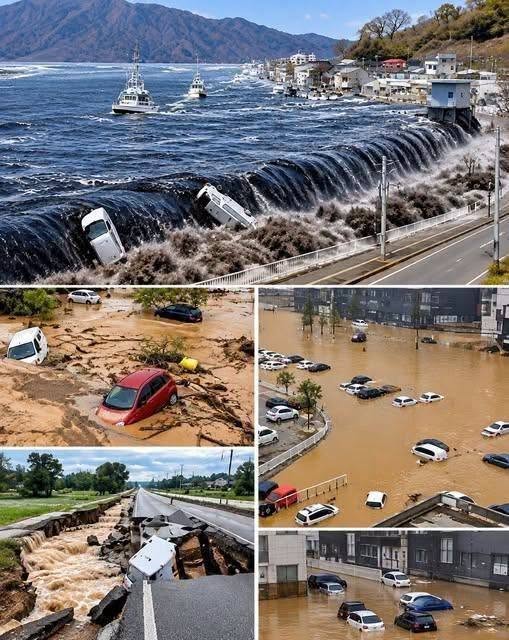
A powerful earthquake beneath the ocean can set an enormous volume of water in motion, transforming peaceful coastlines into disaster zones within minutes. Understanding the danger, recognizing the warning signs, and preparing before disaster strikes can save countless lives.
Chapter 1: The Moment the Ocean Becomes a Threat
Imagine a peaceful coastal community on an ordinary morning.
Fishing boats are returning to the harbor after hours at sea. Families are preparing breakfast, shopkeepers are opening their businesses, and children are getting ready for school. Along the waterfront, tourists stop to admire the ocean, while residents follow the familiar routines that have shaped their lives for generations.
Nothing about the scene suggests that danger is approaching.
The sea looks calm. The streets are busy. The buildings stand exactly where they stood the day before.
Then, without warning, the ground begins to shake.
At first, the movement may feel like a passing truck or a sudden vibration beneath the floor. Within seconds, however, the shaking becomes more powerful. Furniture moves across rooms, objects fall from shelves, and people struggle to maintain their balance.
Outside, electrical wires sway. Windows break. Cracks may appear in walls, roads, and pavement.
For those living near the coast, the earthquake itself may be only the beginning of the emergency.
Far beneath the ocean, enormous geological forces may have displaced a large section of the seafloor. When this happens, the movement can push an extraordinary volume of seawater out of its normal position.
That disturbance can generate a tsunami.
A disaster that begins deep beneath the ocean may soon become a life-threatening event for communities hundreds or even thousands of kilometers away.
The Extraordinary Power of a Magnitude 9.1 Earthquake
An earthquake measuring magnitude 9.1 would rank among the most powerful seismic events ever recorded.
Earthquake magnitude is not measured on a simple linear scale. Scientists use logarithmic measurements to describe the enormous differences between small and large earthquakes.
According to the United States Geological Survey, an increase of one whole magnitude corresponds to approximately 32 times more energy being released.
This means that a magnitude 9 earthquake releases about 32 times more energy than a magnitude 8 earthquake.
The difference is enormous.
An earthquake of this scale generally involves movement along a vast section of a geological fault. In certain ocean regions, one tectonic plate slowly moves beneath another through a process known as subduction.
These movements occur over immense periods.
The tectonic plates may remain locked together even while powerful forces continue to build beneath the surface. Eventually, the accumulated stress can exceed the strength of the rocks holding them in place.
When the fault suddenly ruptures, sections of the Earth’s crust may move by several meters or more.
If that movement includes substantial vertical displacement of the seafloor, the ocean above can be forced upward or downward.
The resulting disturbance spreads across the water.
Unlike an ordinary ocean wave generated primarily by wind, a tsunami involves movement throughout a significant depth of the water column.
It carries enormous energy across vast distances.
How a Tsunami Travels Across the Ocean
One of the most surprising facts about tsunamis is that they do not always look dangerous while traveling through deep water.
In the open ocean, a tsunami may have a relatively small wave height but an extremely long wavelength.
A vessel far offshore might barely notice the disturbance.
Yet beneath that seemingly modest surface movement, tremendous quantities of water are traveling as part of a powerful wave system.
The speed of a tsunami depends largely on the depth of the ocean.
In deep water, the waves can travel at speeds comparable to those of commercial aircraft.
This allows tsunami energy to cross entire ocean basins in a matter of hours.
As the waves approach shallower coastal waters, however, their behavior changes.
They slow down.
Their wavelengths shorten.
Their heights may increase as the moving water interacts with the seabed and coastline.
In some places, the approaching tsunami forms a rapidly rising surge rather than the towering breaking wave often portrayed in disaster movies.
Elsewhere, the water may arrive as a series of powerful waves or turbulent floods.
The exact appearance depends on the seafloor, shoreline, underwater terrain, and characteristics of the original earthquake.
What matters most is that the water can move with extraordinary force.
When Familiar Streets Become Dangerous Waterways
Picture a waterfront street lined with small restaurants, homes, and shops.
Cars are parked along the roadside. People are walking between buildings. Fishing equipment is stacked beside a harbor.
Then water begins to move inland.
Within moments, the street may become a channel of powerful currents.
Vehicles begin shifting from their parking spaces. Loose objects float away. Doors and windows are struck by debris.
Water pushes through buildings and moves around corners.
A current that appears manageable from a distance may be strong enough to knock an adult off their feet.
As floodwater advances, it can carry trees, motorcycles, vehicles, construction materials, and fragments of damaged buildings.
These objects become dangerous projectiles.
Even structures that initially survive the earthquake can be damaged when debris repeatedly strikes their walls and foundations.
In some locations, seawater can travel inland through rivers, canals, and drainage channels.
This means that people living beyond the immediate beachfront may still be exposed.
The devastation depends not only on how high the water rises, but also on how rapidly it moves and how far inland it reaches.
[Original image — retain unchanged]
Why the First Wave Is Not Always the Worst
A common misunderstanding is that a tsunami consists of one enormous wave that strikes the coastline and disappears.
In reality, tsunamis frequently involve a series of waves arriving over an extended period.
The interval between waves may be several minutes or considerably longer.
Sometimes the first wave is relatively small.
People who see the water retreat may mistakenly assume that the danger has passed.
They may leave evacuation areas, return to their homes, or approach the coast to inspect damage.
This can be a deadly mistake.
A later wave may be larger and more destructive than the first.
Strong currents can also continue long after the most dramatic flooding has occurred.
Harbors, beaches, river entrances, and narrow waterways may remain dangerous for many hours.
The ocean can appear calm between waves, but that temporary calm should never be interpreted as an official all-clear.
Coastal residents must remain in designated safe areas until emergency authorities confirm that conditions are safe.
A Critical Difference Between Earthquakes and Tsunamis
Although the two hazards are closely connected, not every earthquake generates a tsunami.
Some earthquakes occur too deep beneath the Earth’s surface to significantly displace the seafloor.
Others involve primarily horizontal fault movement rather than the vertical movement commonly associated with large earthquake-generated tsunamis.
The location of the earthquake also matters.
An extremely powerful earthquake beneath land may cause extensive structural damage without producing a major tsunami.
Conversely, certain submarine landslides or volcanic disturbances can generate dangerous local tsunamis without a magnitude 9 earthquake.
The relationship between earthquakes and tsunamis is therefore complex.
Scientists consider earthquake depth, magnitude, fault orientation, geological setting, and observed sea-level changes when assessing the possibility of a tsunami.
These distinctions are important because dramatic photographs do not always provide enough information to identify the disaster that caused the damage.
Images of flooded streets, submerged vehicles, and enormous waves can illustrate tsunami hazards, but they cannot independently confirm that a magnitude 9.1 earthquake occurred.
Without reliable information about a photograph’s origin, date, and location, identifying the exact event would be speculation.
[Original image — retain unchanged]
The Few Minutes That Can Change Everything
For people living close to the earthquake source, the time between severe shaking and the arrival of a tsunami may be extremely short.
In some situations, only minutes are available.
This creates a serious challenge for emergency warning systems.
Scientists may detect the earthquake rapidly, but authorities still need time to analyze information and issue alerts.
Meanwhile, communication networks may be damaged by the shaking.
Electricity can fail.
Mobile phone service may become unreliable.
Sirens may not function.
Consequently, natural warning signs are essential.
Someone who experiences strong or prolonged shaking near a tsunami-prone coast should protect themselves during the earthquake and move to higher ground or inland as soon as it is safe to do so.
Waiting to see an approaching wave can waste precious time.
The safest evacuation may happen before anyone notices that the ocean is behaving unusually.
The central lesson of this first chapter is simple but critically important.
The ocean can change from a familiar part of everyday life into a powerful natural hazard with very little warning.
Understanding the science behind that transformation is the first step toward surviving it.
Chapter 2: Why Tsunami Flooding Can Destroy Entire Neighborhoods
The destructive force of a tsunami is difficult to understand until one considers the enormous volume of water involved.
A conventional storm wave may crash against a beach and then retreat.
A tsunami can push seawater across an extensive coastal area, maintaining dangerous currents as water flows into streets, neighborhoods, ports, and river systems.
Its power comes not only from wave height, but from the mass of moving water, its speed, and the obstacles it encounters.
Even relatively shallow, fast-moving floodwater can become life-threatening.
The Hidden Strength of Moving Water
Water may appear gentle when observed in a glass, swimming pool, or calm river.
But large quantities of water moving rapidly can exert tremendous force.
During a tsunami, the current may strike buildings from unexpected directions.
A home may withstand the earthquake yet suffer catastrophic damage when floodwater enters through its doors and windows.
As water pushes against walls, structural components may fail.
Foundations can become exposed or undermined when powerful currents remove surrounding soil.
Debris may repeatedly collide with supporting columns.
In some circumstances, buildings can be displaced from their foundations or collapse.
The danger is especially severe for structures that were not designed to withstand significant coastal flooding.
Lightweight homes, waterfront shops, temporary buildings, and aging infrastructure may be particularly vulnerable.
However, even well-constructed buildings can suffer major damage when exposed to powerful currents and floating debris.
No ordinary building should automatically be considered a safe refuge during a tsunami.
People should follow officially designated evacuation routes and use approved vertical evacuation structures where those have been established.
Why Vehicles Are Especially Vulnerable
Photographs of tsunami damage frequently show cars scattered across roads, piled against buildings, or partially submerged in muddy water.
These images demonstrate an important safety lesson.
Vehicles are not reliable protection against rapidly moving floodwater.
As water rises, tires lose traction.
Buoyancy may begin lifting parts of the vehicle, reducing contact with the road.
The vehicle can then be pushed sideways, rotated, or carried into obstacles.
A driver may become trapped inside when water pressure prevents doors from opening normally.
Electrical systems may stop functioning.
Debris can break windows, and currents may make escape extremely difficult.
For this reason, emergency officials often encourage people to evacuate on foot when safe, practical, and consistent with local evacuation plans, particularly where traffic congestion could delay movement to higher ground.
The correct choice depends on local conditions, evacuation distances, mobility needs, and official guidance.
What should never happen is attempting to drive through floodwater or toward the shoreline to observe an approaching tsunami.
[Original image — retain unchanged]
Geography Can Make the Disaster Worse
Not every coastline responds to a tsunami in the same way.
A broad sandy beach, narrow bay, steep rocky shoreline, and low-lying river delta may experience very different effects from the same wave system.
The shape of the coastline influences how the water moves and concentrates.
In narrow bays and inlets, wave energy may become focused.
In low-lying coastal plains, water may spread across extensive areas.
Rivers can provide pathways that allow tsunami currents to travel upstream.
Ports and harbors can experience powerful oscillating currents capable of damaging vessels and docks.
A neighborhood that appears relatively distant from the open ocean may therefore still be vulnerable.
This is why scientific tsunami hazard maps are so valuable.
They combine information about coastal elevation, geological conditions, potential earthquake sources, and numerical simulations of tsunami behavior.
The results help planners identify areas where evacuation may be necessary.
They also reveal where roads, bridges, and critical services may be exposed.
A family living several streets inland should not assume that distance alone guarantees safety.
Elevation, local terrain, and official hazard-zone boundaries are often more informative.
The Destruction Does Not Stop With the Water
As the tsunami moves through a community, it collects material from everything in its path.
Wooden furniture, fishing equipment, vehicles, roofing materials, containers, household appliances, and pieces of buildings may all become part of the moving debris.
These objects increase the danger to both people and structures.
A large floating object can strike a supporting wall or column with tremendous force.
Broken glass, nails, sharp metal, and splintered timber may remain hidden beneath muddy water.
Floodwater can also mix with fuel, sewage, waste, and industrial materials.
When storage tanks or pipes are damaged, hazardous substances may spread into nearby streets and waterways.
These contaminants create additional risks for survivors and emergency personnel.
People returning after a tsunami should not assume that standing water is safe simply because the waves have stopped.
It may contain biological hazards, dangerous chemicals, or submerged objects capable of causing serious injuries.
When Drinking Water Becomes Unsafe
One of the most urgent problems after major coastal flooding is access to clean drinking water.
A tsunami can damage water-treatment facilities, pumping stations, pipes, and storage tanks.
Saltwater may enter freshwater wells and local water supplies.
Sewage systems can be overwhelmed or destroyed.
Even households whose buildings remain standing may lose access to safe water for drinking, cooking, and hygiene.
Residents may need to depend on bottled water, emergency distribution centers, or other approved sources.
It is important to follow official water safety instructions because different types of contamination require different responses.
Boiling can address many microbial risks, but it does not remove salt or all chemical contaminants.
Therefore, residents should not assume that boiling makes tsunami-contaminated seawater or chemically polluted water safe to drink.
Public health agencies and water authorities must assess the affected systems and provide clear guidance.
Restoring safe water can be one of the most important steps in helping a disaster-stricken community recover.
Hospitals, Schools, and Essential Services Under Pressure
The consequences of tsunami flooding extend beyond damaged homes.
Hospitals may lose electricity, clean water, medical supplies, or access roads.
Emergency departments can become overwhelmed by injured patients.
Ambulances may struggle to reach affected neighborhoods because bridges are damaged or streets are blocked.
Communication failures can make it difficult to coordinate rescue teams.
Schools may be flooded or converted into temporary shelters.
Electrical substations can be damaged, leaving entire districts without power.
Food deliveries may be interrupted when ports, highways, or warehouses become unusable.
A disaster affecting only part of a coastal region can therefore disrupt essential services across a much larger area.
The resulting challenges may continue long after the water retreats.
Communities need backup power, protected equipment, emergency communication systems, and contingency plans to keep essential services operating.
[Original image — retain unchanged]
The Economic Damage That Can Last for Years
For many coastal families, the sea provides both a home and a livelihood.
Fishing communities depend on boats, harbors, storage facilities, markets, and transportation networks.
When a tsunami destroys these resources, people may lose their income immediately.
A fishing vessel that has served a family for decades may be damaged beyond repair.
A shopkeeper may return to discover that inventory, equipment, records, and furniture have been swept away.
Small restaurants and hotels may lose customers for months.
Farmers in low-lying coastal regions can suffer when seawater damages crops, soil, irrigation systems, and freshwater sources.
Depending on the severity of saltwater intrusion, agricultural recovery may require significant work and time.
The economic losses are not limited to the buildings destroyed.
Workers may be unable to reach their jobs.
Businesses may remain closed while utility services are restored.
Tourism can decline because transportation routes, accommodation, and attractions are damaged.
Families who were financially stable before the disaster may suddenly struggle to pay for food, medical care, housing, and education.
Recovery assistance must therefore address livelihoods as well as physical reconstruction.
Replacing a building is important.
Helping people earn an income again is equally essential.
The Emotional Cost Behind the Statistics
Disaster reports often focus on the number of damaged buildings, flooded roads, and displaced residents.
These figures matter, but they cannot fully capture the human experience.
For someone who has lived in the same house for fifty years, the loss may involve far more than walls and furniture.
A home can contain photographs, family keepsakes, handwritten letters, and objects associated with important memories.
When these belongings disappear, survivors may feel that an irreplaceable part of their personal history has been lost.
Children may struggle to understand why their school has closed or why the family must temporarily live somewhere unfamiliar.
Adults may feel pressure to remain strong while dealing with grief, financial uncertainty, and exhaustion.
Older residents may find the disruption especially difficult when familiar neighborhoods and support networks are damaged.
Some survivors experience anxiety, nightmares, sleep disturbances, or fear of returning near the ocean.
Others may recover emotionally with support from family and friends.
Responses to disaster vary greatly, and no single experience should be considered universal.
What matters is ensuring that people have access to compassionate support, reliable information, and professional care when needed.
Why the Same Tsunami Can Have Different Outcomes
A tsunami’s consequences depend on a combination of natural and human factors.
The earthquake’s characteristics influence the waves that may be generated.
Coastal geography affects the height, speed, and inland reach of the water.
Population density determines how many people may be exposed.
Building quality influences structural damage.
Warning systems and evacuation behavior can have an enormous impact on survival.
Two communities facing similar wave conditions may experience very different outcomes if one has practiced evacuation procedures and the other has little knowledge of tsunami hazards.
The difference is not simply luck.
Preparation, education, and infrastructure can substantially reduce risk.
This is why tsunami safety must be approached as a community-wide responsibility rather than an issue affecting only those who live directly beside the beach.
Chapter 3: Warning Signs That Should Never Be Ignored
When an undersea earthquake occurs, the most valuable resource for someone near the coast may be time.
A person who recognizes the warning signs and immediately moves toward safety may have a much better chance of escaping dangerous flooding.
But people who wait for confirmation from the shoreline can lose critical minutes.
Understanding the warnings is therefore one of the most practical ways to reduce tsunami casualties.
Strong or Prolonged Shaking
The first natural warning may come directly from the ground.
If someone near a tsunami-prone coastline experiences strong or prolonged earthquake shaking, it may indicate that a nearby earthquake has occurred.
The shaking itself can cause injuries through falling objects, broken glass, damaged structures, and collapsing materials.
During the earthquake, people should follow appropriate earthquake safety guidance, including protecting themselves from falling hazards.
Once the shaking stops and it is safe to move, those in tsunami hazard areas should promptly head toward higher ground or inland.
They should not wait for an official alert when natural signs strongly suggest a tsunami threat.
Locally generated tsunamis can arrive before warning messages reach everyone.
People who are already on a beach or near the water should move away from the shoreline after any felt earthquake as soon as it is safe to do so, following local guidance.
The essential principle is to recognize the danger early and respond without unnecessary delay.
When the Ocean Suddenly Retreats
One of the most widely recognized tsunami warning signs is an unusual withdrawal of seawater.
In some events, the ocean may suddenly recede, exposing sections of seabed that are normally underwater.
Boats may appear stranded.
Rocks, sand, and marine life may become visible in areas that were submerged moments earlier.
For someone unfamiliar with tsunamis, this strange sight might appear fascinating.
People may be tempted to walk toward the exposed seabed, photograph the phenomenon, or investigate what has happened.
That response can be extremely dangerous.
A sudden, unusual retreat of the ocean can indicate that a powerful wave is approaching.
However, not every tsunami begins with water withdrawing from the shore.
Some arrive with an abrupt rise in sea level.
Others may initially resemble a rapidly advancing flood.
Waiting to see the sea retreat is therefore not a safe evacuation strategy.
A Roaring Sound From the Sea
Some eyewitness accounts describe an unusual roar accompanying an approaching tsunami.
The sound may resemble heavy machinery, an approaching train, or a powerful rushing current.
This can occur because enormous quantities of moving water interact with the shoreline, buildings, and surrounding environment.
Yet sound is not a reliable way to detect every tsunami.
Wind, traffic, emergency vehicles, and other noises can make unusual ocean sounds difficult to recognize.
The absence of a roar does not mean the coastline is safe.
Natural warning signs should be understood together rather than treated as a checklist that must be completed before evacuation.
A single credible warning may be sufficient reason to move immediately.
Understanding Official Tsunami Alerts
Government warning agencies use scientific monitoring and communication systems to inform the public about tsunami threats.
The terminology varies between countries, but official alerts often distinguish between confirmed or expected danger, potential danger, and information-only notices.
In the United States, for example, the National Weather Service uses classifications including tsunami warnings, advisories, watches, and information statements.
A tsunami warning indicates that dangerous flooding and powerful currents are expected or occurring.
A tsunami advisory indicates a threat from dangerous waves or currents, particularly near beaches, harbors, and waterways.
A tsunami watch means that a tsunami is possible and people should remain alert for further information.
Residents should learn how their own country’s warning system works rather than assuming that terminology is identical everywhere.
Official messages may be delivered through mobile alerts, radio, television, sirens, public-address systems, and emergency websites.
But technology can fail during a major disaster.
For this reason, coastal communities need multiple independent ways to warn people.
[Original image — retain unchanged]
Why You Should Never Go to the Beach to Watch a Tsunami
Disaster footage can create the misleading impression that watching a tsunami from the shoreline is merely dangerous when a giant wave becomes visible.
In reality, the danger may arrive before an observer understands what is happening.
Water can rise rapidly.
Strong currents may develop around harbors and river mouths.
Roads can become flooded.
A person who drives toward the coast to take photographs may encounter traffic congestion or lose access to evacuation routes.
Stopping to record a dramatic event can also delay other people trying to escape.
Emergency responders may then be placed at additional risk attempting a rescue.
The safest response to a credible tsunami warning is to leave the hazard area, not approach it.
Images and videos are never worth risking a life.
Building an Evacuation Plan Before Disaster Strikes
A practical evacuation plan should be easy to understand and realistic enough to use during an emergency.
Families living in tsunami-prone regions should identify whether their homes, workplaces, schools, and regular travel routes lie within official hazard zones.
They should know the nearest safe destinations and the fastest available routes.
In many locations, reaching higher ground is the preferred response.
Where suitable high ground is unavailable, officially designated vertical evacuation structures may provide an alternative.
These buildings must be specifically assessed or designed for the relevant hazards.
A random multistory building should not automatically be assumed safe.
Families should also identify alternative routes because an earthquake may damage the road they normally use.
A bridge may become unsafe.
A hillside may experience landslides.
Fallen utility poles or debris may block intersections.
Learning only one evacuation route could leave people without options.
Regular practice can help residents recognize problems before an actual emergency occurs.
Preparing Children and Older Adults
Evacuation planning becomes more effective when everyone understands their role.
Children should learn age-appropriate instructions about earthquakes and tsunami warnings.
They should know which adults are responsible for helping them and where they are expected to go during a school emergency.
Parents and caregivers should understand that schools may follow evacuation procedures rather than waiting for families to arrive.
Trying to travel into a tsunami hazard zone to collect a child may create additional danger.
Older adults and people with disabilities may require more detailed arrangements.
Some individuals need mobility equipment, medication, communication support, or assistance traveling along evacuation routes.
Community plans should account for these needs rather than assuming everyone can climb steep hills or walk long distances at the same speed.
Neighbors can also establish voluntary support arrangements to assist people who may need help.
However, assistance should never require anyone to remain in a dangerous location beyond the time available to evacuate.
Emergency planning must balance compassion with realistic safety considerations.
The Importance of Emergency Supplies
An emergency kit can help families manage the period after evacuation.
Useful supplies may include drinking water, shelf-stable food, essential medication, basic first-aid materials, a flashlight, spare batteries, a portable radio, suitable clothing, hygiene supplies, and copies of important documents.
Families with infants, older adults, or people with medical needs may require additional items.
Where possible, supplies should be packed in a portable bag stored somewhere accessible.
However, collecting belongings must never delay a necessary tsunami evacuation.
A person who has only minutes to reach safety should not spend that time searching for documents or packing extra clothing.
Emergency kits are useful because they are prepared before disaster strikes.
Their purpose is to support evacuation, not slow it down.
Communication Plans When Networks Fail
Major earthquakes may damage mobile communication infrastructure.
Even where towers remain operational, networks can become congested because thousands of people attempt to contact loved ones simultaneously.
Families should agree on a meeting location outside the hazard zone.
They may also identify a trusted contact who lives outside the affected region.
When communication is available, brief text messages may sometimes be more practical than repeated telephone calls.
Residents should also know where local emergency authorities publish reliable updates.
Portable radios can be valuable when electricity or mobile networks are unavailable.
In tourist areas, emergency instructions should be available in languages visitors can understand.
Clear signs and straightforward symbols can help travelers recognize evacuation routes even if they are unfamiliar with the local language.
[Original image — retain unchanged]
Why Returning Too Early Is Dangerous
One of the most difficult parts of tsunami evacuation can be remaining away from home after the first wave has passed.
People naturally want to check on family members, belongings, pets, and property.
Some may believe that the threat has ended because the water appears to have receded.
But tsunami activity can continue for hours, and in some events dangerous currents persist much longer.
Later waves may be stronger.
The changing direction of the water can create additional hazards.
Emergency personnel may also need to inspect damaged roads, bridges, and buildings before residents can safely return.
Therefore, an official all-clear is essential.
Residents should not rely on rumors, photographs, or unverified social media posts suggesting that the danger has passed.
A safe evacuation only succeeds when people remain outside the hazard area until returning is appropriate.
Knowledge Becomes Protection Only When People Act
Reading about a tsunami is useful.
Practicing an evacuation route is better.
Knowing that strong shaking can signal danger is important.
Responding promptly when the warning appears is what can save lives.
The most effective preparedness programs do more than distribute information.
They help people build habits.
Schools conduct drills.
Families discuss meeting points.
Businesses train employees.
Community leaders ensure that visitors, older residents, and people with disabilities understand the available options.
When an emergency occurs, these familiar actions can reduce confusion.
No preparation can guarantee that every person will remain safe.
But practical knowledge, effective warnings, and immediate evacuation can significantly improve survival.
Chapter 4: Rebuilding Lives After a Coastal Disaster
When the final dangerous waves have passed and authorities begin allowing access to affected areas, the true scale of a tsunami disaster may gradually become visible.
Streets once filled with traffic are covered in mud.
Homes stand damaged or completely destroyed.
Vehicles lie in unexpected places.
Fishing boats may be stranded far from the harbor.
Power lines are down, shops are empty, and familiar landmarks have disappeared.
For survivors, the emergency does not end when the floodwater recedes.
A difficult process of recovery begins.
The First Priority: Protecting Survivors
Emergency response teams must initially focus on saving lives and preventing further injuries.
Search-and-rescue personnel may work through damaged buildings and debris fields to locate missing people.
Medical teams assess injuries and provide urgent treatment.
Authorities establish evacuation centers and identify safe transportation routes.
Engineers may inspect bridges, roads, and essential structures before allowing them to reopen.
These activities require coordination between multiple organizations.
Firefighters, police, medical workers, disaster management agencies, military units where deployed, utility providers, and volunteers may all contribute.
The challenge can be overwhelming when communication systems are damaged and large areas are inaccessible.
Even well-equipped emergency teams may struggle to reach every location immediately.
This is one reason community preparedness before a disaster is so valuable.
Residents who know basic safety principles can reduce unnecessary exposure while professional assistance is being organized.
The Hidden Dangers of Returning Home
A damaged building may appear stable from the outside while concealing serious structural problems.
Earthquake shaking can weaken foundations, columns, walls, and connections.
Floodwater can remove supporting soil or damage materials.
A building that remained standing during the tsunami may still be unsafe to enter.
Residents should follow local building-safety assessments and restrictions before returning.
Electrical systems create another important danger.
Water can damage wiring, outlets, appliances, and equipment.
Contact with energized electrical components can cause serious injury.
People should avoid electrical equipment in flooded areas and seek qualified assistance before restoring power to damaged installations.
Gas systems and fuel containers may also require inspection.
Floodwater and mud can conceal broken glass, nails, unstable surfaces, open drains, and other hazards.
Suitable protective equipment can help reduce exposure during authorized cleanup activities.
However, protective clothing does not make structurally unsafe buildings or contaminated environments automatically safe.
Professional assessments and public health guidance remain essential.
Restoring Water and Sanitation
Safe water is one of the foundations of successful disaster recovery.
After a tsunami, broken pipes and damaged treatment systems can interrupt water services for extended periods.
Seawater may contaminate wells.
Sewage may enter floodwater.
Stored water supplies may become unusable.
Authorities must identify contamination, repair damaged systems, and confirm that supplies meet appropriate safety standards.
In the meantime, emergency water distribution may be necessary.
Sanitation facilities are equally important.
Temporary shelters require functioning toilets, handwashing stations, waste collection, and suitable hygiene supplies.
Without these services, crowded conditions and contaminated water can increase public health risks.
Special consideration should be given to infants, pregnant women, older adults, and people with medical conditions that require reliable hygiene or water access.
Restoring sanitation is not merely a matter of comfort.
It is essential to protecting health and dignity.
Finding Shelter After Losing a Home
For many families, the most immediate question after surviving a tsunami is where they will sleep.
Temporary shelters may provide emergency accommodation, meals, basic medical care, and information about available assistance.
Some residents can stay with relatives or friends.
Others may require longer-term housing support.
The needs of displaced families can vary considerably.
A household with young children may need access to schools and childcare.
Someone who relies on regular medical treatment may need accommodation near health services.
An older adult may require accessible facilities.
People who rent their homes may face different recovery challenges from property owners, particularly when damaged rental housing becomes unavailable.
Effective recovery programs should consider both groups.
Safe housing is also important for psychological recovery.
Having somewhere secure to rest, prepare meals, and maintain a routine can help survivors regain stability.
[Original image — retain unchanged]
Helping Children Return to Normal Life
Children may experience disaster differently from adults.
They may struggle to understand why their surroundings have changed or why familiar people and places are suddenly missing.
Some may become more anxious about separation from caregivers.
Others may have difficulty sleeping, concentrating, or returning to normal activities.
These reactions can vary and do not necessarily indicate a lasting mental health condition.
Stable relationships and reassuring routines can be helpful.
Reopening schools is therefore an important recovery goal.
Schools provide education, but they also offer structure, social interaction, familiar adults, and a connection to everyday life.
When school buildings are damaged, temporary learning spaces may be necessary.
Teachers may need additional resources to support students affected by displacement or loss.
Families should be encouraged to communicate with schools and seek qualified support if children experience persistent or severe distress.
Recovery should address children’s emotional and educational needs together.
The Long Journey of Emotional Recovery
For survivors, a tsunami may divide life into two periods: before the disaster and after it.
The event can leave lasting memories of intense fear, loss, uncertainty, and disruption.
Some people may feel grateful to have survived while simultaneously grieving what they have lost.
Others may experience anger, exhaustion, guilt, or emotional numbness.
There is no single correct way to respond to a disaster.
Many people recover with time, stable support, and practical assistance.
Others may benefit from professional mental health services, particularly when symptoms interfere with everyday functioning.
Community connections can play a valuable role.
Neighbors sharing meals, helping clear debris, and supporting displaced families can restore a sense of belonging.
Cultural traditions, community gatherings, and local organizations may also provide comfort.
Emotional recovery should never be treated as less important than repairing roads or rebuilding houses.
A community is made of people, not just infrastructure.
Rebuilding Livelihoods and Local Businesses
Economic recovery is often one of the longest parts of disaster reconstruction.
For small business owners, the loss of equipment or inventory can mean losing years of investment.
Fishing communities may need replacement vessels, repaired harbors, storage facilities, and functioning markets.
Farmers may require assistance restoring irrigation systems, assessing soil conditions, and replacing damaged equipment.
Workers may need temporary income support while their employers recover.
Local shops and service businesses can be especially important because they provide essential goods while also creating employment.
Recovery programs may include grants, loans, technical assistance, insurance support, or training, depending on the country and resources available.
However, financial assistance must be transparent and accessible.
People facing displacement may lack the documents or internet access required for complicated applications.
Authorities and aid organizations should make reasonable efforts to reach those who are most vulnerable.
Restoring livelihoods helps families regain independence and reduces the long-term social consequences of disaster.
Why Infrastructure Must Be Inspected Carefully
After a tsunami, reopening roads and bridges is essential for emergency services, business activity, and daily life.
But damaged infrastructure may not always show obvious signs of weakness.
A bridge can appear intact while its foundations have been affected by erosion.
A road may conceal undermined sections beneath the surface.
Electrical equipment may have been submerged even if the surrounding building remains standing.
Engineers need to assess the condition of critical structures before they are returned to regular use.
This process can be frustrating for residents eager to resume normal activities.
Nevertheless, reopening unsafe infrastructure could lead to additional injuries or damage.
Recovery decisions should prioritize long-term safety rather than appearances.
A road that looks usable is not necessarily a road that has been verified as safe.
Building Back Better Instead of Repeating Old Mistakes
Major disasters expose vulnerabilities that may have existed for years.
A neighborhood may have depended on a single road for evacuation.
A hospital may have placed backup electrical equipment in a flood-prone basement.
Important communication systems may have lacked independent power supplies.
A community may have expanded into low-lying areas without sufficient hazard planning.
Reconstruction offers an opportunity to address these weaknesses.
Engineers can recommend stronger structures, improved foundations, safer equipment locations, and more resilient transport links.
Urban planners may review whether essential facilities should be located farther from high-risk areas.
Emergency managers can improve warning systems and evacuation procedures.
Community leaders can identify residents who require additional support.
Rebuilding should also preserve important social and cultural connections where possible.
Moving families without considering their livelihoods, schools, and community relationships may create new difficulties.
The goal is not simply to reconstruct buildings.
It is to restore communities in ways that reduce future risks while respecting the needs of the people who live there.
The Importance of Reliable Information During Recovery
In the aftermath of a major disaster, rumors can spread rapidly.
Unverified messages may claim that additional waves are approaching, that certain roads are safe, or that emergency aid is available at specific locations.
Some claims may be inaccurate or outdated.
Misleading information can cause unnecessary panic or direct people toward dangerous areas.
Fraudulent fundraising campaigns may also exploit public concern.
Residents should rely on official emergency management agencies, public health authorities, established aid organizations, and verified local announcements.
People making charitable donations should check whether the organization is legitimate and whether its work is connected to the affected community.
Accurate communication helps emergency operations function more effectively and builds public trust.
Recovery Is Measured in More Than Buildings
A community may rebuild its roads and restore electricity while many residents continue struggling with the effects of disaster.
Some families may still be living in temporary housing.
Children may have missed substantial periods of education.
Businesses may remain closed.
People may continue coping with grief or financial uncertainty.
A meaningful recovery therefore requires more than visible reconstruction.
It involves restoring safe housing, healthcare, education, transportation, employment, and community support.
It also requires learning from the event.
Every repaired bridge, revised evacuation plan, improved warning system, and strengthened public facility can contribute to a safer future.
The disaster cannot be undone.
But the lessons it reveals can help protect future generations.
Chapter 5: Preparing Coastal Communities for the Future
Earthquakes cannot be prevented.
Scientists also cannot reliably predict the exact date, time, and location of a future major earthquake.
But this does not mean coastal communities are powerless.
Modern science, public education, infrastructure planning, and emergency preparedness can substantially reduce tsunami risks.
The most effective approach begins long before the ocean shows any sign of danger.
Understanding Which Areas Are Most Exposed
Every coastal community has its own geographical characteristics.
Some are surrounded by steep hills that provide nearby evacuation destinations.
Others occupy flat plains where high ground may be far away.
Some depend on bridges and narrow roads.
Others contain densely populated waterfront districts or major industrial facilities.
Risk assessments must consider these local differences.
Scientific hazard maps identify areas that may be exposed to tsunami flooding under different scenarios.
These maps help authorities decide where evacuation signs, shelters, emergency facilities, and public information should be placed.
They can also guide land-use planning and decisions about future development.
Residents should familiarize themselves with the official tsunami hazard maps available for their communities.
Tourists should be encouraged to do the same, particularly when visiting regions with a known history of major earthquakes and tsunamis.
Understanding exposure is the foundation of effective preparation.
Designing Evacuation Routes That Actually Work
An evacuation route is useful only if people can reach and follow it during an emergency.
Planners must consider realistic walking distances, terrain, population size, road conditions, and possible earthquake damage.
A route that depends entirely on one bridge may become unusable if that bridge is damaged.
A narrow street may be overwhelmed when thousands of residents attempt to leave simultaneously.
Steep routes may be difficult for people with limited mobility.
Evacuation plans should therefore include alternatives where feasible.
Clearly visible signs can help people navigate unfamiliar areas.
Nighttime lighting and backup arrangements may also be important.
Drills provide opportunities to test whether the routes work under realistic conditions.
When problems are identified, plans should be improved.
When Vertical Evacuation May Be Necessary
In some low-lying coastal communities, people cannot reach natural high ground quickly enough.
This creates an especially difficult challenge when a locally generated tsunami may arrive within minutes.
One possible solution is a specially designed vertical evacuation structure.
These structures are engineered or assessed to provide refuge above expected flood levels under specified hazard conditions.
They may be purpose-built evacuation towers or suitable reinforced buildings that have been designated through appropriate engineering and emergency planning.
Vertical evacuation requires careful consideration of structural strength, foundation conditions, accessibility, capacity, and the local tsunami hazard.
It should never be confused with climbing into any tall building.
An ordinary structure may fail during severe shaking or flooding.
Only officially approved locations should be included in community evacuation planning.
The Technology Behind Modern Tsunami Warnings
Scientists use several kinds of instruments to detect earthquakes and assess tsunami threats.
Seismometers measure ground movement and help determine the location and characteristics of earthquakes.
Advanced seismic networks can rapidly estimate earthquake magnitude and identify potentially dangerous events.
Ocean monitoring systems provide additional information.
Tide gauges measure sea-level changes at coastal locations.
Deep-ocean monitoring instruments can detect pressure changes associated with tsunami waves.
These observations help authorities assess whether tsunami activity is occurring and how it may evolve.
Computer models are used to estimate travel times and potential impacts.
However, no monitoring system is perfect.
Initial earthquake estimates may be revised as additional observations become available.
Communication networks can fail.
Some local tsunamis may arrive too quickly for detailed warnings to reach everyone.
Technology is therefore most effective when combined with public understanding of natural warning signs.
[Original image — retain unchanged]
International Cooperation Saves Lives
Tsunamis do not respect national borders.
A major earthquake in one region can generate waves that travel across an entire ocean basin.
Countries must therefore cooperate in monitoring seismic activity, sharing ocean observations, issuing warnings, and improving preparedness.
Organizations such as UNESCO’s Intergovernmental Oceanographic Commission support international tsunami warning and risk-reduction initiatives.
The UNESCO-IOC Tsunami Ready Recognition Programme encourages communities to improve preparedness through hazard assessments, evacuation planning, public education, exercises, and reliable warning communication.
The program emphasizes that preparedness is not simply a matter of installing equipment.
It requires participation by residents, community leaders, scientists, emergency managers, and local authorities.
Communities must understand both the natural threat and the actions required to reduce its consequences.
International cooperation can strengthen these efforts by making scientific knowledge and practical experience available across different regions.
The Role of Schools in Building a Culture of Safety
Children who learn disaster safety principles can carry that knowledge into adulthood.
Schools are therefore valuable places to strengthen tsunami preparedness.
Lessons can explain why earthquakes occur, how tsunamis develop, and what warning signs require immediate action.
Students can practice identifying evacuation routes and understanding emergency instructions.
Teachers and school administrators should know how to account for students during evacuation and how to communicate with families afterward.
Schools located within tsunami hazard areas need clear plans that reflect their local geography and student population.
Education should avoid creating unnecessary fear.
The goal is to help children understand that natural hazards are serious but that preparation provides practical ways to respond.
When safety knowledge becomes part of everyday learning, communities become better equipped to act decisively.
Preparing Businesses and Tourist Destinations
Coastal economies often depend heavily on tourism, fishing, transportation, hospitality, and local services.
Businesses in these regions should understand their exposure to tsunami hazards.
Hotels can display evacuation maps and provide guests with clear safety instructions.
Restaurants and shops can train staff to recognize warnings and guide customers away from danger.
Ports and transportation facilities can establish emergency communication procedures.
Employers should identify safe meeting areas and make arrangements for accounting for workers after evacuation.
Business continuity plans can also reduce financial disruption.
Important records should be backed up securely.
Emergency contact information should be accessible.
Critical equipment may need protection from expected flooding.
These measures cannot prevent every loss, but they can make recovery more manageable.
Tourist destinations have a particular responsibility because visitors may not know local hazards or evacuation routes.
Simple, multilingual instructions can make a meaningful difference.
Protecting Essential Infrastructure Before the Next Disaster
Hospitals, emergency communication centers, water-treatment facilities, and transportation systems are essential during disaster response.
If these facilities fail, the consequences can spread far beyond the flooded area.
Authorities should consider tsunami and earthquake hazards when designing new infrastructure or upgrading existing facilities.
Backup power systems may need to be installed above potential flood levels.
Water facilities may require protective measures and alternative supply arrangements.
Communication centers should have redundant systems.
Hospitals need emergency plans that account for damaged roads, utility failures, and increased patient demand.
Investment in resilience can be expensive.
However, the costs of losing essential infrastructure during a major disaster may be far greater.
Preparedness should therefore be considered a long-term investment in public safety and economic stability.
Can Natural Coastal Features Reduce Tsunami Damage?
Natural environments can contribute to coastal protection, although their effectiveness depends on the location and type of hazard.
Dunes, wetlands, mangroves, and other coastal ecosystems may help reduce certain forms of erosion, flooding, and wave impacts.
They also provide important environmental benefits.
However, natural barriers cannot guarantee protection against a major tsunami.
Extremely powerful waves and currents may cross or damage these features.
Coastal ecosystems should therefore be considered one component of broader risk-reduction strategies.
They cannot replace evacuation plans, warning systems, or appropriate building standards.
Protecting natural coastal environments can support resilience, but public safety planning must remain realistic about their limitations.
Learning From Historical Disasters
Some of the world’s most devastating tsunamis have demonstrated the consequences of extreme seismic events.
The 2004 Indian Ocean earthquake and tsunami revealed how dangerous a major undersea earthquake can become when waves reach densely populated coastal regions.
The 2011 Tōhoku earthquake and tsunami in Japan showed that even highly developed countries with substantial disaster preparedness can experience catastrophic losses.
These events also contributed to greater public awareness, scientific research, and improvements in warning and emergency management systems.
Historical disasters provide valuable evidence about wave behavior, evacuation challenges, infrastructure vulnerability, and long-term recovery.
Researchers can study surviving structures, flood deposits, geological records, eyewitness accounts, and instrumental observations.
These findings help improve future hazard assessments.
But historical experience should not create the assumption that the next tsunami will look exactly like the last one.
Every event is influenced by different earthquake characteristics and coastal conditions.
Preparedness must account for uncertainty.
The Growing Challenge of Coastal Development
Coastal regions attract people for many reasons.
They offer access to trade, transportation, tourism, fishing, recreation, and economic opportunities.
As populations grow, more homes, businesses, and important facilities may be constructed near the shoreline.
This development can increase the number of people and assets exposed to tsunami hazards.
Urban planning must therefore balance economic benefits with public safety.
New development should consider official hazard assessments.
Critical facilities may need safer locations or stronger protective designs.
Emergency access and evacuation capacity should be incorporated into planning decisions.
Communities should also review whether existing evacuation routes can support population growth.
A plan created for a small town may become inadequate as that town expands into a busy coastal city.
Preparing for the future requires recognizing how exposure changes over time.
Climate Change and Tsunami Risk
Climate change does not directly cause tectonic earthquakes or the earthquake-generated tsunamis discussed in this article.
However, rising sea levels can affect coastal exposure.
Where relative sea level increases, tsunami flooding may reach areas that were previously less vulnerable, depending on local terrain and other conditions.
Coastal erosion, land subsidence, and development patterns can also influence the consequences of flooding.
This means long-term coastal planning should consider multiple hazards together.
Tsunami risk assessments, sea-level projections, flood management, and infrastructure planning can inform one another.
Communities benefit from approaches that address both sudden disasters and gradual environmental changes.
Why Public Trust Matters
Emergency systems depend on more than technology.
They also depend on people believing and understanding the information they receive.
When warnings are confusing or contradictory, residents may hesitate.
If previous alerts were misunderstood, people may incorrectly assume that future warnings are unnecessary.
Authorities can improve trust by communicating clearly, explaining uncertainty, and providing regular public education.
Emergency messages should tell people what hazard is expected, which areas are affected, and what actions they should take.
Instructions should be accessible to people with different languages, abilities, and communication needs.
Community leaders and trusted local organizations can help distribute reliable information.
Preparedness works best when residents and authorities cooperate before the emergency rather than meeting for the first time during a crisis.
[Original image — retain unchanged]
The Danger of Misleading Disaster Images
Powerful images are frequently shared after earthquakes, floods, and tsunamis.
They can raise awareness and encourage people to learn about natural hazards.
But dramatic photographs can also spread misinformation when they are presented without reliable context.
An image showing submerged vehicles does not establish the magnitude of the earthquake that may have caused the flooding.
A photograph of a towering wave does not necessarily show a tsunami.
A damaged street may have been affected by storm surge, heavy rainfall, river flooding, or another event.
Some viral images are old photographs reused with new captions.
Others may have been digitally altered or artificially generated.
For these reasons, readers should avoid accepting specific disaster claims solely because the accompanying picture looks convincing.
Claims about earthquake magnitude, location, date, casualties, or tsunami height should be checked against reputable scientific agencies and official emergency reports.
Reliable sources may include national geological surveys, tsunami warning centers, meteorological agencies, and established disaster management authorities.
Image verification is especially important when a post claims that a magnitude 9.1 earthquake has struck a particular region.
Such an extraordinary event would require authoritative confirmation.
Accurate information helps people respond to real emergencies without spreading unnecessary fear.
Practicing Preparedness Before It Is Needed
One of the most effective ways to strengthen disaster readiness is through regular exercises.
Communities can practice how warnings are distributed, how schools evacuate, and how residents reach designated safe areas.
These exercises can reveal unexpected problems.
A route may be too narrow.
A sign may be difficult to see.
A shelter may lack accessibility features.
A communication system may fail when electricity is interrupted.
Identifying these weaknesses during a drill allows authorities to make improvements before a real emergency.
Exercises should involve a wide range of participants, including families, schools, businesses, emergency responders, and people who may require assistance.
After each drill, organizers should evaluate the results.
What worked?
What caused confusion?
Which routes were difficult to use?
Did every group receive understandable information?
Effective preparedness is a continuous process of learning and improvement.
The Responsibility We Share
Disaster resilience does not belong to one government agency or scientific organization.
It is a shared responsibility.
Scientists provide information about hazards.
Engineers design safer infrastructure.
Emergency managers develop response procedures.
Teachers help young people understand the risks.
Business owners protect workers and customers.
Families prepare evacuation plans.
Neighbors support one another.
When these efforts are connected, communities become better prepared to respond to extreme events.
No plan can eliminate every danger.
No warning system can guarantee that every message reaches its intended audience.
And no building standard can make an entire coastline immune to every possible tsunami.
But risk can be reduced.
Lives can be protected.
Recovery can become more effective.
The knowledge gained from past tragedies can be used to prevent future losses.
Final Reflections: The Ocean Deserves Respect, Not Fear
The sea has always played a central role in human civilization.
It provides food, transportation, employment, cultural identity, and natural beauty.
For generations, coastal communities have built their lives around it.
A tsunami does not change the importance of the ocean.
It reminds us that the natural environment possesses forces far beyond human control.
A powerful undersea earthquake can begin without warning.
The waves it generates may cross enormous distances and reach coastlines that appeared peaceful only hours earlier.
In some places, there may be only minutes to escape.
The difference between danger and survival can depend on something as simple as recognizing strong shaking, understanding evacuation signs, or knowing which road leads to higher ground.
Preparedness may not attract attention during ordinary times.
A carefully marked evacuation route may seem unremarkable.
A school drill may feel routine.
An emergency radio may sit unused for years.
But when disaster strikes, these ordinary preparations can become extraordinary tools for protecting lives.
The aftermath also teaches an important lesson about resilience.
Communities are not defined only by the buildings they lose.
They are shaped by the people who help one another recover, the services they restore, and the decisions they make to reduce future risks.
Reconstruction can create stronger infrastructure.
Education can improve public awareness.
Scientific monitoring can provide earlier warnings.
Community cooperation can help vulnerable residents reach safety.
Every improvement matters.
The dramatic flooding scenes associated with this article illustrate the destructive potential of powerful coastal inundation. However, without independently verified dates, locations, and original sources, the images should not be treated as proof of any particular magnitude 9.1 earthquake.
The underlying safety message remains important regardless of where the photographs originated.
A tsunami can transform an ordinary day into an emergency.
But knowledge can lead to preparation.
Preparation can lead to faster action.
And faster action can save lives.
The most important time to prepare for a tsunami is not when the water begins to rise. It is long before the earthquake occurs, while there is still time to learn, plan, practice, and protect the people who matter most.
Reliable Sources and Further Reading
The following scientific and emergency-management organizations provide authoritative information about earthquake science, tsunami hazards, warning systems, evacuation, and community preparedness.
Editorial note: This is an educational article about earthquakes, tsunami hazards, and disaster preparedness. It does not report a newly verified magnitude 9.1 earthquake or identify an otherwise unconfirmed disaster depicted in accompanying images. For an ongoing emergency, always follow instructions from the responsible local authorities.