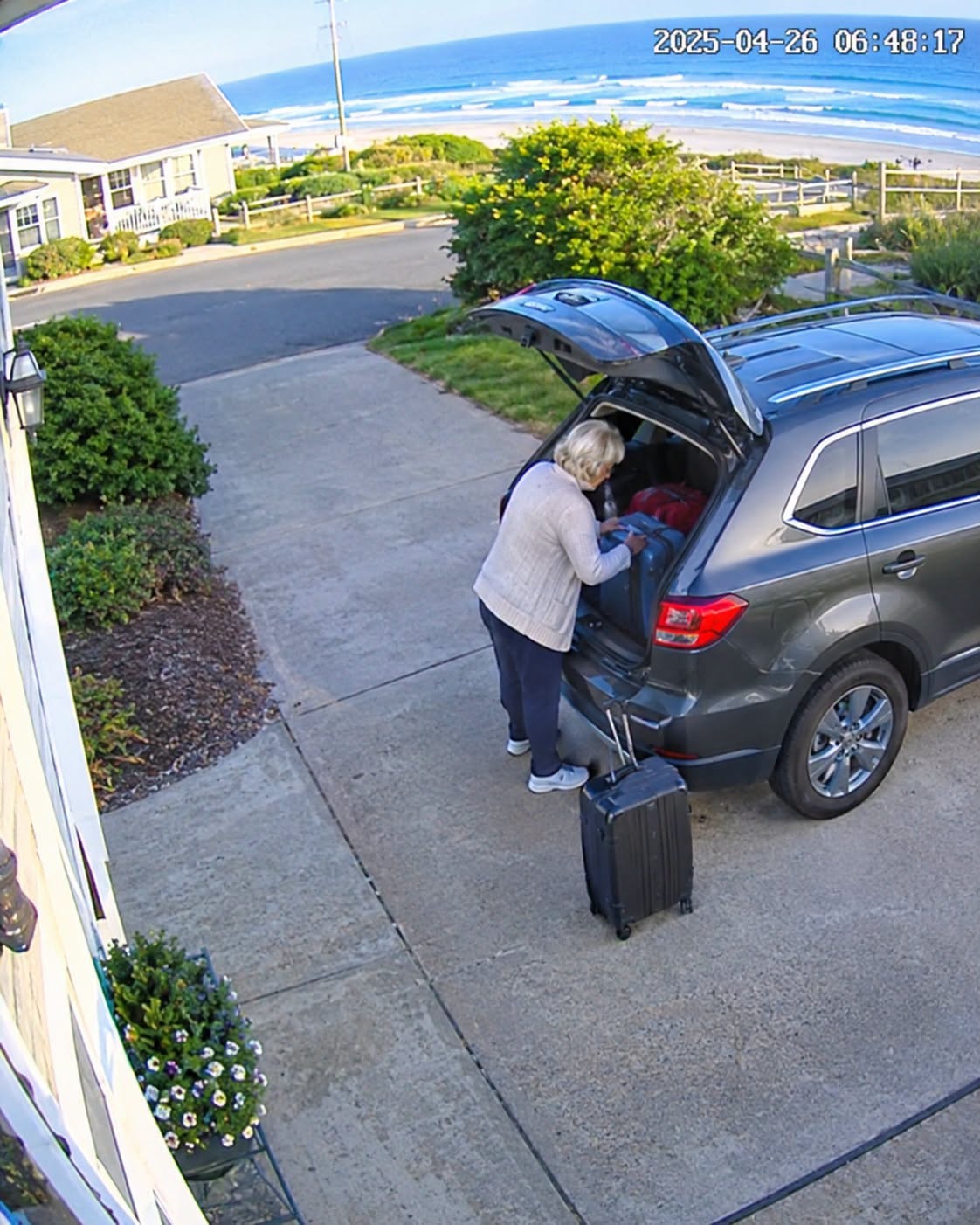
A Week Before Christmas, I Overheard My Daughter Say: “Just Send All 8 Kids to Mom — We’ll Go on Vacation and Enjoy Ourselves.” On December 23, I Packed My Bags and Drove Straight to the Sea.
A week before Christmas, I heard something over the phone that left me sitting in silence for several minutes.
I hadn’t meant to listen to my daughter’s conversation. I was in the kitchen, preparing a cup of tea, when I heard her voice coming from the living room. She was speaking to someone, laughing as she discussed her plans for the upcoming holiday.
Then she said something that made my hands freeze.
“Just send all eight kids over to Mom. She can watch them while we’re gone. We’ll go on vacation and enjoy ourselves for once.”
At first, I thought I had misunderstood her.
All eight children.
My grandchildren.
And me, apparently, had already been assigned the responsibility of looking after them for the Christmas holiday. No one had asked whether I was available. No one had wondered whether I wanted to spend Christmas caring for eight energetic children. The decision had simply been made on my behalf.
I stood in the kitchen, holding my cup, trying to process what I had heard.
I loved my grandchildren more than words could express. I had spent countless afternoons helping with homework, preparing meals, buying birthday presents, and stepping in whenever my daughter needed an extra pair of hands.
I had never regretted helping them.
But somewhere along the way, helping had quietly become an expectation.
And that afternoon, I realized that my daughter no longer seemed to see my time as something that belonged to me.
She saw it as something she could arrange.
The Grandmother Who Was Always Available
My name is Margaret, and I was sixty-seven years old when this happened.
For most of my adult life, my family had been the center of everything I did. After my husband passed away several years earlier, my daughter, Emily, became even more important to me.
I wanted to be there for her.
When her first child was born, I took time off to help her settle into motherhood. When the second arrived, I cooked meals and helped with the older child. As the family grew, so did the number of times I was asked to babysit.
Eventually, Emily had four children of her own, and her husband, Daniel, had four children from his previous marriage. Between them, there were eight children who regularly needed attention, transportation, meals, and supervision.
I loved every one of them.
But looking after eight children was no small responsibility, especially at my age.
There were school schedules to remember, different food preferences to accommodate, arguments to settle, and endless questions to answer. Even a few hours could leave me exhausted.
Still, whenever Emily called and said, “Mom, I really need your help,” I usually agreed.
I told myself that families helped one another.
I told myself that my daughter was busy and that being a grandmother meant making sacrifices.
What I failed to notice was that my sacrifices had become invisible.
Thank you had turned into an assumption.
And my willingness to help had slowly been mistaken for an obligation.
The Conversation That Changed Everything
After hearing Emily’s words, I quietly walked into the living room.
She was still on the phone.
“We’ll leave early on the twenty-third,” she said. “That way, we can get a full vacation. Mom won’t mind. She’s always happy to have the kids.”
I stood just outside the doorway.
She wasn’t asking me.
She wasn’t even discussing the possibility with me.
She had already decided.
For a moment, I wanted to walk into the room and ask her what gave her the right to make plans with my time without speaking to me first.
Instead, I returned to the kitchen.
I sat down at the table and looked out the window at the small garden my husband and I had planted decades earlier.
I remembered the Christmases when our own children were young. My husband would bring home a tree, and we would decorate it together. The house would smell of cinnamon, roasted vegetables, and freshly baked cookies.
Those memories were precious to me.
I had imagined spending this Christmas quietly. I wanted to visit the cemetery where my husband was buried, cook a few of his favorite dishes, read the book I had left unfinished, and perhaps take a short trip somewhere peaceful.
I had been looking forward to it for months.
But apparently, my plans did not matter.
That evening, Emily called me.
“Mom, just so you know, the kids will be coming over on the twenty-third,” she said. “Daniel and I have booked a trip.”
I took a breath.
“How long will you be gone?”
“Probably a week. Maybe a little longer, depending on the flights.”
“And you’ve arranged for me to look after all eight children?”
There was a brief silence.
“Well, yes,” she replied. “You love having them around.”
I looked at the calendar on the wall.
“Emily, did you ever think to ask me?”
She sighed as though I were making the situation unnecessarily difficult.
“Mom, please don’t start. It’s Christmas. We thought you’d want to spend time with your grandchildren.”
That sentence hurt more than I expected.
Because it was true that I wanted to spend time with them.
But loving my grandchildren did not mean I had agreed to become their full-time caregiver whenever their parents wanted a holiday.
“I’ll think about it,” I said.
Emily seemed surprised.
“There’s nothing to think about, Mom. We’ve already booked everything.”
Then she ended the conversation.
I sat there for a long time, listening to the quiet of my house.
For the first time in years, I wondered what would happen if I stopped saying yes.
A Decision Made in the Middle of the Night
I barely slept that night.
Every time I closed my eyes, I heard my daughter’s voice repeating the same words.
“Mom won’t mind.”
She had said it with such certainty.
Not because she had spoken to me.
Not because she knew what I wanted.
But because I had spent years teaching her that I would always make room for everyone else.
At three in the morning, I got out of bed and walked into the spare room.
The room was filled with toys, children’s books, extra blankets, and little things I had collected for my grandchildren over the years. I had made it comfortable because they often stayed overnight.
I looked around and realized that even my home had gradually been organized around everyone else’s needs.
There was nothing wrong with loving my family.
There was something wrong with believing that love required me to disappear from my own life.
I returned to my bedroom and opened the drawer where I kept my travel documents.
I hadn’t taken a proper holiday since my husband died.
There had always been a reason to postpone it. Someone needed help. Someone had a problem. Someone needed money, a meal, a ride, or a babysitter.
I had always told myself I would travel another time.
But another time never came.
That night, I made a decision.
I was not going to spend Christmas being punished for having a life of my own.
I was going to the sea.
December 23: The Morning Everything Changed
On the morning of December 23, I woke before sunrise.
The house was quiet, and the air outside was cold enough to make the windows fog.
I made coffee, ate a piece of toast, and began packing.
I chose comfortable clothes, a warm coat, my toiletries, a few books, and the photograph of my husband that I kept beside my bed.
I placed everything carefully into a small suitcase.
Then I went through the house one last time.
I checked the heating, locked the back door, and watered the plants that needed attention.
Before leaving, I stood in the hallway and looked at the Christmas decorations I had put up earlier that month.
For a moment, guilt crept into my heart.
I imagined the children arriving with their bags and excited voices. I imagined Emily calling me, expecting everything to be ready.
Then I remembered that she had made those arrangements without asking me.
I picked up my keys.
At 8:15 a.m., I placed my suitcase in the trunk, got into the car, and drove away.
I did not head toward my daughter’s house.
I did not drive to the grocery store to buy enough food for eight children.
I did not prepare beds or plan meals.
I drove straight toward the sea.
The farther I traveled, the lighter I began to feel.
The familiar streets disappeared behind me. The traffic grew thinner, and the winter landscape opened into long stretches of road.
I turned off my phone’s notifications and kept driving.
For the first time in years, I wasn’t going somewhere because someone needed me.
I was going somewhere because I wanted to.
The First Sight of the Sea
By early afternoon, I reached the coast.
The sky was pale gray, and the sea stretched toward the horizon like a vast sheet of silver. The wind carried the smell of salt, and the waves rolled against the shore with a steady rhythm.
I parked near the water and stepped outside.
The cold air touched my face.
I stood there for several minutes without moving.
Then, unexpectedly, I began to cry.
Not because I regretted leaving.
But because I realized how long it had been since I had done something simply for myself.
I cried for the years I had spent putting my own wishes last. I cried for my husband, who had always encouraged me to enjoy life rather than spend every moment worrying about everyone else.
And I cried because I finally understood that I could love my family without agreeing to every demand they made.
That afternoon, I found a small hotel overlooking the water.
The receptionist greeted me with a smile and helped me arrange a room for several nights.
When she asked whether I was traveling with anyone, I paused.
“No,” I replied. “Just me.”
She smiled again.
“Then I hope you enjoy some peace and quiet.”
I almost laughed.
Peace and quiet.
It sounded like the greatest luxury in the world.
The Phone Calls I Didn’t Answer
My phone began ringing shortly after four o’clock.
First, it was Emily.
Then Daniel.
Then Emily again.
I watched the screen light up while I sat near the hotel window, holding a cup of tea.
I knew what was happening.
They had arrived at my house, or they were preparing to drop off the children, and they had discovered that I was not there.
For years, I had answered every call almost immediately.
If Emily needed something, I responded.
If Daniel had a question, I answered.
If one of the children wanted to talk, I stopped whatever I was doing and listened.
But that afternoon, I allowed the phone to ring.
Eventually, a message appeared.
“Mom, where are you? We are trying to reach you. The kids are supposed to come over today.”
I read it twice.
Not once had she asked whether I was okay.
Not once had she asked whether something had happened.
Her first concern was that the arrangement she had made without my permission was no longer working.
I put the phone on the table.
For a long time, I simply watched the waves.
Then I turned the phone off.
I knew that difficult conversations were waiting for me. I knew my daughter might be angry, and I knew I would have to explain my decision.
But I also knew that I did not have to solve every problem the moment someone else decided it was urgent.
That evening, I ate dinner alone in a small restaurant overlooking the sea.
I ordered fish, vegetables, and a glass of sparkling water.
There were families at nearby tables, couples sharing meals, and travelers talking about their journeys.
I listened to the sound of their conversations and felt something I had almost forgotten.
I felt free.
What My Daughter Didn’t Understand
The next morning, I switched my phone back on.
There were several missed calls and a long message from Emily.
She was upset.
She said I had embarrassed her, that she had relied on me, and that leaving without warning had created a difficult situation.
I read the message carefully.
Then I called her.
“Mom, where are you?” she asked immediately.
“At the sea.”
“What do you mean, at the sea?”
“I mean that I drove to the coast yesterday. I’m staying in a hotel.”
There was silence.
“You left? On Christmas week?”
“Yes.”
“But what about the children?”
“Emily, you arranged for me to look after eight children without asking me. I never agreed to that.”
She began explaining how expensive the vacation had been, how difficult it would be to change the plans, and how much she and Daniel needed a break.
I listened.
I understood that raising children was exhausting. I understood that parents sometimes needed time away from their responsibilities.
But I also needed her to understand something.
“I am your mother,” I said quietly. “I am not a childcare service that you can book whenever it suits you.”
She fell silent.
I continued.
“I love those children. I love spending time with them. But looking after eight children for an entire holiday is a serious responsibility. You cannot decide that I will do it without asking me.”
“But you’ve always helped us,” she replied.
“Yes, I have. Because I wanted to help. But helping you does not mean that I have given up the right to make decisions about my own life.”
For the first time in a long while, Emily had no immediate answer.
I told her I was safe, that I would be away for several days, and that she and Daniel needed to arrange appropriate childcare themselves.
Then I ended the call.
My hands were shaking, but I did not regret what I had said.
A Christmas I Will Never Forget
Over the next few days, I walked along the beach, read my book, and watched the changing colors of the sky.
I bought a small Christmas ornament from a local shop and placed it on the windowsill of my hotel room.
On Christmas Eve, I called a friend who had lost her husband the previous year. We talked for nearly an hour, sharing memories and wishing one another peace.
On Christmas morning, I woke to the sound of waves and sunlight slipping through the curtains.
I made myself a cup of coffee and sat beside the window.
There was no rush to prepare breakfast for eight children. No arguments over television. No shopping list waiting on the kitchen counter.
There was only quiet.
I thought about my husband and imagined what he would have said if he had seen me there.
He would probably have smiled and told me it was about time.
For years, I had believed that being a good mother meant being available whenever my daughter needed me.
Now I understood that being a good mother also meant teaching my children that other people’s time, energy, and boundaries deserved respect.
I could be generous without being taken for granted.
I could be loving without being available every hour of every day.
And I could be a grandmother who adored her grandchildren while still protecting her own health, independence, and happiness.
The Conversation That Needed to Happen
When I returned home several days later, Emily and Daniel asked to speak with me.
The conversation was uncomfortable.
Emily admitted that she had assumed I would agree because I had always helped in the past. Daniel acknowledged that they should have discussed their plans with me before making arrangements.
I explained that I had not driven to the sea because I wanted to hurt them or punish the children.
I had gone because I needed to make a decision for myself.
We discussed what would happen in the future. If they needed childcare, they would ask in advance, explain how long they needed help, and accept that I might say no.
I would spend time with my grandchildren because I loved them, not because someone had decided that my time belonged to them.
Our relationship did not become perfect overnight. There were still difficult moments, and learning to respect new boundaries took time.
But something important had changed.
For the first time, my daughter understood that my willingness to help was a gift, not an obligation.
And I had finally learned that saying no did not make me a bad mother.
It made me a person who understood her own worth.
The Lesson I Learned at Sixty-Seven
Looking back, I don’t remember that Christmas as the holiday when I abandoned my family.
I remember it as the Christmas when I stopped abandoning myself.
I still love my daughter. I still adore my grandchildren. I still want to be part of their lives and create beautiful memories with them.
But I no longer believe that love requires me to sacrifice every personal plan, every quiet afternoon, or every opportunity to enjoy the life I have left.
Family should be built on love, consideration, and mutual respect.
Helping one another is a beautiful thing when it is freely offered. It becomes painful when one person’s kindness is treated as an unlimited resource.
That December, I packed a small suitcase, put it in my car, and drove toward the sea.
I thought I was taking a short holiday.
In reality, I was taking back something I had slowly surrendered over many years: the right to decide how I wanted to spend my own time.
And if there is one thing I hope other parents and grandparents learn from my story, it is this:
You can love your family with your whole heart without giving them ownership of your life.
Sometimes, the most loving thing you can do for yourself—and for the people you care about—is to establish a boundary before resentment takes the place of love.
That Christmas, the sea gave me something I desperately needed.
It gave me room to breathe, time to think, and the courage to remember that my life still belonged to me.
And when I finally returned home, I was not a different woman.
I was simply a woman who had remembered her own worth.