Chapter: A Journey That Was Supposed to Be an Adventure
On the evening of April 15, 2014, the passenger ferry MV Sewol departed from Incheon, South Korea, heading toward the southern island of Jeju. For many passengers, the overnight journey was an ordinary part of travel. For hundreds of students from Danwon High School in Ansan, however, it was the beginning of a school trip they had been looking forward to.
Jeju Island is known for its dramatic coastline, volcanic landscapes, and popular tourist destinations. School trips to the island offer students an opportunity to learn outside the classroom, spend time with friends, and create memories away from their usual routines. The teenagers aboard the Sewol had every reason to expect a safe journey followed by several days of exploration.
The ferry carried 476 people, including 325 students and accompanying teachers, as well as other passengers and crew members. Parents had entrusted their children to the adults organizing and operating the trip. The journey depended on a basic expectation shared by every passenger: that the vessel and the people responsible for it would get them to their destination safely.
The following morning, that expectation was shattered.
At approximately 8:48 a.m. on April 16, the Sewol made a sharp turn and began listing heavily. A ship listing means that it leans to one side rather than remaining upright. At first, passengers may not have understood how serious the situation was. Objects began moving, floors tilted, and the ship’s normal surroundings became increasingly unfamiliar.
An emergency call alerted authorities that the ferry was in danger. Other distress communications followed. The situation was deteriorating, and passengers needed clear information about what to do.
Many students were in cabins or interior areas of the vessel. They were young people on an organized trip, accustomed to following instructions from adults. When the ship’s announcements told passengers to remain where they were, many obeyed, trusting that the crew understood the danger and knew how to keep them safe.
That trust would become one of the most painful aspects of the tragedy.
As the vessel tilted further, moving through corridors and stairways became increasingly difficult. Furniture and other objects shifted, while water began entering parts of the ship. Passengers who had remained inside faced a growing risk of becoming trapped as the angle of the ferry changed.
Outside, rescue personnel began responding to the emergency. Coast Guard vessels, helicopters, and nearby boats became involved in efforts to save those aboard. Some passengers managed to reach the exterior of the ship or enter the water, where rescuers could reach them. Fishing boats and other civilian vessels also played a significant role in bringing survivors to safety.
Yet the rescue did not save everyone.
The ferry continued to capsize and eventually sank. Of the 476 people aboard, 172 survived and 304 died or were lost in the disaster. Most of those who died were students travelling on the school trip.
For families waiting on shore, the hours after the first reports were filled with uncertainty. Early announcements about the rescue were confusing, and information changed as authorities attempted to determine how many people had escaped. Parents and relatives searched for reliable updates, hoping that their children would be among the survivors.
The tragedy transformed an ordinary school outing into one of South Korea’s most devastating maritime disasters. The loss was not simply a statistic. It represented hundreds of individual lives, each connected to families, classmates, teachers, and communities.
The students had been preparing for a trip, not confronting a life-threatening emergency. Their families expected them to return with stories and photographs, perhaps tired from travelling but safe at home. Instead, parents faced an unimaginable loss and questions about how the disaster had happened.
The Sewol disaster became a national moment of grief. It also raised urgent questions about whether the ferry had been operated safely, why passengers were not evacuated effectively, and whether authorities had done everything possible to rescue those trapped inside.
Understanding the tragedy requires looking beyond the final moments when the ship disappeared beneath the water. It requires examining the decisions and safety failures that created the emergency, as well as the actions taken—or not taken—during the critical minutes when passengers still had a chance to escape.
The journey to Jeju was supposed to be a memorable experience for hundreds of students. Instead, it became a lasting reminder of how much responsibility rests with the people and institutions entrusted with passenger safety.
Chapter: Why the Ferry Capsized
The Sewol disaster was not simply an unpredictable accident at sea. Investigations identified a combination of problems involving the ship’s stability, cargo loading, steering, and the way the vessel was operated. These failures interacted, leaving the ferry unable to recover once it began leaning severely.
A passenger ship must be designed and loaded so that it can remain stable when it turns or encounters changing conditions. Stability depends on the vessel’s shape, the distribution of its weight, the amount of cargo it carries, and the position of that cargo. Ballast water—water deliberately carried in designated tanks—also plays an important role in helping a ship maintain the required stability.
The Sewol had been modified after being brought into service in South Korea. The alterations increased its upper structure and affected its stability. Investigators found that the vessel departed with substantially less ballast water than required while carrying excessive cargo. The cargo was also inadequately secured. These conditions reduced the ferry’s ability to remain upright when it made a sharp turn. To understand why these factors mattered, imagine a tall object balanced on a narrow base. If its weight is concentrated high above the base, even a relatively small movement can make it unstable. A ship works differently in detail, but the underlying principle is similar: the distribution of weight affects how readily the vessel can return to an upright position after leaning.
Adding weight high in a ship can raise its centre of gravity. Carrying too much cargo can place additional demands on its stability, while insufficient ballast may reduce its ability to recover from a significant tilt. If heavy vehicles or cargo containers are not properly secured, they can shift when the vessel turns, creating an additional imbalance.
Investigators concluded that the Sewol’s condition and loading made it vulnerable. During the voyage, a sharp turn caused the ship to lean heavily. Cargo shifted, further undermining its stability. Water entered the vessel, and the growing flooding made recovery increasingly difficult.
The disaster illustrates why loading procedures are a fundamental part of maritime safety. Cargo limits are not simply commercial guidelines. They are tied to the vessel’s ability to operate within safe conditions. Securing cargo is equally important because even a ship that initially remains stable can become dangerous if heavy loads move unexpectedly.
Modifications to a passenger vessel must also be carefully assessed. Increasing space or carrying capacity may appear commercially attractive, but changes to a ship’s structure can alter how it behaves in the water. Technical approval and inspection are intended to ensure that modifications do not compromise safety.
The Sewol investigation also examined the responsibilities of the ferry operator and crew. A vessel’s safety depends on multiple layers of protection: proper design, maintenance, loading, navigation, training, and oversight. When several safeguards fail together, the resulting danger can be far greater than any single problem might suggest.
This is why major maritime investigations consider both immediate causes and underlying conditions. Investigators examine the ship’s records, loading arrangements, navigation data, communications, and operational decisions. The purpose is to establish how the accident unfolded and identify measures that could prevent similar incidents.
The official investigation found that the ferry had lost its ability to recover from the severe tilt and eventually capsized. Authorities recommended improvements intended to reduce the chance of similar failures. The findings reinforced a basic principle: passenger safety must not be compromised by attempts to carry more cargo, reduce operating costs, or overlook technical requirements.
The technical details may seem distant from the personal tragedy experienced by the passengers, but they are central to understanding what happened. A ship’s stability is not an abstract engineering concept. It is one of the safeguards that allows passengers to trust a vessel with their lives.
The disaster also shows that safe transportation depends on institutions enforcing rules consistently. Regulations have little value if operators can ignore them, inspections fail to identify serious problems, or warnings do not lead to corrective action. Effective oversight must work before a voyage begins, not only after a tragedy has occurred.
The Sewol was carrying students, teachers, and other passengers who had no reason to expect that a routine journey would become so dangerous. They relied on the vessel being properly maintained and loaded, and on the people responsible for it making safe decisions.
Those responsibilities were not optional. The disaster demonstrated the consequences when basic maritime safeguards fail and the urgent need to make safety standards effective in everyday operations.
Chapter: The Rescue Effort and the Decisions That Cost Lives
When a passenger vessel begins to sink, the first minutes are critical. Passengers need accurate information, crew members must respond decisively, and rescue agencies must coordinate their efforts quickly. The Sewol disaster exposed serious failures in the way the emergency was managed, with devastating consequences for those still inside the ferry.
As the vessel began listing, passengers received instructions to remain where they were. In some emergencies, remaining in a designated area may be appropriate. But such instructions must be continually reassessed as conditions change. When a ship is tilting rapidly and the risk of flooding is increasing, an effective evacuation plan must be communicated clearly and promptly.
Many of the students aboard the Sewol were teenagers travelling under adult supervision. They had reason to believe that the crew and teachers understood the situation. Following instructions may have seemed safer than trying to navigate an unfamiliar ship on their own.
However, the ferry’s condition worsened, and the opportunity to leave safely became more limited. As the ship tilted, moving through interior corridors and stairways became increasingly difficult. Passengers who remained inside faced the danger of becoming trapped as water entered the vessel.
Rescue teams reached the area, and some passengers were saved by Coast Guard personnel, helicopters, and civilian boats. But the operation failed to rescue hundreds of people who remained aboard. The response was later criticized for delays, poor coordination, and the failure to ensure that passengers received timely and effective evacuation instructions.
One of the most controversial aspects of the disaster was the conduct of the captain and crew. The captain and some crew members left the vessel and were rescued while many passengers remained inside. The captain’s actions became the subject of criminal proceedings, and he was ultimately sentenced to life imprisonment for his role in the disaster.
The captain had a special responsibility to protect the passengers and coordinate the response. A ship’s master must make difficult decisions under pressure, but those decisions must prioritize the lives of people aboard. The failure to issue an effective evacuation order in time became a central issue in the legal and public response to the sinking.
The actions of emergency authorities also came under scrutiny. Investigators examined how distress calls were handled, how information was shared between agencies, and why rescue resources did not save more passengers. The disaster revealed that sending rescue vessels to the scene is not enough by itself. Responders must also be able to identify where people are trapped, communicate with the ship, and make effective decisions under severe time pressure.
A rescue operation requires clear command responsibilities. Teams must know who is directing the response, what information is available, and which actions are most likely to save lives. When information is incomplete or authority is unclear, delays can occur at precisely the moment when time matters most.
The Sewol disaster also demonstrated the importance of emergency drills. Crew members need to know how to respond if a vessel loses stability, begins taking on water, or becomes impossible to navigate safely. Passengers need understandable safety information so that they know how to respond when an emergency order is given.
Training must prepare people for circumstances that are more difficult than routine operations. A safety plan should consider what happens when a vessel tilts so severely that ordinary routes become unusable. It should also establish how evacuation instructions will reach people in cabins and other interior spaces.
Communication is particularly important during an emergency. Passengers need instructions that are direct, consistent, and updated as the situation develops. If people are told to remain in place, they need to know when that advice no longer applies. Conflicting or outdated information can undermine trust and delay action.
The Sewol tragedy showed that responsibility for passenger safety extends beyond the ship itself. Ferry operators must train crews and maintain emergency procedures. Regulators must ensure that operators meet safety requirements. Rescue agencies must be equipped and prepared to respond. Each part of the system must function effectively for passengers to have the best possible chance of survival.
For the families waiting on shore, the unfolding emergency was agonizing. Information was uncertain, official updates changed, and parents struggled to discover whether their children were safe. As the number of confirmed deaths increased, grief was joined by anger and demands for answers.
The failure to rescue more passengers remains one of the defining features of the Sewol disaster. Remembering what happened requires examining the mistakes made during the emergency and ensuring that future crews and rescue agencies learn from them.
A disaster investigation is most valuable when it leads to practical improvements. The lessons must influence training, communication, command procedures, and the way emergency decisions are made. Otherwise, the same weaknesses may remain hidden until another crisis exposes them.
The recovered Sewol ferry during the salvage operation in 2017, nearly three years after the sinking.
Chapter: The Families’ Grief and the Demand for Answers
The sinking of the Sewol ferry did not end when the vessel disappeared beneath the sea. For the families of the victims, the tragedy continued through uncertainty, searches for missing passengers, funerals, investigations, and years of efforts to understand how so many lives could have been lost in a disaster that might have been less devastating.
For parents of the students aboard the ferry, the morning of April 16, 2014, began with the expectation that their children were travelling toward a school trip destination. Many had said goodbye believing that their sons and daughters would return with photographs, stories, and memories of time spent with friends. Instead, they were confronted with reports of a sinking vessel and an increasingly desperate rescue operation.
The first hours were marked by confusion. Information about the number of people rescued changed as authorities attempted to establish who had escaped and who remained missing. Families gathered at locations where they hoped to receive updates, watching television reports and waiting for information from officials. Each new announcement carried the possibility of relief or heartbreak.
As the scale of the loss became clear, grief spread across South Korea. The victims included 250 students, alongside teachers, other passengers, and crew members. Each person represented a family and a network of relationships. The loss affected classmates, neighbourhoods, school communities, and people who had never met the victims but were deeply moved by the circumstances of their deaths.
The tragedy also prompted widespread anger. Many people wanted to know why the ferry had been allowed to sail in an unsafe condition, why passengers had not been evacuated effectively, and whether the authorities had responded quickly enough. These questions went beyond the immediate actions of individuals. They raised concerns about the systems designed to protect passengers and the institutions responsible for enforcing safety standards.
Investigations examined the ferry’s modifications, cargo loading, operational practices, and the actions of the crew. Prosecutors pursued criminal cases, while public inquiries and later investigations examined the rescue operation and broader questions of accountability. The captain’s life sentence became one of the most prominent legal outcomes, but many families believed that responsibility extended beyond the person in command of the vessel.
That concern reflected a broader principle: major disasters rarely involve only one decision. Companies, regulators, inspectors, and emergency agencies all have responsibilities. A ferry operator must maintain the vessel and follow loading requirements. Inspectors must identify dangerous conditions. Crew members must understand how to respond to emergencies. Rescue agencies must be prepared to coordinate quickly when a vessel is in danger.
When these responsibilities are not fulfilled, families are left to live with consequences that cannot be reversed. Holding individuals accountable may be necessary, but it does not automatically guarantee that the wider system has improved.
For many relatives, remembrance became inseparable from the pursuit of answers. Public memorials, ceremonies, flowers, and yellow ribbons helped preserve the memory of the victims. These symbols were not merely expressions of sadness. They were reminders that the people who died should not be reduced to a number and that the circumstances of their deaths deserved sustained attention.
The school community also faced an immense challenge. Students who survived the disaster returned to a world in which friends and classmates were missing. Teachers and families had to confront grief while attempting to restore ordinary routines. For young people, the loss of peers can alter the way they remember school, friendship, and the transition into adulthood.
The tragedy also had wider political consequences. Public anger focused on the government’s response, the operation of the ferry industry, and the broader question of whether public institutions were adequately prepared to protect citizens. The Sewol disaster became a major issue in South Korean public life and contributed to wider debates about leadership, transparency, and accountability.
Yet the passage of time has not made the loss less important. Families continue to remember the people they lost, while anniversary ceremonies offer opportunities for the wider public to reflect on what happened. For those directly affected, remembrance is not confined to a single day. It can be part of birthdays, family gatherings, school anniversaries, and the many moments when a loved one should have been present.
The demand for answers is also a demand for prevention. Families have a legitimate interest in knowing whether the failures that contributed to a disaster have been corrected. Transparency allows the public to assess whether recommendations have been implemented and whether the institutions responsible for safety are meeting their obligations.
The Sewol tragedy remains painful because so many victims were young people on a journey organized around education and friendship. It also remains important because the questions it raised apply to passenger transportation everywhere. People should be able to trust that safety rules will be enforced and that emergency plans will be used effectively when danger arises.
Remembering the victims means more than expressing sorrow. It means acknowledging the failures that contributed to the tragedy, respecting the families who continue to mourn, and ensuring that the search for accountability leads to meaningful improvements.
Chapter: The Lessons the World Must Never Forget
More than a decade after the Sewol ferry sank, its legacy remains a warning about the consequences of neglecting basic safety responsibilities. The disaster demonstrated how weaknesses in vessel stability, cargo handling, emergency communication, and rescue coordination can combine to create a catastrophe. It also showed that the consequences of such failures extend far beyond the people aboard a ship.
Passenger ferries remain essential in many parts of the world. They connect islands with mainland communities, carry people to work and school, transport vehicles and goods, and support tourism. For many passengers, travelling by ferry is a routine necessity rather than a special event. They depend on operators and authorities to ensure that a vessel is safe before it leaves port.
The first lesson from the Sewol disaster is that technical safety requirements must be treated as essential protections. Vessel modifications should be carefully assessed, cargo must remain within approved limits, and heavy loads must be secured properly. Ballast and stability requirements must be followed even when doing so limits the amount of cargo that can be carried.
These measures may appear costly or inconvenient, but the cost of ignoring them can be catastrophic. Commercial pressure should never take priority over the safety of passengers and crew.
The second lesson concerns emergency training. Crew members must be prepared to recognize a developing crisis and respond decisively. Procedures should make clear who can order an evacuation, how passengers will be informed, and what must happen if the vessel begins to tilt or flood. Drills should reflect realistic emergencies rather than simply repeat routine instructions.
Passengers also need clear information. They should know where safety equipment is located, how to identify emergency exits, and how to respond to announcements. However, the responsibility for a safe evacuation cannot be shifted onto passengers, particularly when they are following instructions from trained crew members. The crew must provide timely and appropriate guidance based on the actual conditions aboard.
The third lesson is that rescue operations require effective coordination. Agencies must have clear responsibilities, reliable communication, and the ability to share information quickly. Nearby vessels, including commercial boats and fishing vessels, can become valuable resources during a maritime emergency. Their assistance should be integrated into an organized response that prioritizes the lives of those at risk.
The fourth lesson is that safety regulation must be independent and effective. Inspections should be thorough, and violations should lead to corrective action before a vessel carries passengers. A regulatory system cannot protect people if it simply assumes that operators are following the rules. It must have the resources and authority to identify dangerous practices and stop unsafe operations.
The fifth lesson concerns transparency after a disaster. Investigations should establish what happened, explain which safeguards failed, and recommend practical changes. Their findings should be made available to the public in a way that allows families and communities to understand the conclusions. Recommendations must then be implemented and reviewed rather than left as promises.
These lessons apply not only to South Korea but to every country that operates passenger vessels. The particular circumstances of the Sewol disaster were shaped by its ship, crew, cargo, and emergency response. Yet the broader risks—overloading, inadequate training, poor communication, and ineffective oversight—can arise wherever safety systems are not taken seriously.
The disaster also reminds us that public trust is built through action. People trust schools to organize safe trips, transport companies to operate responsibly, and authorities to respond effectively when something goes wrong. When that trust is broken, restoring it requires more than statements of sympathy. It requires visible improvements, honest accountability, and evidence that the lessons have been learned.
For families who lost children, no reform can restore the future that was taken from them. But stronger safety practices can help prevent other families from experiencing the same loss. This is one reason remembrance matters: it keeps attention focused on the people behind the statistics and on the responsibilities that remain after public attention moves elsewhere.
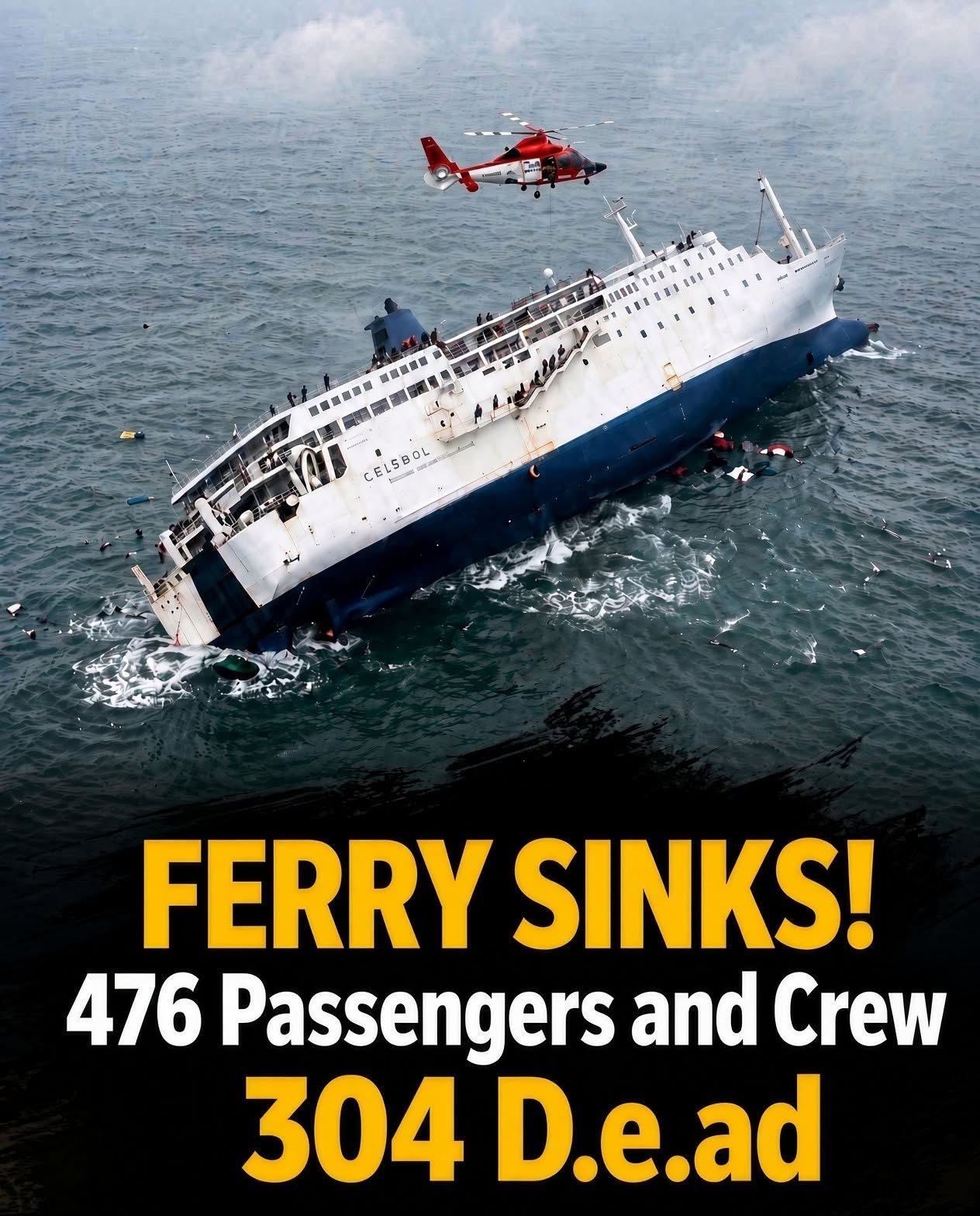
The supplied graphic uses dramatic language and an image of a sinking ferry, but the historical record is more important than the presentation. The disaster occurred on April 16, 2014, when the Sewol capsized and sank while travelling from Incheon to Jeju Island. Of the 476 people aboard, 304 died. Most of the victims were students on a school trip. These facts alone reveal the scale of the tragedy.
The image should not be presented as an authentic photograph of the Sewol because the name visible on the hull does not match the actual vessel. Historical images should be captioned accurately, and illustrative graphics should be identified as such. Accuracy is especially important when reporting a disaster involving real victims and grieving families.
Ultimately, the Sewol disaster was not only a maritime accident. It was a human tragedy that exposed the consequences of failures across a chain of responsibility. It forced South Korea to confront difficult questions about safety, leadership, emergency response, and public accountability.
The ferry was supposed to carry its passengers to a destination where a school trip would unfold as planned. Instead, hundreds of families received news that changed their lives forever.
The most meaningful way to remember those who died is to preserve the truth, respect their families, and insist that passenger safety never becomes secondary to convenience or commercial interests.
A journey should end with passengers arriving safely at their destination. The Sewol disaster reminds the world why every safeguard, every emergency instruction, and every decision made in the name of safety matters.