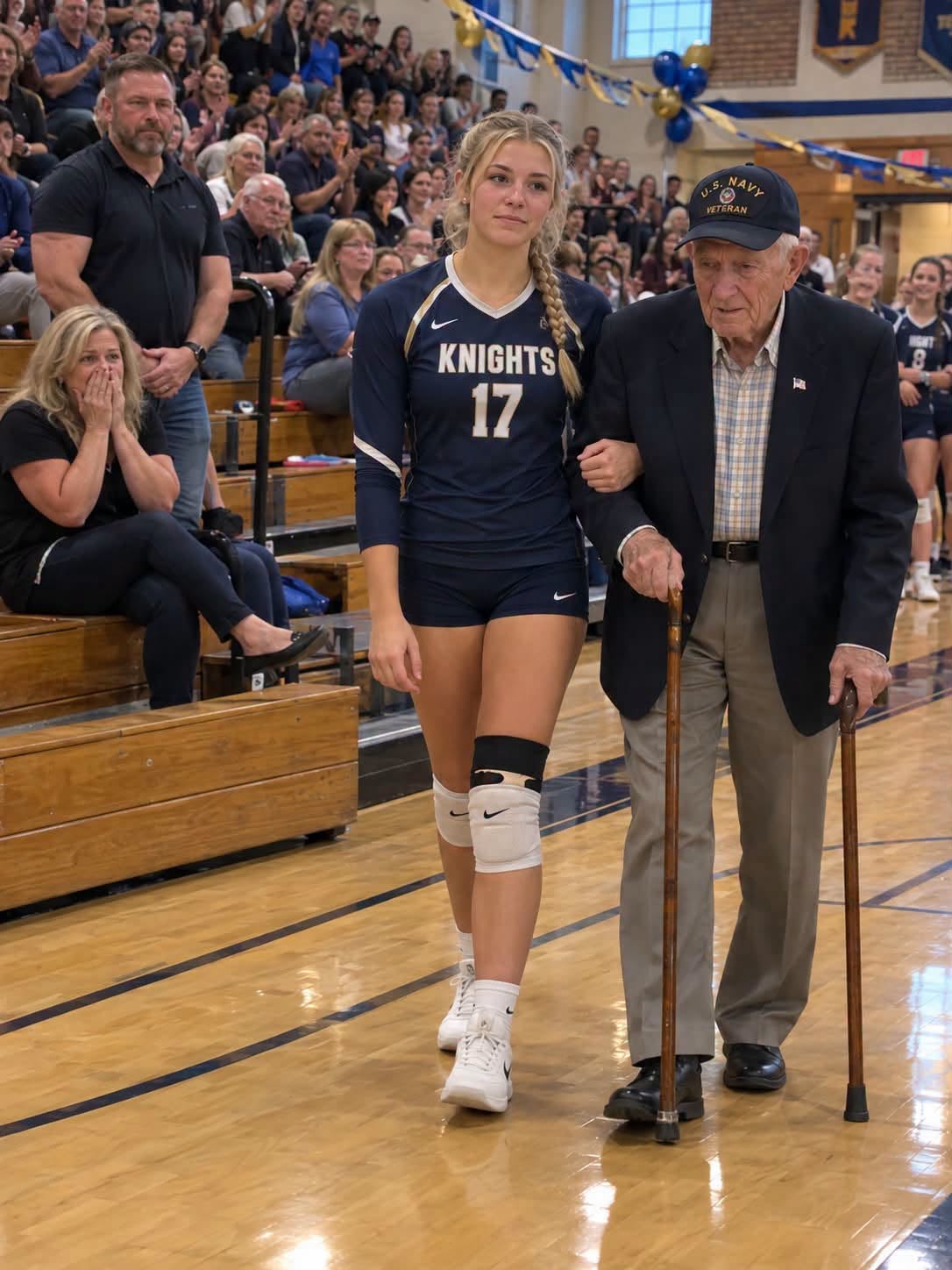
Her Stepfather Refused to Walk With Her on Senior Night—Until She Revealed What He Really Meant to Her
Kaylee’s stepfather shattered her senior night before she ever reached the field. When she asked Travis to walk beside her during the ceremony, he refused, insisting that the honor belonged to the biological father who had never shown up. At the dinner table, the silence that followed was almost unbearable. Kaylee stared down at her plate, her excitement fading as the man she had hoped would stand beside her seemed determined to push her away.
Her mother watched helplessly, caught between a husband who believed he was doing the right thing and a daughter whose simple request carried years of unspoken emotion. Travis had helped raise Kaylee, driven her to practices, taught her important life skills, and been present during moments when her biological father was nowhere to be found. Yet when the time came for one public gesture of love, he suddenly questioned whether he had the right to be there.
What happened next changed the entire evening. Kaylee finally explained why she had chosen Travis, and her words forced him to confront something he had failed to understand: she wasn’t asking him to replace her father. She was asking him to recognize the relationship they had built together.
A Dinner Table Filled With Unspoken Hurt
The conversation began like an ordinary family dinner, but the atmosphere changed when Kaylee brought up senior night.
She had been looking forward to the ceremony for weeks. It marked the end of an important chapter in her life, a moment when years of practices, schoolwork, friendships, and personal growth would finally be celebrated.
For Kaylee, the event meant more than walking onto a field in front of classmates and relatives. It was an opportunity to acknowledge the people who had helped her reach that moment.
And she wanted Travis beside her.
He had been part of her life for years, filling many of the everyday roles that make someone feel supported and loved. He had shown up for school activities, helped her learn to drive, and made time for her even when life was busy.
But when she asked him to accompany her during the ceremony, his response was not what she expected.
Travis insisted that walking with her should be the biological father’s responsibility.
The man who had been absent for so many important moments, he argued, was the person who deserved that honor.
Kaylee went quiet.
Her mother could see how deeply the words had hurt her. This was supposed to be a happy occasion, but suddenly Kaylee was being asked to defend a choice she had made out of love.
The hardest part was that Travis seemed unable to see the difference between replacing a father and honoring someone who had actually been there.
The Father Who Was Missing When It Mattered
Kaylee’s biological father had a place in her life, but his absence had left its own mark.
Children often grow up hoping that an absent parent will eventually become more involved. They may wait for phone calls, birthday visits, school events, or promises that never quite become reality.
Even when they learn to live with disappointment, the longing for that parent’s attention may remain.
For Kaylee, the contrast between her biological father and Travis had become part of her understanding of family.
Her father might have shared her history, but Travis had shared her everyday life.
He was there for the practical moments that rarely attract attention but matter deeply to a child: the rides, the conversations, the encouragement, and the quiet reassurance that someone would come when she needed help.
Yet Travis’s response suggested that he believed biology gave her absent father a claim that years of involvement could never equal.
Perhaps he was trying to respect a boundary. Perhaps he feared taking a place that did not belong to him. Whatever his reasoning, the effect was painful.
Kaylee was not asking him to erase anyone from her history.
She simply wanted to honor the person who had consistently been part of her present.
“I Didn’t Ask You to Take His Spot”
Kaylee looked down at her plate for a moment.
Her mother wanted to intervene, but before she could speak, Kaylee raised her head and found the courage to explain what she had been trying to say.
“I didn’t ask you to take his spot,” she told Travis. “I asked because you’re the one who’s been here.”
The words changed the atmosphere at the table.
Travis began to respond, but then he stopped.
For the first time that evening, he seemed to understand that Kaylee was not asking him to compete with her biological father. She was asking him to accept a place in her life that he had earned through years of showing up.
She reminded him of the driving lessons in the school parking lot, when he patiently helped her practice until she felt confident behind the wheel.
She remembered the early rides to practice, the mornings when getting out the door required effort, and the evenings when he made sure she reached home safely.
Then she mentioned a moment that carried even more emotional weight.
She remembered the night her biological father forgot her birthday.
Travis had waited outside her bedroom afterward, giving her space while making sure she knew she wasn’t alone.
He had not needed to make a grand speech or promise that everything would be fine. His presence had been enough.
Those were the memories Kaylee carried with her.
They were the reason she wanted him beside her on senior night.
“You don’t have to walk with me,” she added. “But don’t tell me I picked the wrong person.”
For Travis, those words made the truth difficult to ignore.
He had been so concerned about taking someone else’s place that he had failed to recognize the place Kaylee had already given him.
The Apology She Needed to Hear
Travis reached for Kaylee’s hand.
“You didn’t,” he told her. “I’m sorry.”
It was a simple apology, but it acknowledged something important.
Kaylee had not made her decision carelessly. She had chosen him because of the relationship they shared, not because she had forgotten her biological father.
For years, Travis had participated in the ordinary work of helping raise a child. He had invested time, patience, and care without necessarily knowing how she would describe their relationship when she grew older.
Now he was hearing the answer directly from her.
The moment also revealed how easily good intentions can cause harm when they are guided by assumptions rather than listening.
Perhaps Travis believed that refusing the invitation would demonstrate respect for Kaylee’s biological father. But Kaylee had already made her own decision about whom she wanted beside her.
By rejecting that choice, he had unintentionally made her feel that the love and gratitude she wanted to express were somehow misplaced.
His apology could not erase the hurt of the conversation, but it opened the door to something better.
He could stop worrying about whether he deserved the honor and begin understanding what the honor meant to her.
Thursday Evening Finally Arrived
When Thursday evening came, Travis stood beside Kaylee at the edge of the field.
He wore a shirt that he kept smoothing even though it did not need to be straightened. His nervousness showed in the small movements of his hands and the way he waited for her name to be announced.
Kaylee stood close beside him.
From the bleachers, her mother watched them together, remembering the tension of the dinner conversation and wondering whether the evening would feel different after their difficult exchange.
Then Kaylee’s name came over the speakers.
She hooked her arm through Travis’s.
For a moment, he glanced at her before they stepped forward.
This time, he did not hesitate.
He did not look around for permission or wonder whether someone else should be standing in his place. He simply walked beside the girl he had helped raise.
And Kaylee led him forward.
The ceremony may have looked ordinary to the other families in the stands. One student walked onto the field with a loved one, surrounded by classmates and relatives celebrating the end of a school chapter.
But for Kaylee and Travis, the walk represented something much deeper.
It was an acknowledgment of the years they had shared, the difficulties they had worked through, and the relationship they had chosen to build.
The moment did not erase the absence of Kaylee’s biological father. It did not resolve every complicated feeling connected to that relationship.
It simply allowed Kaylee to celebrate the person who had been there for her.
Family Is About More Than a Title
Stories like Kaylee’s reveal how complicated family relationships can become when biology, loyalty, and love seem to point in different directions.
A biological parent can remain important even when they have been absent. A stepparent can become deeply meaningful without trying to replace anyone. And a child can feel affection for both while recognizing that each relationship has its own history.
There is no single formula for navigating those feelings.
Stepparents may worry about overstepping boundaries, while biological parents may struggle with the consequences of missed opportunities. Children can find themselves caught between adults who interpret the same situation in very different ways.
The most important thing is to listen to the child rather than assume that adults already know what the child needs.
Kaylee knew why she wanted Travis beside her. She was old enough to express that choice, and she deserved to have it taken seriously.
Her request was not a rejection of her biological father. It was an expression of gratitude toward the person who had helped her grow.
Recognizing that distinction allowed Travis to see the invitation for what it truly was: a gesture of trust and love.
The Moments That Build a Parent’s Place in a Child’s Heart
It is easy to imagine that family bonds are defined by dramatic milestones, major sacrifices, or carefully planned celebrations.
But often, the strongest relationships are built through smaller moments.
They are formed when someone wakes up early to provide a ride, stays patient during a frustrating lesson, remembers an important date, or quietly waits outside a bedroom door because a child is hurting.
Those actions may seem insignificant at the time.
There may be no applause, no photographs, and no immediate expression of gratitude. The person offering support may not even realize that the moment will be remembered years later.
But children notice consistency.
They notice who follows through on promises, who listens when they are upset, and who remains present when circumstances become uncomfortable.
Travis’s place in Kaylee’s life had been built through those ordinary experiences.
Senior night simply gave her an opportunity to express what those years meant.
And when he finally accepted her invitation, he allowed the relationship they had built to speak for itself.
A Walk Neither of Them Would Forget
From the bleachers, Kaylee’s mother watched Travis and her daughter move forward together.
The tension of the dinner table had given way to something gentler. The hurt had been acknowledged, an apology had been offered, and the two of them had found a way to move forward.
Travis had initially believed that walking beside Kaylee might mean taking another man’s place.
Instead, he learned that he could honor the relationship he already had with her without erasing her past.
Kaylee, meanwhile, had found the courage to tell someone she loved exactly why he mattered to her.
That courage made the moment more meaningful than a simple ceremony.
There was no need for a grand declaration or a perfect family history. The important thing was that, when her name was called, the person she wanted beside her was there.
And he was finally willing to stand where she had asked him to stand.
The Lesson Behind Kaylee’s Senior Night
The most powerful part of this story is not that Travis eventually walked onto the field. It is that Kaylee made him understand why his presence mattered.
Love is not always about claiming a title. Sometimes it is about accepting the place another person has freely offered you.
A stepparent does not need to erase a biological parent to become important. A child does not have to deny one relationship to celebrate another. And a family does not have to fit a perfect picture to contain genuine love.
Travis had spent years helping raise Kaylee, but in that difficult conversation, she gave him something he may not have realized he already possessed: the knowledge that his efforts had mattered.
She remembered the rides, the lessons, the disappointments, and the quiet moments when he stayed close even when he could not fix what had hurt her.
Those memories were her answer.
When Kaylee hooked her arm through his and led him onto the field, she was not asking him to become someone else.
She was asking him to be the person he had already been.
Sometimes, the people who earn a place in our hearts are not the ones who share our beginnings, but the ones who keep showing up along the way.