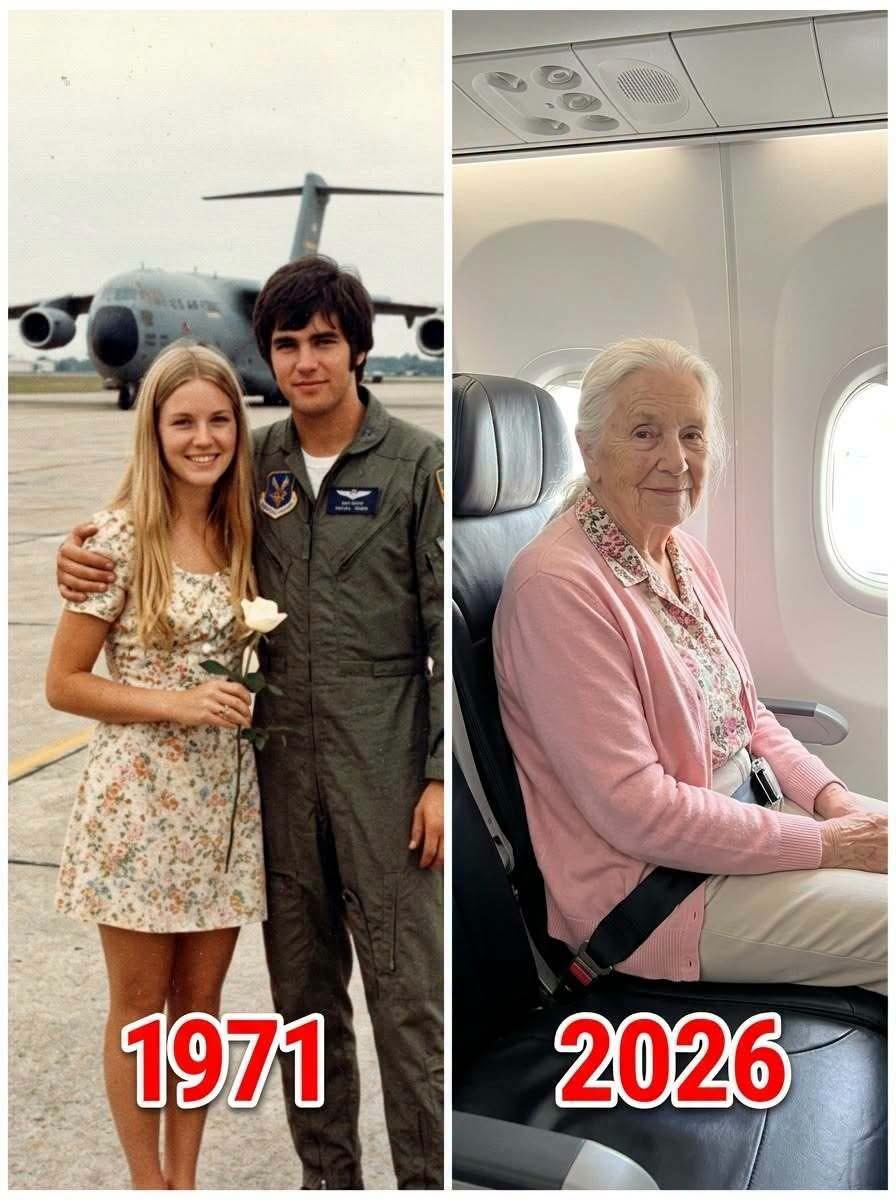
Her College Sweetheart Vanished in Vietnam 55 Years Ago — Decades Later, One Unexpected Discovery Changed Everything
For 55 years, she wondered whether the man she had loved as a young woman was still alive. He had left for Vietnam with a promise to return, a photograph tucked inside his wallet, and a future they had carefully planned together. Then he disappeared. No goodbye. No final letter. No explanation. Just silence that lasted more than half a century.
When Margaret Ellis first met Daniel Carter, she was 19 years old, a college student with big dreams and a habit of believing that love could overcome almost anything.
It was the autumn of 1968, and their university campus was filled with the restless energy of a generation living through uncertain times. Students debated the war, protested in the streets, and worried about friends and family members whose lives were being changed by events far beyond their control.
Margaret met Daniel in the university library.
He was sitting at a table near the window, surrounded by books he appeared to have forgotten to read. When she asked whether the empty chair beside him was taken, he looked up and smiled.
“Only by my terrible study habits,” he replied.
She laughed.
That simple conversation became the beginning of a love story neither of them could have imagined would remain unfinished for so long.
A Promise Made Before He Left
Daniel was 21, thoughtful, funny, and quietly ambitious. He wanted to become a teacher after finishing his studies. Margaret dreamed of becoming a writer.
They spent afternoons walking across campus, sharing inexpensive meals, and talking about the little house they hoped to buy someday.
They had almost nothing, but they believed they had time.
Then Daniel received orders connected to the Vietnam War.
The news changed everything.
Margaret remembered the evening he told her. They sat on a bench beneath an old oak tree, their hands intertwined, neither knowing what to say.
“I don’t want you to wait for me if it becomes too difficult,” Daniel told her.
She turned toward him.
“Don’t ask me to do something I haven’t agreed to do.”
He smiled sadly.
Before he left, Daniel gave her a small silver pendant. She gave him a photograph of herself wearing the blue dress he liked.
“Keep it somewhere safe,” she said.
“I’ll bring it home,” he promised.
On the morning of his departure, Margaret stood beside him at the station, trying not to cry.
Daniel kissed her forehead.
“Write to me,” he whispered.
“Every week.”
“And I’ll write back.”
She watched him disappear into the crowd, believing she would see him again in a few months.
She had no idea that it would be the last time she saw his face for 55 years.
The Letters That Suddenly Stopped
At first, the letters came regularly.
Daniel wrote about the heat, the long days, the unfamiliar surroundings, and the small things that reminded him of home. He asked about Margaret’s classes and teased her about the books she was reading.
His letters were never dramatic. They were filled with ordinary details, and that was what made them precious.
He wanted to know whether she had passed her examinations.
He wanted to know whether the university café still served terrible coffee.
He wanted to know whether she was keeping the pendant close.
Margaret kept every letter in a wooden box beneath her bed.
Then, in the spring of 1970, something changed.
The letters became less frequent.
She told herself that mail was delayed. She knew that communication during wartime could be difficult. She tried to remain patient.
Then a letter arrived that contained only three sentences.
Margaret,
Things have become complicated here. I cannot explain everything in a letter, but please remember that I have never forgotten you.
Daniel.
She read it dozens of times, searching for a hidden meaning.
Two weeks later, she wrote back.
No answer came.
She wrote again.
Still nothing.
Eventually, Margaret contacted the appropriate military offices, hoping to learn whether Daniel had been injured, transferred, or returned home.
The answers offered little comfort.
His status had not been clearly resolved in the information available to her. Different records provided incomplete details, and nobody could give her the explanation she needed.
Daniel had vanished from her life without a trace she could follow.
And the waiting began.
A Life Built Around an Unanswered Question
Margaret did not stop living.
She finished college, found work, and eventually became a teacher. Years passed, and the world changed around her.
Friends married. Children were born. Parents grew old.
She met a kind man named Robert, who understood that a part of her heart remained connected to a story she had never been able to finish.
They married and built a life together.
Margaret loved Robert, and she never pretended otherwise. Their marriage was filled with its own memories, struggles, and quiet happiness.
But she never threw away Daniel’s letters.
She kept them in the wooden box, along with his photograph and the silver pendant.
Sometimes, when Robert asked about the box, she explained what it contained.
He never demanded that she forget.
“Some questions don’t disappear just because life moves forward,” he once told her.
Years later, after Robert passed away, Margaret returned to the letters more often.
She was in her seventies by then.
Her hair had turned white, her hands had grown thinner, and the campus where she and Daniel had met had changed beyond recognition.
Yet whenever she read his handwriting, she could still hear his voice.
She wondered whether he had survived the war.
Whether he had returned to America.
Whether he had married someone else and raised a family.
Or whether he had spent his final days wondering what had happened to the girl who promised to write every week.
The hardest part was not knowing.
The Telephone Call at 7:15 on a Tuesday Morning
In 2025, Margaret’s granddaughter, Emily, discovered the wooden box while helping her grandmother organize an upstairs bedroom.
Emily was 28 and worked in archival research. She was fascinated by old photographs, handwritten correspondence, and the way personal records could reveal forgotten histories.
She sat on the floor and began reading the letters.
By the end of the afternoon, she understood why her grandmother had kept them for so long.
“Grandma,” Emily asked, “have you ever tried to find him again?”
Margaret shook her head.
“Where would I even begin? It’s been more than half a century.”
Emily looked at the photograph of Daniel.
“Maybe we could start here.”
Over the following weeks, Emily carefully examined the dates on the letters, the military references, and the few details Daniel had mentioned about his service.
She searched historical archives, public records, veterans’ resources, and reunion notices. She contacted organizations that helped families investigate unresolved military histories.
Most leads went nowhere.
Some records were incomplete. Others referred to people with similar names.
Emily refused to assume that a possible match was the right person.
Then, one morning, she found a digitized record connected to a veterans’ reunion organization.
The name was Daniel Carter.
The date of birth appeared to match.
So did the home state.
But the record contained an unfamiliar middle initial.
Emily contacted the organization and explained the situation. She provided the dates of the letters and asked whether anyone could help determine whether the record belonged to the same man.
Several days later, she received a response.
The man was alive.
He was 78 years old and living in Oregon.
Emily stared at the screen, hardly daring to breathe.
She printed the information and drove to her grandmother’s house.
Margaret was sitting beside the window when Emily arrived.
“Grandma,” she said softly, “I think I found him.”
Margaret looked up.
“Found who?”
Emily placed the photograph on the table.
“Daniel.”
For several seconds, Margaret did not move.
Then she covered her mouth with both hands and began to cry.
The Man Who Had Never Forgotten Her
Emily contacted Daniel through the veterans’ organization, explaining that she was the granddaughter of Margaret Ellis.
At first, there was no response.
Then, a week later, an email arrived.
It contained only a few lines.
I have wondered about Margaret for many years. If this is the same Margaret I knew at university, please tell her that I remember everything.
I never forgot the photograph.
Emily read the message to her grandmother.
Margaret asked her to read it again.
Then once more.
For 55 years, she had wondered whether Daniel remembered her.
Now she had her answer.
The two began exchanging letters and telephone calls. Their conversations were hesitant at first, filled with pauses and questions neither knew how to ask.
They talked about the university library.
The oak tree.
The terrible coffee.
The silver pendant.
Daniel remembered details Margaret thought he must have forgotten decades earlier.
He remembered the blue dress.
He remembered the station.
And he remembered the promise he had made to return.
But there was one question Margaret had carried for more than half a century.
“Why did you disappear?” she finally asked.
Daniel was quiet for a long time.
Then he began to explain.
The Truth Behind His Disappearance
Daniel told her that his final months in Vietnam had been far more complicated than his letters suggested.
After being separated from members of his unit during a period of intense fighting, he was evacuated for medical treatment. The injuries he sustained required an extended recovery, and his personal belongings were separated from him during the confusion.
His return home was delayed by medical complications and administrative problems.
During that period, the address he had for Margaret became outdated. He tried to contact her through the information he remembered, but his attempts did not lead to a reunion.
He had believed that Margaret would eventually hear that he was home.
She had believed that something terrible had happened to him.
Neither had understood how completely their lives had become disconnected.
Daniel admitted that there were parts of the story he could no longer reconstruct with certainty. After so many years, some details had faded, and not every record had survived.
But he remembered returning to civilian life feeling profoundly changed.
He had struggled to speak about his experiences. He had moved between jobs and states, eventually building a new life far from the university town where he had met Margaret.
He had never forgotten her.
He had simply never found a way back to her.
Margaret listened without interrupting.
When he finished, she wiped her eyes.
“I thought you had died,” she whispered.
Daniel’s voice broke.
“I thought you had moved on and forgotten me.”
They sat quietly, separated by a telephone line and 55 years of unanswered questions.
Finally, Margaret said the words she had wanted to say since the day he left.
“I’m glad you’re alive, Daniel.”
He began to cry.
“So am I, Margaret. So am I.”
The Reunion Nobody Expected
Several months later, Emily helped arrange a reunion.
Daniel traveled to Margaret’s town with his daughter, Susan, who had supported his decision to make the journey.
Margaret waited in her living room, wearing a simple blue cardigan.
On the table lay the wooden box, the old letters, and the photograph from 1969.
When the doorbell rang, she stood slowly.
Emily opened the door.
Daniel was thinner than the man in the photograph, his hair silver and his steps careful. He held a small paper bag in one hand.
For a moment, neither he nor Margaret spoke.
Then Daniel smiled.
“You still have the photograph.”
Margaret laughed through her tears.
“Of course I do. You promised to bring it home.”
He looked down at the photograph on the table.
“I suppose I took a little longer than I expected.”
She reached for his hand.
And just like that, two people who had spent decades wondering about each other were sitting together again.
They talked for hours.
They shared memories, compared the lives they had lived, and laughed about the small things they had once considered important.
There was sadness, too.
They spoke about the people they had loved, the families they had raised, and the years neither could recover.
Neither pretended they could return to the lives they might have shared.
They were no longer the young students who had made promises beneath an oak tree.
They were two elderly people who had finally been given the chance to understand what happened.
Before Daniel left, Margaret gave him the original photograph.
“I think you should have this,” she said.
He studied it for a long time.
Then he handed it back.
“No,” he replied gently. “You kept it safe all these years. I think it belongs with you.”
Some Stories Never Really End
Daniel and Margaret remained in contact after their reunion.
They spoke regularly, sharing memories and discussing the ordinary details of their days.
Their story did not erase the pain of the past. It did not undo the years of uncertainty or change the lives they had built separately.
But it brought something neither had expected to find so late in life.
An answer.
For Margaret, the greatest relief was discovering that Daniel had survived.
For Daniel, it was learning that the girl who had promised to write every week had never forgotten him.
And for Emily, it was seeing how a collection of old letters could reconnect two people separated by history, distance, and time.
The wooden box remains in Margaret’s home.
Inside are the letters, the photograph, and the silver pendant Daniel gave her before leaving for Vietnam.
They are no longer simply reminders of a lost love.
They are pieces of a story that finally makes sense.
Fifty-five years ago, Margaret watched her college sweetheart disappear into a crowd, believing their goodbye would only last a few months. She spent decades wondering whether she would ever learn what happened to him.
She never imagined that the answer would arrive through a telephone call, a granddaughter’s determination, and a message from a man who had carried the same unanswered question for years.
Their lives had taken different paths.
But after 55 years, one thing remained unchanged.
Neither had forgotten.
Sometimes, life does not give us the ending we once imagined. Sometimes, it gives us something quieter and just as precious: the truth, a final conversation, and the chance to say the words that time never allowed us to say.