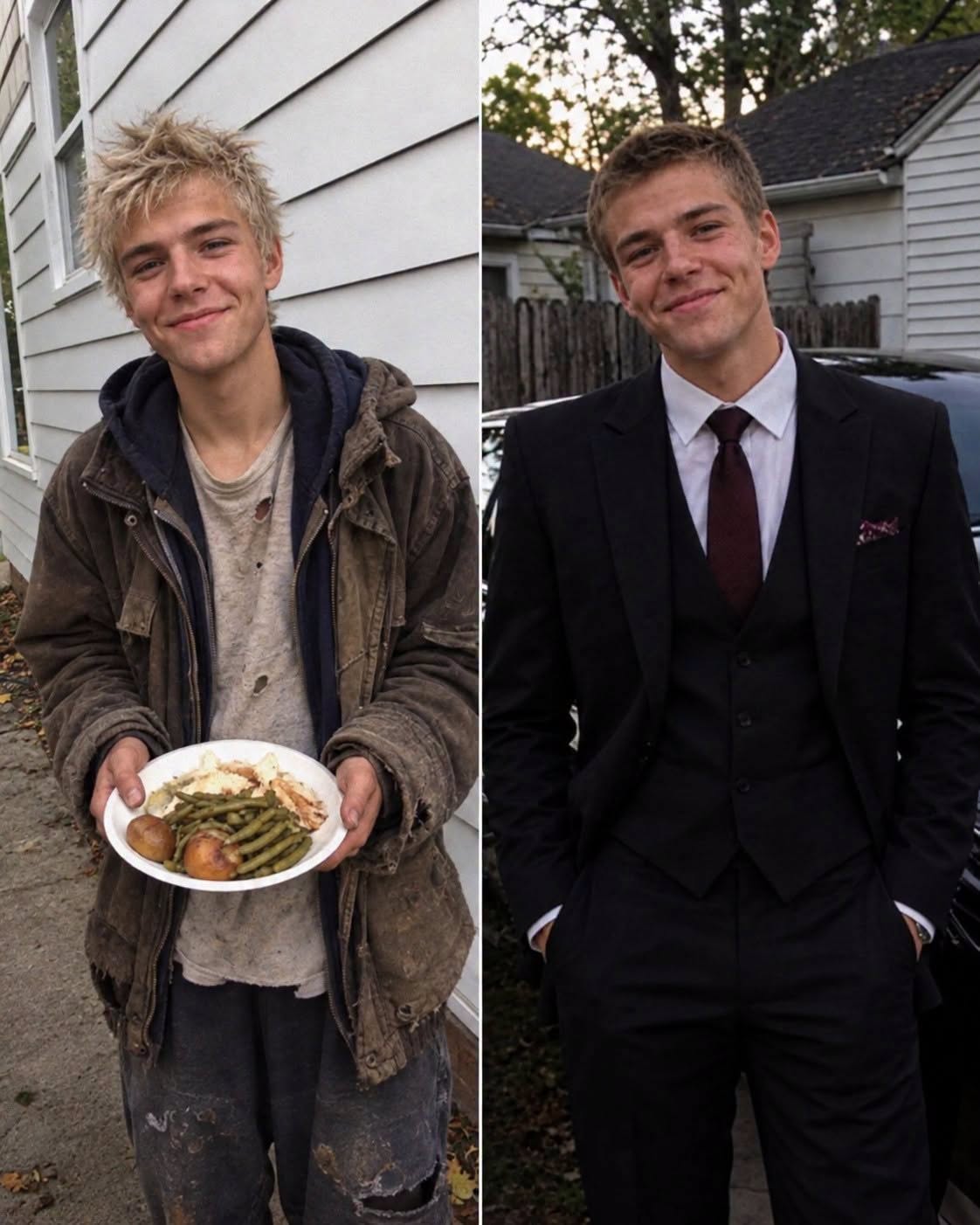
For 20 Years, My Mother Fed the Homeless Boy Behind Our House. After Her Funeral, He Took My Hands and Revealed Her Secret.
For twenty years, my mother made sure a homeless boy living behind our house never went hungry. After her funeral, he stood before me with tears in his eyes, took both my hands in his, and whispered words that would change everything I thought I knew about her.
“Before she died,” he said, his voice trembling, “she begged me to keep her secret from you.”
I stared at him, unable to speak.
My mother had been the most generous person I had ever known. She was the kind of woman who cooked extra food because she never knew who might need a meal. She kept blankets in the hallway closet for cold nights and gave away coats she could barely afford to replace.
But a secret?
Something she had hidden from me for twenty years?
I couldn’t imagine what it could be.
Then the young man reached into his jacket, pulled out a small, yellowed envelope, and said six words that made my knees feel weak.
“Your mother saved my life twice.”
And suddenly, the story I thought I knew began to fall apart.
The Boy Who Lived Behind Our House
I was twelve when I first noticed him.
He was sitting behind our garage, near an old wooden fence covered in ivy. He looked about fourteen, perhaps fifteen, although hunger and exhaustion made him seem older. His clothes were dirty, his shoes were falling apart, and he had a small backpack beside him.
I remember asking my mother who he was.
She looked through the kitchen window and saw him sitting there with his knees pulled against his chest.
“Someone who needs a little kindness,” she answered.
That afternoon, she prepared two sandwiches, poured soup into a thermos, and placed everything inside a paper bag.
“Take this to him,” she told me.
I hesitated.
“Shouldn’t we call someone?”
“We can do that if he needs help,” she replied gently. “But first, let’s make sure he’s eaten.”
I carried the bag outside.
The boy watched me approach with frightened eyes. For a moment, I thought he might run away.
Instead, he looked at the food and whispered, “Is this really for me?”
I nodded.
He took the bag with shaking hands.
“Tell your mom thank you,” he said.
That evening, I saw my mother standing at the kitchen sink, quietly watching the backyard.
She had a strange expression on her face.
It wasn’t pity.
It looked more like grief.
I didn’t understand it then.
I wouldn’t understand it for another twenty years.
A Promise My Mother Never Broke
The boy’s name was Daniel.
Over the months that followed, he continued appearing near the fence. Sometimes he came in the morning. Other times, he arrived after dark, when he thought nobody would notice him.
My mother always noticed.
She began leaving food outside in a covered container. On cold nights, she brought out an old blanket. When it rained, she allowed him to sit beneath the small covered porch behind the garage.
She never asked him to explain himself.
She never demanded that he tell her where his family was.
She simply made sure he ate.
Eventually, Daniel began speaking to her.
I would sometimes watch them from the kitchen window. My mother would sit on an overturned crate while Daniel ate, listening to him as though he were telling her the most important story in the world.
When I asked what they talked about, she always gave me the same answer.
“He’s had a difficult life, sweetheart. That’s all you need to know.”
I found that frustrating.
I wanted details. I wanted to know why he was living outside, where his parents were, and why nobody had come looking for him.
But my mother refused to tell me.
“Some stories aren’t ours to share,” she said.
I thought she was simply protecting his privacy.
I never imagined she was protecting something else.
Twenty Years Passed
Life moved forward, as it always does.
I grew up, left home for college, found a job, and eventually returned to our hometown. My mother grew older, her hair turned silver, and the house became quieter.
Yet one thing never changed.
Daniel still came around.
He was no longer the frightened boy hiding behind the garage. He had grown into a tall, quiet man who carried himself with a kind of careful dignity.
He found occasional work repairing fences, painting houses, and helping local businesses with deliveries. When he could afford it, he brought my mother small gifts: a bunch of flowers, a loaf of bread from a bakery, or a jar of honey someone had given him.
She always accepted them with a smile.
“You don’t have to bring me anything,” she would tell him.
“I know,” he would reply. “I want to.”
Their relationship remained a mystery to me.
Sometimes, when I came home unexpectedly, I would find them talking in the backyard. The moment they noticed me, their conversation would change.
Once, I asked my mother directly whether she knew Daniel before he first appeared behind our house.
She went very still.
Then she shook her head.
“No,” she said softly. “Not in the way you mean.”
At the time, I assumed she was simply being mysterious.
Now, I wish I had asked her what those words meant.
Because they were the closest she ever came to telling me the truth.
The Funeral
My mother died on a rainy Tuesday morning.
She had been ill for several months, and although we knew the day was approaching, nothing could have prepared me for the emptiness that followed.
The house felt different without her.
Her slippers remained beside the bed. Her favorite mug sat near the kitchen sink. A half-finished knitting project rested in a basket beside her chair.
I couldn’t bring myself to move anything.
At the funeral, neighbors came carrying flowers and sharing stories about her generosity. People spoke about meals she had delivered, children she had helped, and families she had supported without ever expecting recognition.
Daniel stood near the back.
He wore a simple black suit that appeared slightly too large for him. His hands were clasped in front of him, and his face looked pale.
He didn’t approach me during the service.
He didn’t approach me afterward.
I assumed he was grieving in his own way.
Three days later, as I stood outside my mother’s house sorting through sympathy cards, I heard footsteps behind me.
It was Daniel.
He looked as though he hadn’t slept.
“Can we talk?” he asked.
I nodded.
He looked toward the backyard, toward the old fence where I had first seen him twenty years earlier.
Then he took both my hands in his.
“Before she died,” he whispered, “your mother begged me to keep her secret from you.”
I felt the blood drain from my face.
“What secret?”
He swallowed hard.
Then he handed me the envelope.
The Letter She Left Behind
My name was written across the front in my mother’s unmistakable handwriting.
I opened it carefully.
Inside was a letter, folded twice, with a smaller photograph tucked between the pages.
The photograph showed my mother standing beside a young woman I had never seen before. The woman was holding a baby wrapped in a pale blue blanket.
On the back, my mother had written a date.
It was the year before Daniel first appeared behind our house.
I looked up at him.
“Who is this woman?”
Daniel took a shaky breath.
“Her name was Anna,” he said. “She was my mother.”
I looked back at the photograph.
“Why did my mother have a picture of her?”
He closed his eyes for a moment.
“Because your mother knew her long before I ever came to live behind your house.”
I began reading the letter.
My mother’s first sentence was simple.
My darling, there is something I should have told you years ago. I wanted to find the right moment, but every year that passed made it harder.
My hands started trembling.
She explained that, long before Daniel appeared behind our house, she had known a young woman named Anna who was struggling to care for her newborn son.
Anna had been alone, frightened, and without a stable home.
My mother had helped her find temporary accommodation and had brought her groceries when she could.
But the letter revealed that their connection was much deeper than a simple act of charity.
Anna had once been my mother’s closest friend.
And the baby in the photograph was Daniel.
The Truth About the Boy Behind Our House
According to my mother’s letter, Anna had disappeared from our lives after a devastating family crisis.
My mother had searched for her, contacted people who might know where she had gone, and tried repeatedly to reach her.
Years passed.
Then, one winter evening, Daniel appeared behind our garage.
He was frightened, hungry, and reluctant to explain where he had come from.
When my mother finally learned his identity, she recognized him from the photograph she had kept for years.
He was Anna’s son.
The child she had once promised to help protect.
My mother had wanted to tell me immediately, but Daniel had begged her not to reveal his history.
He was ashamed of what had happened to him. He feared being treated differently and worried that people would look at him with pity instead of respect.
My mother made him a promise.
She would give him food, warmth, and whatever practical assistance she could, but she would not share his story without his permission.
And she kept that promise for twenty years.
I lowered the letter.
“Why didn’t she tell me?” I asked.
Daniel looked at me with tears in his eyes.
“Because I asked her not to. And because she believed that one day I would be ready to tell you myself.”
I stared at the photograph again.
My mother hadn’t simply been feeding a hungry stranger.
She had been keeping a promise to someone she loved.
But there was still one question I couldn’t answer.
Why had Daniel been so afraid of anyone discovering who he was?
The Secret Beneath the Secret
Daniel sat beside me on the porch.
For several minutes, he said nothing.
Then he told me what had happened after his mother’s life began to unravel.
His childhood had been marked by instability. He had spent time moving between relatives and temporary homes. Eventually, he lost contact with the people who had once cared for him.
By the time he arrived behind our house, he had learned not to trust promises.
He didn’t want to be rescued.
He wanted to survive without becoming someone else’s burden.
My mother understood that fear.
Rather than force him to accept help, she gave him choices. She offered food without demanding explanations. She helped him look for work when he was ready. She kept his confidence when he needed someone to listen.
Over time, Daniel began rebuilding his life.
He found steady work, saved money, and eventually rented a small room. He still visited my mother because she had become the closest thing to family he had known in years.
Then he told me something that made me cry.
“Your mother never called me a homeless boy,” he said. “Not once.”
He looked down at his hands.
“She called me Daniel. Every single time.”
For twenty years, I had thought her kindness was about giving someone food.
Now I understood that it had also been about giving him something the world had repeatedly taken away.
His dignity.
The Final Page
I returned to the letter and noticed a final page folded behind the photograph.
My mother had written it separately.
There is one more thing I want you to understand.
I did not keep Daniel’s story from you because I thought you would judge him. I kept it because he had already lost so much, and I wanted him to have one place where he could exist without being defined by his past.
I hope you will understand that kindness does not give us ownership of another person’s story.
We can help someone without demanding to know everything that hurt them.
And sometimes, the greatest gift we can give is the freedom to tell the truth when they are ready.
I pressed the paper against my chest.
For years, I had wondered why my mother had never explained her relationship with Daniel.
I had thought she was keeping me outside some private circle.
Instead, she had been honoring a promise.
And she had trusted me enough to believe I would eventually understand.
What Happened After Her Funeral
Daniel and I spent the afternoon talking.
For the first time, he told me about the little things my mother had done over the years that I had never known about.
She had helped him prepare for job interviews. She had kept a list of local services that might assist him. When he was sick, she had brought him medicine and encouraged him to seek proper medical care.
She had never made him feel that he owed her anything.
“She gave me more than food,” Daniel said. “She gave me time to become someone who could stand on his own feet again.”
I looked toward the backyard.
The old fence was still there. The wooden crate where my mother used to sit had begun to rot, and the garden needed tending.
Yet the place no longer looked ordinary.
It was where my mother had quietly changed a life without asking anyone to notice.
Before Daniel left, I asked whether he would keep visiting.
He nodded.
“If that’s all right with you.”
I smiled through my tears.
“You don’t need permission to be remembered here.”
For the first time since the funeral, he smiled too.
It was a small smile, but it carried the weight of twenty years.
The Secret I Finally Understood
In the months after my mother’s death, I began to see her differently.
I remembered the extra meals, the blankets, and the way she always seemed to know when someone was struggling.
I had thought those things were simply part of her personality.
Now I understood that, behind some of her quietest acts of kindness, there had been stories I would never fully know.
Daniel still visits occasionally.
Sometimes we sit outside and talk about my mother. Other times, we talk about ordinary things: work, the weather, and the small changes happening in our neighborhood.
I never pressure him to reveal more than he wants to share.
My mother taught him that his story belonged to him.
And through her letter, she taught me the same lesson.
I keep the photograph in a frame beside her favorite chair.
It shows my mother holding a baby wrapped in a pale blue blanket, smiling at the camera as though she already knew how much the future would ask of her.
Whenever I look at it, I remember Daniel’s words.
“Your mother saved my life twice.”
The first time, she helped him survive when he had nowhere to turn.
The second time, she gave him the freedom to rebuild his life without being forced to explain his pain to the world.
For twenty years, I believed my mother was feeding a homeless boy behind our house. After her funeral, I discovered that she had been keeping a promise, protecting a wounded young man, and quietly teaching me one final lesson: sometimes, the most extraordinary love is the kind that asks for no recognition at all.