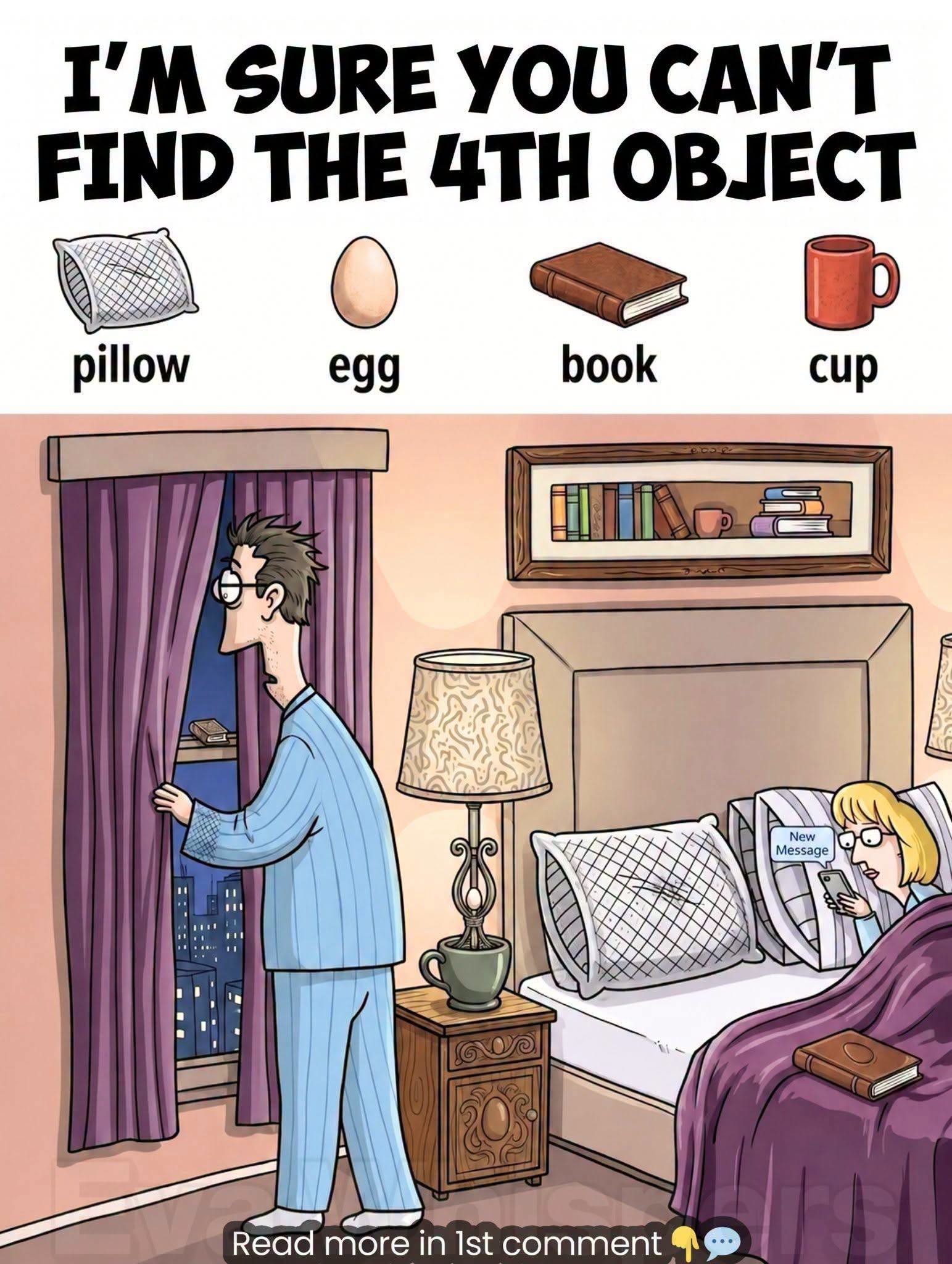
Can You Find the Hidden Fourth Object? This Brain Teaser Is Stumping the Internet
At first glance, it looks like a simple visual puzzle that anyone should be able to solve in just a few seconds. Four everyday objects are supposedly hidden within an image, and the challenge is to identify each one. Three objects may be easy to recognize, but the fourth seems to disappear into the background, leaving even the most observant viewers wondering whether they have missed something obvious.
The challenge sounds simple: look carefully, find the objects, and prove that you have a sharp eye. Yet, as more people encounter these kinds of brain teasers online, many discover that spotting the final object can be surprisingly difficult.
Some viewers scan every corner of the image repeatedly. Others zoom in, turn their phones sideways, or ask friends and family members to take a look. Despite their efforts, the mysterious fourth object remains elusive.
So, what makes this type of puzzle so challenging? Is the object cleverly concealed in plain sight, or is there another explanation?
A Simple Puzzle That Challenges the Brain
Hidden-object puzzles have been entertaining people for generations. From printed puzzle books to modern social media challenges, these visual games invite people to examine familiar scenes in unfamiliar ways.
The appeal lies in their simplicity. Unlike complicated mathematical problems or difficult trivia questions, a hidden-object challenge usually requires no special knowledge. Anyone can participate, regardless of age, education, or experience.
All you need is a picture and a willingness to look closely.
However, simplicity can be deceptive. The human brain does not process every detail of a visual scene equally. Instead, it organizes information, identifies familiar patterns, and directs attention toward what seems most important.
This ability is extremely useful in everyday life, allowing us to recognize faces, read signs, and navigate busy environments without consciously analyzing every detail. But it can also make us overlook things that do not immediately fit our expectations.
That is precisely what makes a well-designed visual puzzle so effective.
When you look at an image, your brain begins identifying shapes and objects almost instantly. If something resembles a familiar item, you may recognize it immediately. If the same object is partially concealed, rotated, or incorporated into a larger pattern, however, recognition becomes much more difficult.
The challenge is not necessarily that the object is invisible. It may simply be presented in a way that prevents your brain from recognizing it quickly.
Why Can You Find Three Objects but Not the Fourth?
One of the most frustrating aspects of this puzzle is the idea that three objects can be found while the fourth remains hidden.
Once you successfully identify the first three, you naturally assume that the fourth must also be present. You begin searching with greater determination, convinced that the answer is somewhere in the picture.
This expectation can influence how you interpret the image.
You might examine the background, search between larger shapes, or look for unusual outlines that could represent the missing object. Every unfamiliar mark begins to look like a possible clue.
Yet the more you search, the more uncertain you may become.
This happens partly because attention can become narrowly focused. After deciding that an object must be hidden somewhere, you may concentrate on specific details while overlooking the overall composition.
You can also become trapped by your own assumptions. If you expect the missing object to resemble its normal shape, you may fail to recognize it when it is presented from an unusual angle.
For example, a familiar object viewed from the side may look completely different from the same object viewed from above. A shape that seems meaningless at first may become recognizable when you mentally rotate it.
The difficulty increases when several objects overlap or share similar outlines.
In such situations, the challenge is not simply to look harder. It is to look differently.
The Psychology Behind Hidden-Object Brain Teasers
Visual puzzles reveal something interesting about the way people perceive the world.
Our brains constantly make predictions based on previous experiences. When we encounter an object, we compare its appearance with familiar patterns stored in memory. This allows us to identify things quickly without having to study every detail.
However, perception is not a perfect recording of everything in front of us.
Several psychological processes can influence how we solve hidden-object puzzles.
1. Selective Attention
Selective attention allows us to concentrate on certain information while ignoring other details.
Imagine looking for a small key on a crowded table. You might immediately notice the largest objects, such as books, cups, and electronic devices, while overlooking the key lying between them.
A hidden-object puzzle takes advantage of the same tendency. The image may contain many visual distractions that compete for your attention.
If the missing object is small or blends into the background, your eyes may pass over it without your brain registering its significance.
2. Pattern Recognition
Humans are naturally good at recognizing patterns. We identify familiar shapes, connect related details, and organize visual information into meaningful groups.
This ability can help us solve puzzles, but it can also lead us in the wrong direction.
If you expect to see an object in a particular form, you may reject a shape that does not match your mental image. The object could be visible, yet your brain might interpret it as part of the background instead.
Sometimes, the key is to stop searching for the complete object and begin looking for the features that define it.
3. Confirmation Bias
Confirmation bias occurs when people pay more attention to information that supports what they already believe.
In this puzzle, the assumption is that four objects must be present.
Once you accept that premise, you may interpret almost any unusual shape as evidence that the fourth object exists. Instead of questioning the puzzle’s instructions, you continue searching because you believe the answer must be there.
This is why some visual challenges are more than tests of eyesight. They also test whether you are willing to reconsider your original assumptions.
4. Visual Distraction
A complicated background can make it difficult to distinguish one shape from another.
Lines, shadows, textures, and overlapping elements may create the illusion that an object is hidden somewhere in the scene. The more visual information an image contains, the harder it can be to determine which details matter.
Sometimes, stepping away from the picture for a moment and returning with fresh eyes can be more helpful than staring at it continuously.
How to Search for the Hidden Fourth Object
If you encounter this challenge, there are several techniques that may improve your chances of solving it.
Start by identifying the obvious objects. Confirm which three items you can clearly recognize. This establishes what you already know and prevents you from repeatedly searching the same areas.
Divide the picture into sections. Examine the top, bottom, left, right, and center separately. A systematic search can help you avoid skipping areas.
Look at the outlines rather than the colors. The contour of an object may be easier to recognize than its surface details. Pay attention to curved edges, straight lines, corners, and shapes that seem out of place.
Consider different orientations. Some objects are easier to recognize when mentally rotated. A familiar item might be positioned upside down, sideways, or partially covered by another shape.
Examine the negative space. Negative space refers to the empty areas between objects. Sometimes, the outline formed by two or more surrounding shapes resembles another object.
Take a short break. Repeatedly staring at the same image can make you less sensitive to details. Looking away and returning later may help you notice features that previously escaped your attention.
Finally, ask yourself an important question: Is there clear visual evidence that the fourth object exists?
This last step may be the most important of all.
What If the Fourth Object Is Not There?
Here is where the puzzle becomes especially interesting.
Some online challenges are designed to make viewers search for an object that may not actually be present. The headline promises four hidden objects, but the image may contain only three.
This approach can encourage people to spend more time examining the picture, comparing theories, and discussing possible answers in the comments.
However, it is important not to assume that every difficult puzzle is a trick. Without examining the exact image, it is impossible to determine whether the fourth object is genuinely concealed, unusually shaped, or missing entirely.
The distinction matters because the wording of a challenge is not proof that its premise is correct.
If you have searched the entire image carefully and still cannot identify the final object, reconsidering the instructions is a reasonable next step. The solution may depend on a visual detail you overlooked, but it may also depend on recognizing that the puzzle itself is misleading.
In other words, sometimes the most useful question is not, “Where is the fourth object?” but, “What evidence tells me that the fourth object is actually there?”
Why These Puzzles Become So Popular Online
Hidden-object challenges are particularly suited to social media because they are easy to understand and invite immediate participation.
A person can encounter the image while scrolling, begin searching within seconds, and decide whether to share the challenge with friends.
The format also creates a natural reason for discussion.
One person may claim to have found the answer immediately. Another may insist that the object is impossible to locate. Someone else may suggest that the missing item does not exist at all.
These different reactions help keep the conversation going.
The puzzles also provide a small sense of achievement. Finding an object that others have overlooked can feel rewarding, while failing to find it can create enough curiosity to encourage another attempt.
There is also an element of friendly competition. People often want to know whether they solved the puzzle faster than their friends, family members, or other viewers.
Nevertheless, not every viral challenge has been scientifically tested or professionally designed. Some are created primarily for entertainment, and their claims about improving intelligence or testing eyesight should be treated cautiously.
Solving a hidden-object puzzle can be an enjoyable way to practice observation, but a single puzzle cannot determine someone’s intelligence or overall cognitive ability.
Can Adults and Children Solve It Differently?
Hidden-object puzzles can appeal to people of different ages, although individual results vary considerably.
Children may approach a puzzle with curiosity and explore unusual interpretations of the shapes they see. Adults may benefit from experience recognizing familiar objects, but they can also become attached to assumptions about how those objects should appear.
Neither approach guarantees success.
The difficulty of a puzzle depends on several factors, including the complexity of the image, the size of the hidden shapes, the amount of visual distraction, and the similarity between the objects and their surroundings.
A well-designed puzzle can challenge an experienced adult while remaining accessible to a younger participant.
These activities can also encourage people to explain their reasoning. Instead of simply announcing an answer, a participant can describe which visual features led them to recognize the object.
That process can make the activity more engaging and help others understand how different people interpret the same image.
The Real Lesson Behind the Challenge
At its heart, the hidden fourth object puzzle reminds us that seeing something and understanding what we see are not always the same.
We often assume that if we look carefully enough, every answer will eventually become obvious. Yet our perception is influenced by attention, experience, expectations, and the way information is presented.
The same principle applies beyond visual games. In everyday situations, people can overlook important details because they are concentrating on the most obvious information. They may accept an assumption without questioning it or continue searching for an expected answer even when the evidence does not support it.
Taking a step back, considering alternative explanations, and examining the available evidence can help us approach problems more effectively.
Of course, a hidden-object puzzle is only a small example of these broader ideas. It should not be treated as a scientific assessment of reasoning ability. But it can provide a simple and entertaining reminder that our first impression is not always the complete picture.
So, Can You Find the Hidden Fourth Object?
The challenge is waiting, and the question remains: Can you identify all four objects, or is the final one hiding behind a clever visual trick?
Before giving up, inspect the image one more time. Examine the edges, reconsider unusual shapes, and look at the empty spaces between the objects. Try changing your perspective instead of repeating the same search.
But if the fourth object remains impossible to find, do not immediately assume that you have failed. The image itself may hold the answer to the mystery.
The real challenge is not simply finding what is hidden. It is learning to question what you expect to see.
After all, sometimes the hardest thing to spot is not an object concealed in a picture, but the assumption that tells us it must be there.