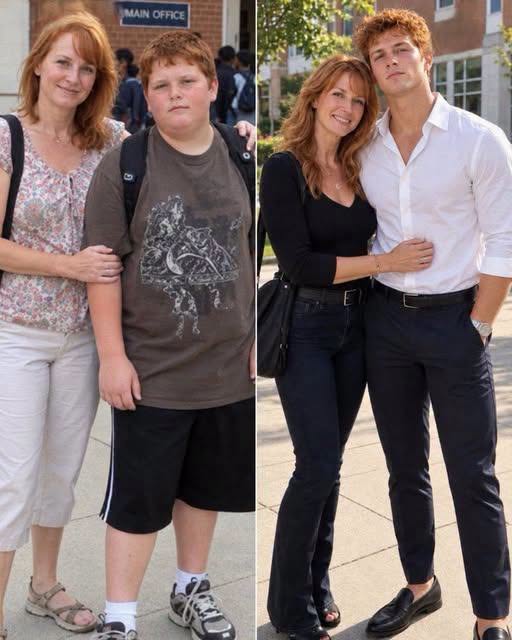
For years, I watched my son come home from school with the same expression on his face: a quiet mixture of disappointment, embarrassment, and the determination to pretend that nothing had happened.
He would drop his backpack near the door, tell me that everything was fine, and disappear into his bedroom. Sometimes, I heard him moving things around or turning on his computer. Other times, he simply sat in silence, hoping that if he didn’t talk about his day, he could leave it behind.
But a mother knows when something is wrong.
My son was never the loudest boy in the classroom. He wasn’t the kind of child who demanded attention or tried to impress everyone around him. He was thoughtful, intelligent, and gentle, with a habit of noticing things that other people overlooked. He preferred a few genuine friendships to a large circle of acquaintances, and he often spent his free time reading, drawing, or working on projects that interested him.
Unfortunately, those qualities made him an easy target for classmates who believed that being different was something to mock.
Throughout his school years, he endured jokes, cruel comments, exclusion, and the kind of everyday humiliation that adults sometimes dismiss because it doesn’t leave visible scars.
He was left out of group activities. His classmates laughed at his clothes. Invitations to birthday parties somehow never reached him. When students formed teams, he was often the last person chosen, standing awkwardly while everyone else pretended not to notice.
And when he tried to defend himself, the situation sometimes became worse.
I remember asking him once why he never told a teacher what was happening.
He shrugged and said, “What’s the point, Mom? They’ll just say I’m too sensitive.”
That answer broke my heart more than any insult his classmates could have thrown at him.
He had already begun to believe that asking for help would only give people another reason to laugh.
I wanted to protect him. I wanted to march into that school and demand that every child who had hurt him explain themselves. I wanted the adults responsible for his education to understand that their classrooms were not supposed to be places where a child learned to feel ashamed of who he was.
But I also knew that I could not fight every battle for him.
All I could do was remind him, day after day, that the way other people treated him did not determine his worth.
I never imagined that years later, after he had worked so hard to build a life beyond those painful memories, the same people would find another way to make him feel invisible.
This time, however, the hurt would lead to a discovery none of us expected.
The School Years That Left Their Mark
My son’s name is Daniel, and when he started high school, I genuinely believed those years would be among the best of his life.
I pictured him finding friends who shared his interests, discovering what he was good at, and gradually becoming more confident. I imagined school dances, funny stories about classmates, and the kind of friendships that people remember decades later.
Instead, I watched him become increasingly careful about everything he did.
He thought twice before answering questions in class because he worried someone might laugh at his response. He avoided wearing anything that might draw attention. He stopped talking about certain interests because he had learned that enthusiasm could make him a target.
The cruelty wasn’t always dramatic.
Sometimes it was a group of students falling silent when he approached. Sometimes it was a joke whispered loudly enough for him to hear. Sometimes it was a photograph shared among classmates with a humiliating caption.
The hardest part was that each individual incident could be dismissed as insignificant by someone who had not experienced it.
“It’s just a joke.”
“Kids can be mean.”
“He needs to learn not to take everything personally.”
I heard variations of those excuses whenever I tried to explain how deeply the situation was affecting my son.
But I saw what happened afterward.
I saw him lose his enthusiasm for school. I saw him invent excuses to avoid social events. I saw him begin to question qualities that I had always considered strengths.
One evening, I found him sitting at the kitchen table long after dinner had ended. His homework was open in front of him, but he wasn’t writing anything.
I asked him what was wrong.
He stared at the page and said, “I think there’s something about me that makes people hate me.”
I pulled out the chair beside him and sat down.
“Daniel, listen to me. People can treat you badly for reasons that have nothing to do with your worth. Sometimes, they target someone because they think being cruel will make them look important. Sometimes, they follow a group because they’re afraid of becoming the next target themselves.”
He listened without looking up.
“But none of that means there’s something wrong with you.”
He nodded, although I wasn’t sure he believed me.
That night, I promised myself that whatever happened at school, our home would remain a place where he never had to earn the right to be respected.
He would always have a place at our table.
He would always have someone willing to listen.
And he would never have to pretend that cruelty didn’t hurt.
Graduation Day Wasn’t the Happy Ending I Had Hoped For
By the time Daniel reached his final year, he had learned how to endure school without allowing every insult to ruin his day.
He focused on his studies, completed his assignments, and began thinking seriously about what he wanted to do after graduation.
He didn’t suddenly become popular, and the students who had mistreated him never gathered around to apologize.
There was no dramatic moment when everyone realized they had misunderstood him.
Life rarely works that way.
Instead, Daniel gradually stopped seeking approval from people who had repeatedly shown him that they were unwilling to give it.
When graduation finally arrived, I was immensely proud of him.
I watched him walk across the stage to receive his diploma, and I felt tears gather in my eyes. I knew how much emotional energy it had taken for him to keep going through those years.
I knew about the mornings when he had wanted to stay home, the afternoons when he had pretended not to care, and the evenings when he had questioned whether he would ever find people who accepted him.
Yet he had made it.
After the ceremony, I hugged him tightly.
“You did it,” I whispered.
He smiled and said, “I’m glad it’s over.”
Those five words told me more than any graduation speech could have.
He wasn’t celebrating the end of an exciting chapter. He was relieved to leave a painful one behind.
That summer, Daniel began working toward a future that had nothing to do with the people who had made his school years miserable.
He enrolled in further education, found new interests, and slowly developed friendships with people who appreciated his quiet humor and thoughtful nature.
For the first time in years, he seemed comfortable being himself.
I watched his confidence return in small ways. He started speaking more openly about his interests. He no longer worried so much about what strangers might think of his clothes. He began making plans without first asking whether other people would approve.
It wasn’t an overnight transformation, but it was real.
I thought the worst part of his school experience was finally behind him.
Then, ten years after graduation, the reunion invitations began arriving.
The Invitation Everyone Received Except My Son
I first heard about the reunion on a Sunday afternoon.
Daniel was visiting me, and we were sitting in the living room when he glanced at his phone and laughed softly at something he had read.
“Apparently, my old class is having a ten-year reunion,” he said.
I looked up from my book.
“Really? That’s wonderful. Have they contacted you?”
He shook his head.
“No. I saw someone post about it online.”
I waited for him to say more.
He explained that several former classmates had been sharing details about the event. There were photographs of the old school, comments about teachers everyone remembered, and enthusiastic messages from people who seemed excited to see one another again.
Some had traveled from other cities. Others were arranging to bring their partners. A few were posting old photographs and laughing about memories from their teenage years.
Daniel had found out about the reunion by accident.
No invitation had arrived in his mailbox.
No message had appeared in his inbox.
Nobody had contacted him directly.
At first, I thought it might have been an oversight.
Perhaps the organizers had outdated contact information. Maybe someone had forgotten to update a list. After all, ten years was a long time, and people moved, changed jobs, and lost touch.
I told Daniel that he should contact one of his former classmates and ask about the arrangements.
He gave me a small smile.
“It’s fine, Mom. I don’t think they expect me to be there.”
The way he said it troubled me.
He wasn’t angry. He didn’t sound surprised.
He sounded as though he had already accepted that he wasn’t wanted.
I remembered the boy who had once sat at the kitchen table wondering what made people dislike him. I remembered his graduation-day relief and the years it had taken him to regain his confidence.
Now, a decade later, he was looking at a group of people who had hurt him and assuming that their silence meant he had no place among them.
I wanted to tell him that he was wrong.
But before I could respond, he said something that made my heart ache.
“Maybe they just want to remember school the way it was. I don’t exactly fit into those memories.”
I put my book aside.
“Daniel, you were part of that class. You have just as much right to be there as anyone else.”
He shrugged.
“Being part of something doesn’t mean people want you there.”
I had no easy answer to that.
Because, after everything he had experienced, I understood why he believed it.
Why the Reunion Hurt More Than He Expected
For the next few days, Daniel tried not to think about the event.
He continued working, met a friend for coffee, and talked about an upcoming project. From the outside, he appeared to have moved on.
But I noticed that he checked the reunion page more than once.
He would glance at the photographs and read the comments before putting his phone away. Sometimes he laughed at a memory someone had shared. Other times, his expression became distant.
I eventually asked him whether he wanted to attend.
He thought about it for a while.
“I don’t know,” he admitted. “Part of me wants to see what everyone looks like now. I wonder whether any of them have changed. I wonder whether they’d even recognize me.”
He paused.
“But another part of me doesn’t want to walk into a room and feel sixteen again.”
I understood exactly what he meant.
A reunion is often presented as a cheerful opportunity to reconnect with old friends. People talk about nostalgia, shared memories, and the excitement of discovering what everyone has accomplished.
But for someone who experienced bullying or exclusion, returning to that environment can feel very different.
A familiar hallway, a recognizable face, or an old joke can bring back emotions that have been quiet for years.
Even when someone has built a successful adult life, the memory of being humiliated as a teenager can remain surprisingly vivid.
Daniel wasn’t afraid that his former classmates would think he had failed.
He had built a life he was proud of.
He was afraid of returning to a place where he had once felt powerless and discovering that nothing had changed.
I told him that he didn’t owe those people his presence.
If he wanted to attend, he could go on his own terms. If he preferred to stay away, that would be equally valid.
The important thing was that his decision should belong to him, not to the people who had treated him badly.
He nodded.
Then he said, “I think I want to know whether they left me out on purpose.”
That was the question neither of us could stop thinking about.
The Message That Raised More Questions
A few days later, Daniel received a message from someone he hadn’t spoken to in years.
It was from a former classmate named Michael.
Michael had never been particularly close to Daniel in school, but he had occasionally spoken to him when they were assigned to the same group. Unlike some of the other students, he had rarely participated in the teasing.
His message was brief.
“Hey, Daniel. I heard you haven’t received the reunion invitation. Did you get the details from anyone?”
Daniel replied that he had only seen the announcement online.
Michael responded almost immediately.
“That’s strange. I thought everyone was being contacted.”
Daniel asked whether there had been a problem with the invitation list.
There was a pause before Michael answered.
“I’m not sure. You might want to ask the organizers directly.”
It wasn’t an accusation, and it didn’t prove that anyone had deliberately excluded Daniel.
But it made the situation harder to dismiss as a simple misunderstanding.
Daniel showed me the exchange.
“Do you think they did it on purpose?” he asked.
I told him I didn’t know.
I didn’t want to give him false hope, but I also refused to assume the worst without evidence.
There could have been a mistake. The organizers might have used an outdated class list. Someone might have overlooked his contact information.
Or there might have been a more uncomfortable explanation.
The only way to find out was to ask.
Daniel stared at the screen for a long time before putting his phone down.
“I don’t want to beg people to invite me somewhere.”
“You shouldn’t have to,” I replied. “Asking a question isn’t begging. But you also don’t have to chase anyone who makes you feel unwanted.”
He thought about that.
Then he decided to contact the reunion organizers, not because he needed their approval, but because he wanted a clear answer.
The Answer He Had Been Waiting For
The next evening, Daniel called me.
His voice was calm, but I could tell that the conversation had affected him.
He had contacted the person responsible for organizing the reunion and asked whether invitations had been sent to everyone from their graduating class.
The organizer apologized and explained that the invitation list had been assembled using old contact information and responses from a group of former classmates.
Daniel’s details had not appeared on the list they were using.
That explained why he hadn’t received an invitation, but it didn’t immediately explain why nobody had thought to contact him after the reunion was announced publicly.
The organizer said that the omission had not been intentional and offered to send him the event details.
Daniel thanked them.
Then he asked a question he had been carrying for years.
“Would people actually be happy to see me there?”
The organizer hesitated before answering.
They couldn’t speak for everyone, they said, but the reunion was open to members of the graduating class, and he was welcome to attend.
It was not the dramatic apology Daniel might once have imagined.
Nobody admitted to secretly organizing his exclusion. Nobody suddenly confessed that they had spent ten years regretting how they treated him.
The answer was much more ordinary.
An outdated list, an overlooked name, and an invitation that had never reached him.
Yet the uncertainty had exposed something important.
Because of his experiences in school, Daniel had immediately assumed that being left out meant he was unwanted.
The past had shaped how he interpreted the present.
That reaction was understandable, but it wasn’t proof that the same people were deliberately rejecting him now.
When he finished telling me what had happened, I asked whether he planned to go.
He was quiet for a moment.
Then he said, “I think I might.”
The Decision to Return
Over the following week, Daniel considered the invitation carefully.
He looked at the event details, checked the location, and thought about who might attend.
He admitted that he was still nervous.
He worried that he might walk into the room and find himself surrounded by people who remembered him only as the quiet boy they used to mock. He wondered whether anyone would acknowledge what had happened during their school years or whether everyone would pretend that those years had been wonderful.
But he also recognized that he was no longer the teenager who had sat alone at lunch, waiting for someone to invite him to join a group.
He was an adult with his own experiences, responsibilities, friendships, and accomplishments.
He didn’t need the approval of his former classmates to validate the life he had built.
That realization helped him make a decision.
He would attend the reunion, but he would not go there hoping to become popular or receive an apology from everyone who had hurt him.
He would go because he wanted to see the people who had shared that chapter of his life, including those who might remember him kindly.
He would stay as long as he felt comfortable.
And if the evening turned out to be disappointing, he could leave.
There was no longer any reason to remain in a room where he felt disrespected simply because he had once spent years trying to belong.
When he told me his decision, I felt a mixture of pride and concern.
I knew it might be difficult.
But I also knew that he was approaching the situation differently from the way he would have ten years earlier.
He wasn’t asking whether they would accept him.
He was asking whether attending would be worthwhile for him.
That was a meaningful difference.
The Night of the Reunion
On the evening of the reunion, Daniel stood in front of the mirror longer than usual.
He had chosen a simple, well-fitting outfit and looked more confident than he had during his school years. His shoulders were relaxed, and he no longer had the habit of looking down whenever he felt uncertain.
Before leaving, he stopped by my house.
“Do I look all right?” he asked.
I smiled.
“You look wonderful.”
He laughed softly.
“You’re supposed to say that. You’re my mother.”
“Then let me say something else,” I replied. “You don’t have to prove anything to those people tonight. Not one thing.”
He hugged me.
“I know.”
I watched him drive away, wondering how the evening would unfold.
I imagined him arriving at the venue and recognizing familiar faces. I imagined the awkward introductions, the conversations about careers and families, and the possibility that someone might bring up an old memory that he would rather forget.
I also hoped he might discover that some people had matured, that others remembered more than he realized, and that the evening could be different from the years he had left behind.
But I knew there was no guarantee.
People do not always become kinder simply because they grow older.
Sometimes, the best outcome is not reconciliation.
Sometimes, it is simply learning that the people who once hurt you no longer have the power to define you.
Several hours passed before my phone rang.
It was Daniel.
I answered immediately.
“How is it going?” I asked.
He was quiet for a second.
Then he said, “Mom, you’ll never believe who came over to talk to me.”
I sat down.
“Who?”
He began telling me about a former classmate who had approached him shortly after he arrived.
And what happened next was something neither of us had expected.
The Conversation That Changed the Evening
The classmate was Michael, the same person who had messaged him earlier.
Michael greeted Daniel warmly and asked about his life. They talked about work, mutual acquaintances, and how strange it felt to see everyone together after so many years.
Then Michael brought up something from their school days.
He apologized.
Not with a long speech or an elaborate explanation, but with a direct acknowledgment that Daniel had been treated unfairly.
Michael admitted that he had witnessed some of the teasing and exclusion. Although he hadn’t always participated, there had been moments when he had stayed silent rather than risk becoming a target himself.
“I should have said something,” he told Daniel. “I knew it wasn’t right, but I didn’t want to make myself a target.”
Daniel later told me that he didn’t know how to respond at first.
For years, he had wondered whether anyone else had noticed what was happening.
He had assumed that his classmates either agreed with the treatment he received or simply didn’t care.
Michael’s apology didn’t erase the past, but it gave Daniel something he had rarely received during those years: an acknowledgment that the behavior had been wrong.
Daniel accepted the apology, while making it clear that the experience had affected him more than Michael might have realized.
They continued talking, and eventually another former classmate joined them.
Then another.
Not everyone approached him, and not every conversation was meaningful. Some people seemed genuinely pleased to see him. Others offered brief greetings before returning to their own groups.
The evening was imperfect, but it wasn’t the rejection he had feared.
And perhaps the most important discovery was that Daniel no longer needed every person in the room to approve of him.
He could appreciate a sincere apology without pretending the past hadn’t hurt.
He could enjoy a conversation without assuming it would lead to friendship.
He could leave the evening with his dignity intact, regardless of how everyone else behaved.
What He Realized About the People Who Had Hurt Him
When Daniel returned home that night, he looked tired but thoughtful.
I asked him whether he was glad he had gone.
He sat down and took a deep breath.
“Yes,” he said. “But not for the reason I expected.”
He explained that, before the reunion, he had imagined two possible outcomes.
Either everyone would ignore him, confirming that he had never mattered to them, or someone would apologize and somehow make the past feel less painful.
Neither scenario captured what actually happened.
Some classmates were friendly. One apologized sincerely. Others appeared to have little interest in revisiting the past.
The evening didn’t provide a single, satisfying answer about who they had been or who they had become.
Instead, it showed Daniel that people could change in different ways, and that their behavior as teenagers did not always tell the whole story of their adult lives.
Some had matured enough to acknowledge their mistakes.
Others had not.
But Daniel no longer felt that he needed to wait for them to become better people before he could move forward.
He told me that, for years, he had carried a quiet hope that one day his former classmates would recognize how badly they had treated him.
He wanted them to understand that the jokes they had forgotten had followed him long after they stopped telling them.
He wanted someone to say that he had never deserved it.
Michael’s apology had mattered, but Daniel realized that he could not build his healing around receiving apologies from everyone else.
Some people might never acknowledge what they had done.
Some might not remember the incidents at all.
And some might remember them differently.
None of those possibilities changed the reality of his experience.
He had been hurt, and he had worked hard to rebuild his confidence.
That was true whether or not his former classmates understood it.
The Lesson I Learned as His Mother
For years, I had wanted to protect Daniel from every painful experience that came his way.
I wanted teachers to intervene, classmates to show compassion, and other parents to understand that their children could cause lasting harm through behavior they dismissed as harmless teasing.
I still believe adults have a responsibility to take bullying seriously.
Children should not have to endure repeated humiliation simply because their experiences are inconvenient for the people responsible for protecting them.
But watching Daniel grow into an adult taught me something else.
I could support him, remind him of his worth, and help him navigate difficult situations. I could listen when he needed to talk and stand beside him when he felt alone.
What I could not do was control how every person treated him.
Nor could I make his past disappear.
What I could do was help him understand that the way others behaved toward him did not have to become the foundation of his identity.
The reunion reminded both of us of that truth.
Daniel had once believed that being excluded meant there was something wrong with him. Years later, he was able to consider the possibility that an invitation had been missed for an ordinary reason rather than assuming that rejection was inevitable.
And when he encountered people who had hurt him, he was able to decide for himself which conversations were worth having.
He no longer needed to be the boy who stood at the edge of a group, hoping someone would make room for him.
He could choose the people he wanted in his life.
That was the kind of confidence I had hoped he would find all along.
The People Who Excluded Him Didn’t Get the Final Word
A few days after the reunion, Daniel received a message from Michael.
He thanked Daniel for talking with him and said that he was glad they had reconnected.
They began exchanging occasional messages. They were not suddenly inseparable, and neither pretended that one conversation had created a lifelong friendship.
But they had opened the door to something new.
Daniel also heard from another former classmate who apologized for participating in some of the teasing during school. The apology was uncomfortable but sincere, and Daniel appreciated the effort.
Other classmates remained silent.
He eventually stopped checking the reunion page.
There was no longer any reason to watch what the others were doing or wonder whether they had discussed him after the event.
He had learned what he needed to learn.
The boy who had once been excluded had grown into a man capable of deciding where he belonged.
And the answer was no longer dependent on whether a group of former classmates remembered to send him an invitation.
His worth had never depended on their approval.
Their cruelty had been real, and its effects had mattered. But those experiences were only one part of his life, not the whole story.
When I think about Daniel now, I no longer picture only the teenager who came home from school in silence.
I picture the adult who walked into a room filled with people connected to some of his most painful memories and discovered that he could leave on his own terms.
He did not need to win them over.
He did not need to prove that he had become successful.
He did not need to pretend that the past had been harmless.
He simply needed to remember who he was.
My son was mistreated throughout school, and ten years later, he wasn’t even included on the reunion invitation list. For a moment, it felt as though the same rejection had followed him into adulthood. But the most important part of his story wasn’t whether his former classmates wanted him there. It was that he finally understood he no longer needed their permission to feel worthy, respected, or accepted.
Sometimes, the most powerful way to move beyond the people who hurt you is not to make them regret what they did.
It is to build a life in which their opinion no longer determines how you see yourself.