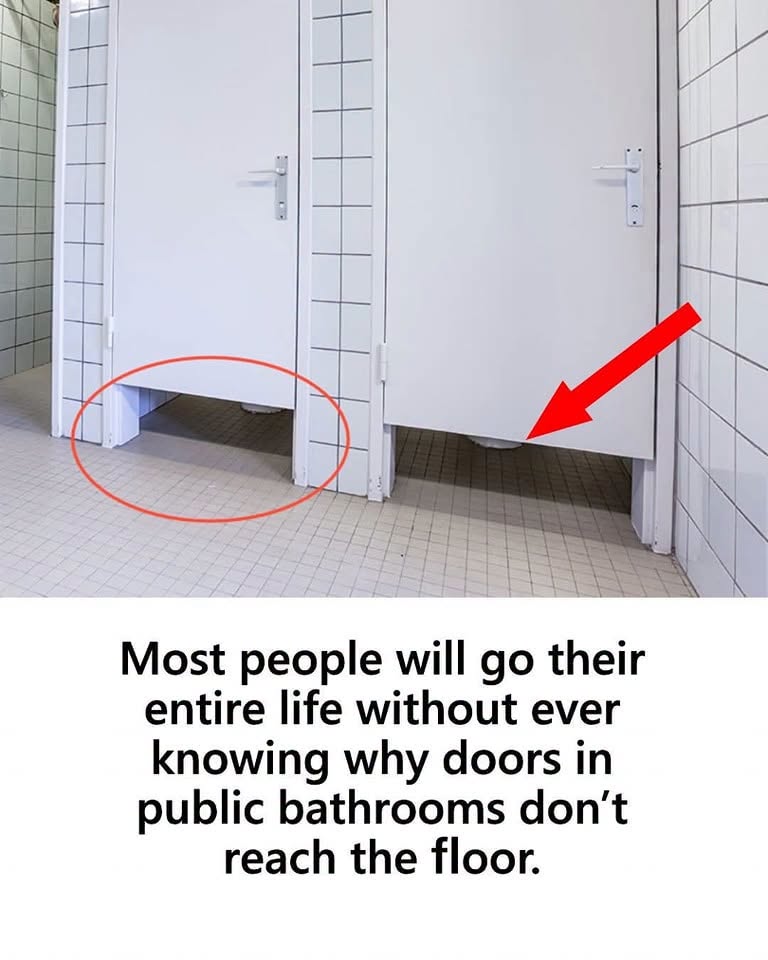
The Real Reason Public Bathroom Doors Don’t Touch the Ground — And It’s Not Just What You Think!
Have you ever walked into a public restroom, looked at the stall doors, and wondered why there’s such a large gap between the bottom of the door and the floor?
At first glance, it might seem like a strange design choice. After all, wouldn’t a door that reaches all the way to the ground provide more privacy?
Surprisingly, there are several practical reasons why many public bathroom stalls are designed this way, and some of them are more important than you might imagine.
1. It Makes Cleaning Much Easier
Public restrooms experience heavy daily use, which means floors need frequent cleaning. The gap beneath the doors allows mops, brooms, and some cleaning equipment to reach further into the stalls without requiring workers to open every door.
This helps cleaning staff work more efficiently and makes it easier to maintain a hygienic environment.
2. It Can Help People Get Assistance in an Emergency
Imagine someone inside a stall suddenly fainting, suffering a medical emergency, or becoming unable to respond.
The open space at the bottom can help other people notice that something may be wrong. In some circumstances, it also provides access for emergency responders to assess the situation or reach someone who has fallen.
It doesn’t guarantee that a person can be rescued easily, but it can make certain emergencies easier to recognize and manage.
3. It Helps Reduce Costs
Public bathrooms in airports, shopping malls, restaurants, schools, and stadiums may contain dozens of stalls.
Doors that don’t extend to the floor can use less material and often work with simpler partition systems. Depending on the design, this can reduce manufacturing, installation, and maintenance costs.
For facilities that serve thousands of people every day, even small savings can add up.
4. It Can Improve Air Circulation
Restrooms can become warm and humid, especially when many people use them throughout the day.
The gaps beneath stall doors allow air to move between the individual stalls and the larger restroom. This can contribute to overall airflow, although proper ventilation systems are far more important for controlling odors and humidity.
5. It Makes It Easier to Tell Whether a Stall Is Occupied
Have you ever approached a stall, noticed someone’s feet underneath the door, and immediately moved on to the next one?
The gap provides a quick visual clue about whether someone is inside. This can reduce unnecessary knocking and help people find an available stall more quickly in busy public restrooms.
6. It Can Help People Exit a Stall More Easily
If a lock breaks, a door becomes jammed, or someone inside needs assistance, the gap may provide another way for trained staff or emergency responders to assess the situation.
However, the gap isn’t a substitute for properly maintained locks, accessible stall designs, or appropriate emergency procedures.
So, What’s the Biggest Reason?
There isn’t one universal explanation for every public restroom. The design depends on local building codes, accessibility requirements, the type of partition system, cost, maintenance needs, and the facility’s intended use.
In many American public restrooms, the gaps are part of a practical combination of considerations: easier cleaning, simpler construction, visibility in emergencies, and convenient maintenance.
And while the design may sometimes feel awkward for people who value privacy, it serves several everyday purposes beyond appearance alone.
The next time you notice a gap beneath a public bathroom door, remember: it’s usually a practical design decision, not a mysterious mistake.
What do you think? Should public bathroom stalls provide more privacy, even if that makes cleaning and maintenance more difficult?