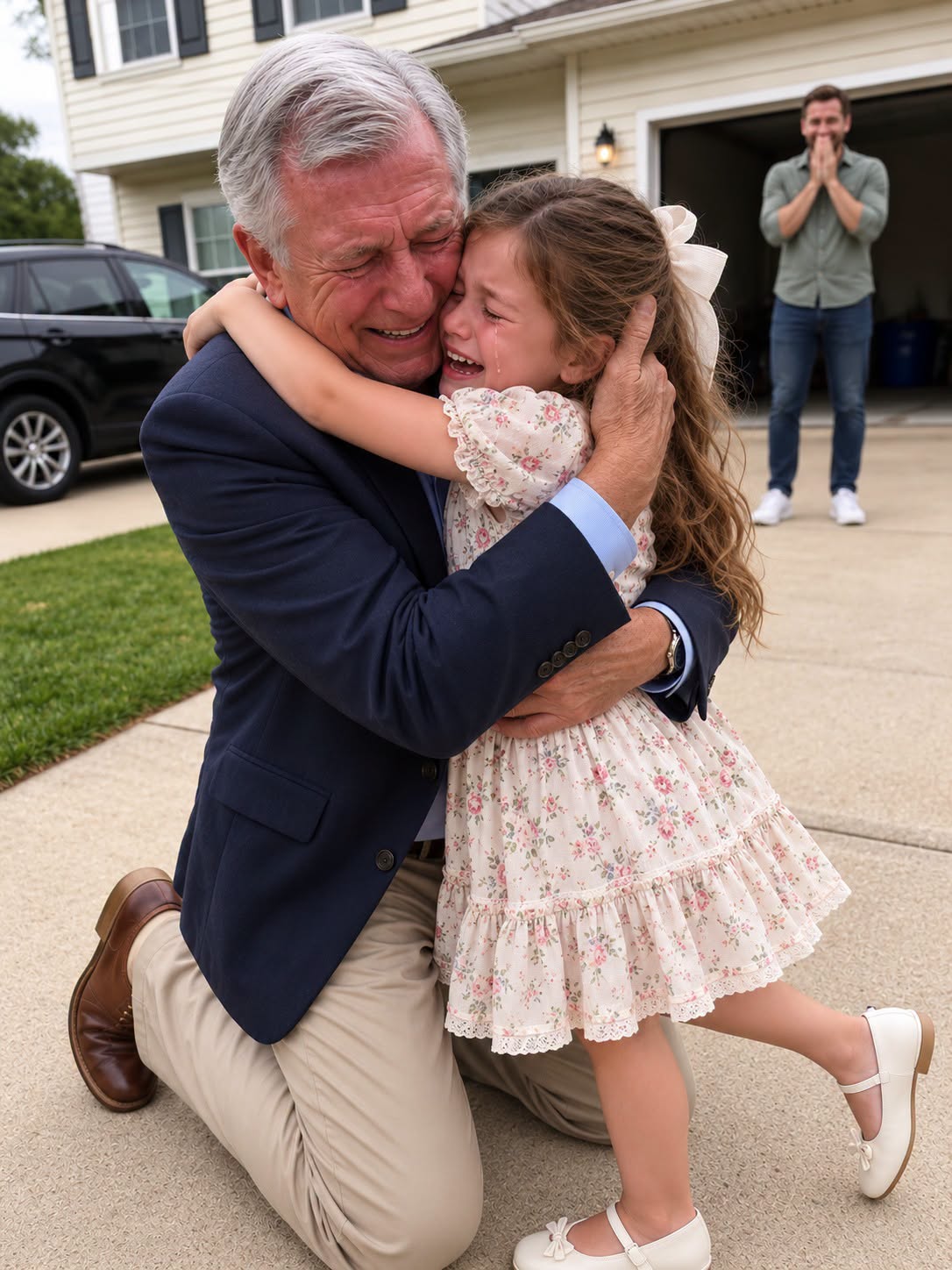
For Seven Years After My Daughter Passed Away, I Sent Her Husband $40,000 Every January to Help Care for My Granddaughter. Then One Afternoon, She Whispered, “Grandpa, Please Stop Giving Dad Money. Follow Him One Day, and You’ll See Why.”
For seven years, I kept the same promise.
Every January, without fail, I transferred $40,000 to my son-in-law to help him raise my granddaughter after my daughter died. I never asked for receipts. I never questioned his decisions. I simply believed that the money was helping the little girl my daughter had left behind.
Until one quiet afternoon, everything changed.
My seven-year-old granddaughter took my hand, led me away from her father, and whispered something that made my blood run cold.
“Grandpa, please stop giving Dad money.”
I stared at her, confused.
She looked over her shoulder to make sure nobody was listening. Then she leaned closer and added five words I would never forget.
“Follow him one day, and you’ll see why.”
At first, I thought she was mistaken. Perhaps she’d overheard an argument or misunderstood something adults had said.
But the fear in her eyes was unmistakable.
And for the first time in seven years, I began to wonder whether the man I had trusted with my daughter’s most precious gift had been lying to me all along.
The Promise I Made at My Daughter’s Funeral
My daughter, Emily, was only thirty-one when I lost her.
She had been the kind of woman who remembered everyone’s birthday, brought groceries to elderly neighbors, and called me every Sunday evening just to ask how my week had gone.
She was my only child.
When she died after a sudden illness, I felt as though someone had taken the future away from me.
But there was one thing I couldn’t allow myself to lose: my connection to her little girl, Sophie.
Sophie was barely a year old when her mother passed away. She was too young to understand why the woman who sang her to sleep would never come back.
At the funeral, I watched my son-in-law, Daniel, holding Sophie against his chest.
He looked exhausted, devastated, and completely lost.
I remember approaching him after the service.
“You don’t have to do this alone,” I told him.
He looked at me with red eyes.
“I promised Emily I’d give Sophie the best life I could,” he whispered. “But I don’t know how I’m going to manage everything.”
I put my hand on his shoulder.
“You’re her father. I’ll help you. Whatever she needs, I’ll make sure she has it.”
I meant every word.
At the time, I had no idea how much that promise would eventually cost me—not just financially, but emotionally.
Forty Thousand Dollars Every January
The first year after Emily’s death, I sent Daniel $40,000.
I told him to use it for Sophie’s childcare, education, medical expenses, and anything else that would help her grow up safely.
He thanked me repeatedly.
“You have no idea what this means,” he said. “Emily would be so grateful.”
Those words stayed with me.
The following January, I sent another $40,000.
Then another.
And another.
For seven consecutive years, I transferred the same amount.
By the time Sophie turned seven, I had given Daniel a total of $280,000.
I never considered it a burden. I had spent decades building my savings, and I believed there was no better use for that money than giving my granddaughter opportunities her mother would have wanted for her.
I imagined Sophie attending an excellent school, taking music lessons, enjoying family vacations, and never worrying about whether she had enough food or warm clothes.
Whenever I visited, however, something about the situation seemed slightly off.
Daniel always said money was tight.
He complained about bills, rising expenses, and the difficulty of raising a child alone.
Yet I rarely saw any evidence of the comfortable life I had imagined my granddaughter would have.
Sophie wore clothes that seemed too small. Her shoes were often worn at the heels. Sometimes, when I took her out for lunch, she ate as though she hadn’t had a proper meal in hours.
Whenever I asked Daniel about it, he had an explanation.
“She’s growing so fast,” he’d say.
Or, “You know how expensive everything is these days.”
I accepted those answers because I wanted to believe him.
I thought he was struggling.
I never considered that he might be hiding something.
The Afternoon Sophie Finally Spoke
It happened on a Sunday.
I had driven to Daniel’s house to spend a few hours with Sophie. I brought her a box of colored pencils, a new storybook, and the strawberry cake she always asked me to bring.
She ran to the door when she saw me.
“Grandpa!”
She threw her arms around my waist, and I hugged her tightly.
For a while, everything felt normal. We sat at the kitchen table, colored pictures, and talked about school.
Then Daniel announced that he needed to go out for a little while.
“I have some errands,” he said, grabbing his car keys. “I’ll be back later.”
Sophie immediately stopped coloring.
Her little hand closed around my wrist.
“Grandpa,” she whispered, “can I tell you something?”
I leaned toward her.
“Of course, sweetheart.”
She looked toward the front door.
Then she said the words that changed everything.
“Please stop giving Dad money.”
I blinked.
“What do you mean?”
Her eyes filled with tears.
“You give him money every year because you think he uses it for me, don’t you?”
I felt a strange heaviness settle in my chest.
“Yes,” I answered carefully. “That’s what the money is for.”
She lowered her voice even further.
“But I don’t think he does.”
I stared at her, struggling to understand.
“Why would you say that, sweetheart?”
She swallowed hard.
“Because he tells people not to tell you things. And when he leaves the house, he goes somewhere he says he doesn’t go.”
I felt my heart begin to pound.
“Where does he go?”
She shook her head.
“I don’t know the name. But please, Grandpa. Follow him one day. Then you’ll understand.”
I wanted to ask a hundred questions.
Instead, I held her hand and made her a promise.
“I’ll find out what’s happening. And whatever it is, you’re not in trouble.”
She threw her arms around me and began to cry.
That was the moment I knew I couldn’t simply send another check the following January and pretend everything was fine.
The Decision That Kept Me Awake All Night
I drove home in silence.
For seven years, I had trusted Daniel because he was the father of my granddaughter and the husband of my beloved daughter.
I had assumed that losing Emily had brought us together in a shared responsibility.
Now I wondered whether my trust had made me blind.
I kept replaying Sophie’s words.
She was only seven. Children sometimes misunderstand adult conversations. I knew that.
But she hadn’t sounded confused.
She had sounded frightened.
That night, I opened my bank statements and reviewed every transfer I had made since Emily’s death.
Seven payments.
Forty thousand dollars each.
Two hundred and eighty thousand dollars in total.
I looked at the figures until they blurred.
Then I opened a notebook and began writing down everything I remembered about Daniel’s financial situation.
The complaints about bills.
The excuses about school expenses.
The worn-out shoes.
The way Sophie sometimes seemed embarrassed to ask for something as simple as a new winter coat.
None of those things proved that Daniel had done anything wrong.
But together, they raised questions I could no longer ignore.
I decided that I would not accuse him without evidence.
I would not frighten Sophie with a confrontation.
And I would not send another dollar until I understood what was happening.
The next morning, I called my financial adviser and asked for copies of the records related to the transfers.
Then I made a decision that felt uncomfortable but necessary.
I would find out whether the money I had sent for Sophie’s future was actually being used for her.
What I Discovered Outside His House
Three days later, Daniel told me he would be taking Sophie to visit a friend.
I offered to stay with her instead, but he declined.
“No need,” he said. “We’ll be out for most of the afternoon.”
I didn’t argue.
Later, after confirming that Sophie was safely spending the afternoon with a trusted relative, I drove toward Daniel’s neighborhood.
I wasn’t trying to create a confrontation. I wanted to understand where he was going and whether his explanation matched reality.
I parked on a public street a short distance away.
About twenty minutes later, Daniel emerged from his house, dressed in clothes far more expensive than anything I had seen him wear during my visits.
He climbed into a luxury SUV.
I had never seen him drive that vehicle before.
I waited several minutes before leaving, keeping my distance and obeying traffic laws.
He drove across town, passing the modest shopping district and heading toward an upscale neighborhood.
Finally, he pulled into the driveway of a large, modern house.
A woman came out to greet him.
She smiled, kissed him on the cheek, and led him inside.
I sat motionless behind the steering wheel.
Perhaps she was a relative. Perhaps there was an explanation.
Then I noticed something else.
A second vehicle in the driveway had a personalized license plate bearing Daniel’s initials.
I recognized those initials from the paperwork he had once shown me when discussing his financial difficulties.
My hands began to shake.
The man who repeatedly told me he could barely afford to raise my granddaughter appeared to have access to a lifestyle I had never known existed.
But I still didn’t know how he had paid for it.
I needed facts, not assumptions.
So I drove home and contacted a lawyer.
The Records That Raised Even More Questions
The lawyer advised me not to confront Daniel impulsively.
Instead, we reviewed the records I had legally obtained and discussed what additional documentation might clarify the situation.
I gathered bank transfer confirmations, copies of messages about Sophie’s expenses, and notes from conversations in which Daniel had described his financial struggles.
Then I requested a meeting with him.
I told him I wanted to discuss Sophie’s future education and make sure the money was being managed appropriately.
He agreed immediately.
At the meeting, I asked a simple question.
“Daniel, can you show me how the money I’ve sent over the years has been used for Sophie?”
His expression changed.
“What do you mean?”
“I mean the $280,000 I’ve given you. I’d like to understand what has been saved for her education and what has gone toward her living expenses.”
He leaned back in his chair.
“Are you accusing me of something?”
“No,” I answered. “I’m asking for transparency.”
He became defensive.
He said raising a child was expensive. He said I had never complained before. He suggested that I was allowing my grief to make me suspicious.
Then he stood up.
“If you don’t trust me, perhaps you shouldn’t have offered to help in the first place.”
And he walked out.
I sat there for several minutes, looking at the empty chair across from me.
His reaction didn’t prove that he had misused the money.
But it convinced me that we needed clearer answers before another payment was made.
The Truth Behind the Lifestyle
Over the following weeks, I learned more about Daniel’s financial circumstances through lawful document requests and information he voluntarily disclosed during discussions about Sophie’s future.
Some of what I discovered was genuinely surprising.
Daniel had been receiving money from several sources, including his own employment and an inheritance from a relative.
He had also made substantial purchases that were difficult to reconcile with the financial hardship he had described to me.
However, the records available to me did not establish that every purchase had been funded by my gifts, nor did they provide a complete accounting of the $280,000.
The most troubling discovery was that Daniel had not established the education savings arrangement he had repeatedly told me he intended to create for Sophie.
There was no clearly documented fund set aside in her name corresponding to the money I had provided.
When my lawyer raised the issue, Daniel claimed that the money had gone toward general household expenses.
That explanation might account for some of it, but he could not provide the detailed records I had requested.
I felt anger rising inside me.
For seven years, I had believed I was helping secure Sophie’s future.
Now I had no reliable way to know how much of that future had actually been protected.
I thought about Emily.
If she were alive, what would she say?
Would she be disappointed in me for trusting too easily?
Or would she tell me that the only thing that mattered now was making sure her daughter was safe?
I knew which question deserved my attention.
Sophie needed protection, stability, and a future that didn’t depend entirely on her father’s willingness to explain himself.
The Conversation That Changed Our Family
I arranged another meeting with Daniel, this time with my lawyer present.
I told him that I would no longer provide unrestricted annual payments.
If I continued helping Sophie financially, the money would go directly toward verified expenses or into a properly structured savings arrangement for her benefit.
I explained that I was willing to pay legitimate school fees, medical costs, and other necessary expenses directly to the relevant providers.
I was also willing to contribute to a professionally managed account designed to support her education, subject to appropriate legal safeguards.
Daniel’s face hardened.
“So that’s it?” he asked. “After everything I’ve done, you’re cutting me off?”
“I’m not cutting Sophie off,” I replied. “I’m making sure the help I give actually reaches her.”
He shook his head.
“You think I’m some kind of criminal?”
“I think I have a responsibility to understand how my money is being used.”
For a moment, neither of us spoke.
Then he said something I hadn’t expected.
“You have no idea how difficult my life has been since Emily died.”
I looked at him carefully.
“Perhaps I don’t,” I admitted. “But neither of us should use her death as a reason to avoid honest conversations about Sophie’s future.”
He left without agreeing to my proposal.
The following days were tense. He limited my visits with Sophie, and I worried that she might believe she had done something wrong by speaking to me.
I contacted my lawyer again to understand what options were available for maintaining a relationship with my granddaughter while respecting the law and her father’s parental rights.
I refused to put Sophie in the middle of an adult dispute.
She had already lost her mother.
She deserved better than to become a messenger between two people who couldn’t agree.
The Promise I Made to My Granddaughter
The next time I saw Sophie, she ran into my arms.
“Grandpa, are you angry with me?” she asked.
My heart broke.
I knelt in front of her.
“No, sweetheart. Not even a little.”
“Is Dad angry because I told you?”
I took a deep breath.
“Your job is to be a little girl. You don’t have to solve grown-up problems, and you don’t have to keep secrets that make you feel scared.”
She looked down at her shoes.
“Are you still going to help me?”
I gently lifted her chin.
“Yes. I’m still going to help you. But we’re going to make sure that the help is used for the things you need.”
She wrapped her arms around my neck.
For the first time in weeks, I felt some of the weight in my chest begin to lift.
I couldn’t change the years that had passed.
I couldn’t recover time with Emily.
And I couldn’t immediately resolve every question surrounding the money.
But I could make a different choice going forward.
I could stop confusing trust with silence.
I could insist on transparency without turning my granddaughter into a weapon in a family argument.
And I could keep the promise that mattered most: to do everything reasonably within my power to help Sophie grow up safe, loved, and prepared for her future.
One Year Later, Everything Looked Different
The following January, I did not send Daniel a check for $40,000.
Instead, after obtaining appropriate legal and financial advice, I made a contribution toward Sophie’s verified educational expenses and arranged for additional support to be handled through a structure intended to benefit her directly.
The change was not painless.
Daniel and I still disagreed about what had happened, and some questions remained unanswered.
But I no longer handed over a large sum of money simply because the calendar told me it was time.
I asked questions.
I kept records.
And I made decisions based on what I could verify.
Sophie continued to grow.
She began talking excitedly about school projects, books she wanted to read, and the possibility of learning to play the piano.
One afternoon, she showed me a drawing she had made.
It was a picture of her mother holding her hand beneath a bright yellow sun.
At the bottom, in uneven letters, she had written:
“Mommy would want me to have a good life.”
I stared at those words for a long time.
Then I hugged her and told her that I believed she was right.
That evening, after I returned home, I took out an old photograph of Emily.
For years, I had thought honoring my daughter meant trusting the man she had married and giving him whatever he said he needed.
Now I understood that honoring her also meant protecting the child she had left behind.
My granddaughter’s whispered warning had not given me every answer.
But it had forced me to ask the questions I should have asked years earlier.
And sometimes, that is where protecting someone begins.
I had spent seven years sending $40,000 every January because I believed I was keeping a promise to my daughter. In the end, I learned that a promise is not just about giving money. It is about making sure the person you love is truly being cared for.
This is a fictional family drama written for storytelling purposes. The characters and events are illustrative, not a verified real-life account.