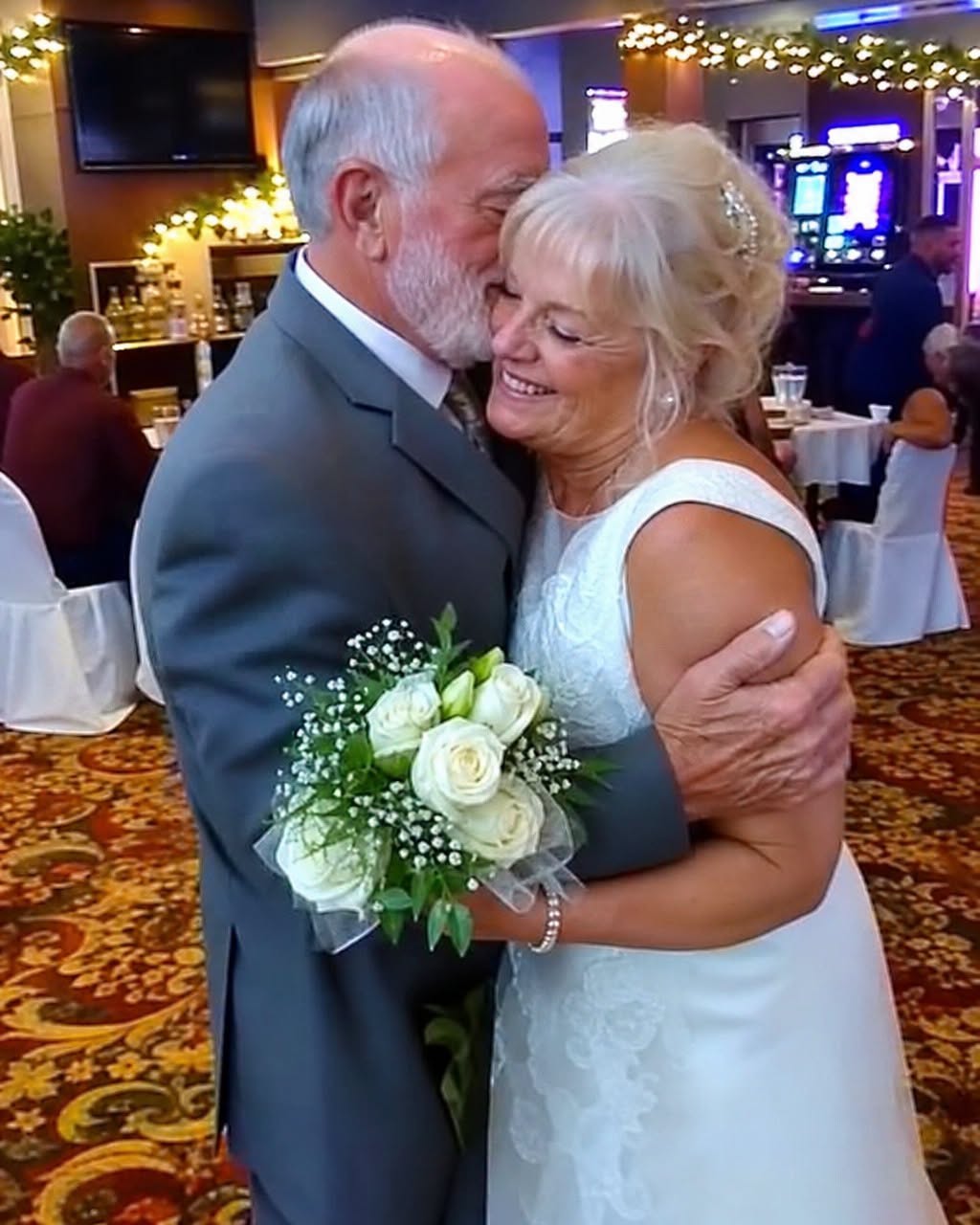
My Father Married My Aunt After My Mom Died — Then, at the Wedding, My Brother Leaned Over and Whispered, “Dad Isn’t Who He Pretends to Be”
The day my father married my aunt was supposed to be a new beginning for our family.
Instead, it became the day everything I thought I knew about my parents, my childhood, and the man who raised me began to fall apart.
My mother had been gone for eleven months when my father announced that he was getting married again. The news alone was difficult enough to process. But when he revealed that his bride was my mother’s younger sister, Aunt Rebecca, I felt as though someone had reached into my chest and torn something apart.
My aunt had been the person who held me while I cried at my mother’s funeral. She had promised that she would always look after us. She had told my younger brother, Daniel, that no one could ever replace our mother.
And now she was wearing a white wedding dress, standing beside our father, promising to spend the rest of her life with him.
Everyone seemed determined to call it a beautiful love story.
My father said my mother would have wanted him to be happy.
My aunt said their relationship had developed unexpectedly.
Relatives told us to be mature, to stop dwelling on the past, and to give them our blessing.
I tried.
I really did.
But something about the entire situation felt wrong.
My father had changed after my mother’s death. He became secretive with his phone, protective of his study, and strangely defensive whenever anyone mentioned the final months of her life.
Whenever I asked him questions, he gave me the same answer.
“Your mother is gone. We need to move forward.”
So I stopped asking.
Until the wedding day.
I was standing near the back of the reception hall when my younger brother, Daniel, suddenly grabbed my wrist.
His face was pale.
“Emily,” he whispered, “we need to talk.”
I turned toward him, expecting another argument about our father’s marriage.
Instead, he looked directly into my eyes and said six words that made the entire room seem to disappear.
“Dad isn’t who he pretends to be.”
Before I could ask what he meant, Daniel glanced toward the head table, where our father was laughing with his new bride.
Then he leaned closer.
“And Mom knew the truth before she died.”
My heart began to pound.
“What truth?”
Daniel swallowed hard.
“The reason Dad married Aunt Rebecca isn’t what everyone thinks. And if you want to know what really happened to Mom, you need to see something I found.”
He reached inside his jacket and pulled out a small, folded envelope.
My mother’s handwriting was on the front.
I hadn’t seen that handwriting in almost a year.
And suddenly, I wasn’t thinking about the wedding anymore.
I was thinking about the last time I had seen my mother alive.
Chapter One: The Woman Who Held Our Family Together
Before everything changed, our family looked ordinary from the outside.
My father, Richard, owned a successful construction business. He was respected in our community, generous at charity events, and always the first person to offer help when someone needed a favor.
People admired him.
They called him a devoted husband, a hardworking businessman, and a father who would do anything for his children.
My mother, Margaret, was the quiet strength behind our family.
She remembered everyone’s birthdays, kept old photographs in carefully labeled albums, and had a way of making even the smallest moments feel important.
When Daniel and I were children, she would sit on the edge of our beds at night and tell us that no matter how complicated life became, we should never be afraid to ask questions.
“Secrets have a way of growing,” she used to say. “And the longer people hide the truth, the harder it becomes to repair the damage.”
At the time, I thought she was talking about ordinary childhood mischief.
I never imagined those words would one day become the most important lesson she had ever given me.
My aunt Rebecca was five years younger than my mother. She had never married, and she had always been a frequent visitor to our home.
She and my mother were close, or at least I believed they were.
Rebecca helped Mom choose clothes for special occasions, joined us for Sunday dinners, and spent holidays with our family.
When Mom became ill, Rebecca was there more often.
She drove her to appointments, brought groceries, and sat beside her during difficult evenings.
I was grateful to her.
So was Daniel.
Neither of us had any reason to suspect that the woman comforting our mother might someday become our father’s wife.
Then Mom died.
And the family we thought we knew began to change.
Chapter Two: The Months After the Funeral
My mother died after a difficult illness.
The final months were filled with hospital visits, medication schedules, and conversations that stopped whenever she entered the room.
My father handled many of the practical arrangements. He spoke to doctors, managed the paperwork, and insisted that Daniel and I focus on our own lives.
At the time, I thought he was simply trying to protect us.
But looking back, I remembered several things that had seemed insignificant.
My mother sometimes became quiet when my father entered her hospital room.
On other occasions, she would ask him to leave so she could speak with Rebecca privately.
Once, I walked into the kitchen and found my aunt crying while Mom held her hand.
When I asked what was wrong, they both smiled too quickly.
“Nothing you need to worry about,” Mom told me.
I accepted the explanation because I wanted to believe that everything was going to be all right.
After the funeral, my father became increasingly distant.
He returned to work almost immediately. He stopped looking through family photographs. He avoided conversations about Mom, and he became irritated whenever Daniel asked whether we could keep some of her belongings in the living room.
“Your mother wouldn’t want us living in the past,” he said.
Then, about six months after her death, he announced that Rebecca had been helping him cope with his grief.
Another two months passed before he told us they were getting married.
I remember sitting at the dining table when he made the announcement.
Daniel dropped his fork.
I stared at my father, waiting for him to laugh and admit that he was joking.
He didn’t.
“Your mother would want me to be happy,” he said.
Rebecca sat beside him, looking down at her hands.
I asked whether their relationship had begun before Mom died.
My father’s expression hardened.
“How dare you ask me that?”
Rebecca immediately began crying.
She told us she had never intended to hurt anyone, that she and my father had found comfort in each other during a painful time, and that she hoped we would eventually understand.
But she never gave us a clear timeline.
And my father refused to discuss it further.
I left the house that evening with one thought repeating in my mind.
If their relationship had truly begun after Mom’s death, why were they so afraid of answering a simple question?
Chapter Three: My Brother’s Discovery
Daniel had always been more observant than I was.
He noticed things other people overlooked. He remembered conversations word for word and could tell when someone was avoiding a question.
After our mother’s death, he became particularly interested in her belongings.
He wasn’t searching for anything dramatic. He simply wanted to preserve her memory.
He collected her handwritten recipes, saved old birthday cards, and organized photographs into albums.
One afternoon, while sorting through a box of family papers, he found a folder containing copies of documents our mother had kept.
Some concerned ordinary household matters.
Others related to my father’s business and the family’s finances.
Daniel noticed that several pages were missing from a set of records. He also found an envelope with our mother’s handwriting on it.
It had been placed inside an old book she used to keep beside her bed.
The envelope wasn’t addressed to either of us.
It simply said:
For my children, when they are ready to know the truth.
Daniel didn’t open it immediately.
He told me later that he had been afraid of what it might contain. Part of him wanted to believe that our parents’ marriage had been happy until the very end.
He didn’t want to discover that the family he remembered had been built on lies.
But when our father announced his wedding to Rebecca, Daniel decided he couldn’t ignore the envelope any longer.
Inside, he found a letter and several photocopied documents.
He read them alone.
Then he read them again.
And according to Daniel, he spent the rest of that night sitting on the floor of his bedroom, trying to understand what our mother had been telling us.
He didn’t reveal the contents to me immediately.
He wanted to be certain that he understood them first.
By the morning of the wedding, he had made a decision.
He was going to tell me everything.
Chapter Four: The Wedding Nobody Could Stop Talking About
The wedding was held at an elegant country venue outside the city.
White flowers covered the tables. A string quartet played near the entrance, and waiters moved through the reception hall carrying trays of champagne.
My father had spared no expense.
He wanted everyone to see that he was beginning a new chapter of his life.
Rebecca looked beautiful in her wedding dress. She smiled for photographs, embraced relatives, and thanked everyone who had come to celebrate.
If I hadn’t known our family history, I might have believed it was an ordinary wedding.
But every time I looked at her, I remembered my mother’s funeral.
I remembered Rebecca holding my hands and promising that she would never let us feel alone.
Now she was standing beside the man who had shared my mother’s life for more than thirty years.
My father seemed happier than I had seen him in a long time.
He laughed loudly, shook hands with business associates, and raised his glass during a toast.
“Life gives us second chances,” he announced. “And sometimes, love finds us when we least expect it.”
The guests applauded.
I looked across the room at Daniel.
He wasn’t applauding.
He was staring at our father with an expression I couldn’t understand.
Then he approached me.
“Emily, we need to talk.”
His voice was so serious that I followed him away from the reception.
We stopped beside a quiet corridor near the gardens.
He took the envelope from his jacket.
“Mom left this for us.”
I recognized her handwriting immediately.
My hands began to shake.
“What’s inside?”
Daniel looked toward the reception hall.
“Proof that Dad lied to us.”
I stared at him.
“About what?”
He took a breath.
“About how his relationship with Rebecca started. About money. And about something Mom discovered before she died.”
I felt suddenly dizzy.
“What did she discover?”
Daniel placed the envelope in my hands.
“Read the letter first.”
I unfolded the paper.
The first sentence made my knees feel weak.
My dear children, if you are reading this, then I was unable to tell you the truth while I was alive.
I had to stop.
For a moment, I couldn’t see the words clearly.
Then I continued.
Chapter Five: The Letter My Mother Left Behind
My mother’s letter was written in careful handwriting, with several lines crossed out and rewritten.
She explained that she had become concerned about certain financial decisions my father had been making during the final year of her life.
At first, she thought he was simply dealing with the pressures of running his business.
But over time, she discovered that he had been making decisions without telling her.
Some involved money that belonged to the family.
Others concerned documents she had believed were being kept for safekeeping.
She had confronted him.
He insisted that everything was legitimate and told her she was worrying unnecessarily.
But the explanations didn’t satisfy her.
She began keeping copies of documents and writing down the dates of conversations she considered important.
She also described a painful disagreement with Rebecca.
According to the letter, my mother had learned that my aunt had been communicating privately with my father about matters that went beyond ordinary family support.
She didn’t claim to know everything that had happened between them.
But she wrote that their closeness had made her uncomfortable, especially because both of them had repeatedly assured her that there was nothing to hide.
One passage stood out.
I don’t know whether they have been honest with me about everything. I know only that when I ask questions, I am made to feel as though I am the problem.
I read that sentence several times.
My mother had been ill, frightened, and increasingly uncertain about the people closest to her.
And rather than giving her reassurance, the people she trusted had dismissed her concerns.
The letter continued.
She asked us not to accuse anyone without evidence. She warned us that grief could make people desperate for simple explanations and that we should examine the documents carefully before deciding what they meant.
Then she wrote something that changed the way I understood her final months.
If your father marries Rebecca, do not assume the marriage itself proves anything. But please, my children, do not allow anyone to use my death to silence your questions.
I lowered the letter.
Daniel was watching me.
“There’s more,” he said.
He removed the photocopied documents from the envelope.
And that was when we discovered the financial issue our mother had been trying to understand.
Chapter Six: The Documents That Raised More Questions
The documents included copies of financial transfers, business correspondence, and records related to a property our parents had owned for years.
Some of the information was difficult to interpret without professional help.
But one detail was clear: significant decisions had been made during the months before our mother’s death, and she had not understood why.
There were references to money moving between accounts connected to my father’s business and a separate entity associated with family assets.
The records did not, by themselves, prove fraud or establish that my father had done anything illegal.
They did, however, raise legitimate questions.
Why had my mother been excluded from decisions that affected their shared finances?
Why had my father refused to explain the transactions?
And why had several documents been missing from the folder she had kept?
Daniel had already spoken to someone who understood financial records. That person had advised him not to jump to conclusions and to preserve the documents in their original form.
I was grateful he had done that.
The last thing we wanted was to destroy evidence or accuse someone publicly before understanding what had happened.
But the timing troubled me.
Some of the financial activity had occurred while our mother was seriously ill.
Other records suggested that plans involving the property had been discussed before the wedding announcement.
None of this established that my father and Rebecca had planned their marriage while Mom was alive.
Still, it made their refusal to answer questions feel even more troubling.
I looked at Daniel.
“Does Dad know you found these?”
He shook his head.
“Not yet.”
“Does Rebecca?”
“I don’t think so.”
We stood in silence, listening to the distant music from the reception.
Then Daniel said something I would remember for the rest of my life.
“Emily, I don’t want revenge. I just want to know whether Mom spent her final months being lied to.”
I looked down at the letter.
For the first time since her death, I realized that our mother’s story might not have ended when we said goodbye at the funeral.
There were still questions waiting for answers.
And the people who could answer them were celebrating a wedding just a few rooms away.
Chapter Seven: The Confrontation at the Reception
I returned to the reception hall with the letter folded inside my handbag.
My father was standing near the head table, speaking to several guests.
Rebecca noticed me first.
She smiled and motioned for me to come closer.
“There’s my girl!” she said. “Come and have a photograph with us.”
I looked at her.
For years, I had called her Aunt Rebecca.
Now I didn’t know what to call her.
I waited until the guests moved away.
Then I asked quietly, “Did you know Mom was keeping documents about Dad’s business?”
Her smile disappeared.
“What are you talking about?”
“She left us a letter.”
Rebecca glanced toward my father.
The look was brief, but I noticed it.
“Emily, this isn’t the time,” she said.
“When would be a good time? After everyone leaves? Next year? When we’re no longer allowed to ask questions?”
My father approached us.
“What is going on?”
I looked directly at him.
“Daniel found something Mom left behind.”
His expression changed.
Only slightly.
But enough.
“What did he find?”
“A letter. And some financial records.”
My father lowered his voice.
“You shouldn’t be discussing private family matters at my wedding.”
“Then you should have answered our questions before today.”
Rebecca began crying.
She said she had loved my mother and had never wanted to hurt her.
I asked whether she had been communicating with my father about his business and the family property before Mom died.
She didn’t answer directly.
Instead, she said my mother had been under tremendous emotional pressure and that some of her suspicions might have come from misunderstandings.
That was when Daniel stepped beside me.
“Mom specifically asked us not to let anyone dismiss her concerns.”
My father stared at him.
“Give me those documents.”
Daniel shook his head.
“No.”
The room around us seemed to grow quieter.
My father had spent his entire life expecting people to obey him. He was accustomed to being the person who ended arguments, made decisions, and decided when a conversation was over.
But this time, neither of us moved.
“We’re not going to destroy anything,” I said. “We’re going to have the documents reviewed properly, and we’re going to get answers.”
My father’s face reddened.
“You are accusing me of betraying your mother on my wedding day?”
I swallowed hard.
“I’m asking you to explain what happened.”
For several seconds, he said nothing.
Then he turned toward the guests and announced that he needed a moment with his children.
The wedding music continued.
But the celebration was no longer the same.
Chapter Eight: The Truth Rebecca Finally Admitted
We moved into a private room adjoining the reception hall.
My father insisted that we were misunderstanding everything.
He said the financial transactions were related to ordinary business decisions and that our mother had not been involved because she had not wanted to deal with the company’s paperwork.
Daniel pointed out that Mom’s letter specifically described asking for explanations.
My father said she had become anxious during her illness.
I asked why he hadn’t simply shown her the records if everything was legitimate.
He didn’t answer.
Rebecca sat in a chair near the window, crying quietly.
Finally, she spoke.
“There are things I should have told Margaret.”
My father turned sharply toward her.
“Rebecca, stop.”
She shook her head.
“No. I’m tired of pretending.”
She admitted that she had known about some of the financial arrangements before our mother’s death. She said she had helped my father organize certain documents and had believed that the decisions were temporary.
She also acknowledged that she and my father had become emotionally close before Mom died.
The room went completely silent.
I felt as though the floor had shifted beneath me.
“How long?” I asked.
Rebecca covered her face.
“I can’t give you an exact date.”
“But you knew Mom was worried about you.”
She nodded.
“And you let her believe nothing was happening?”
“I didn’t know how to tell her.”
I stared at the woman who had once promised to protect us.
“She was your sister.”
Rebecca began sobbing.
“I know.”
My father stood up and insisted that their relationship had not been what we imagined. He said they had not intended to betray our mother and that their feelings had developed during a complicated period.
But his explanation did not erase Rebecca’s admission.
They had become emotionally close while my mother was still alive.
They had withheld information from her.
And when she asked questions, they had failed to give her the honesty she deserved.
That did not answer every question about the finances, nor did it establish the full timeline of their relationship.
But it was enough to confirm that the story we had been told was incomplete.
I looked at my father.
“Mom deserved the truth.”
He lowered his eyes.
For the first time, he did not argue.
Chapter Nine: The Question Nobody Could Answer
There was one question I still needed to ask.
I turned to Rebecca.
“Did Mom know you were going to marry Dad?”
Rebecca shook her head, then hesitated.
“She knew we were close,” she said. “But I don’t think she understood how serious things had become.”
“Did you tell her?”
“No.”
I felt tears burning behind my eyes.
My mother had spent her final months trying to understand why the people closest to her were behaving differently.
She had asked questions.
She had tried to make sense of documents she didn’t understand.
And the people who could have reassured her had chosen silence.
I wanted to believe that they had simply been frightened, confused, and selfish.
Perhaps that was true.
But I also knew that their intentions could not erase the consequences.
My mother had deserved honesty, especially when she was vulnerable.
Instead, she had been left with uncertainty.
I asked my father whether he regretted keeping things from her.
He stared at the floor.
“Yes,” he finally said.
It was the first direct answer he had given us that day.
But regret was not the same as accountability.
I told him that Daniel and I would arrange for the financial records to be reviewed by an independent professional. If there were legal issues, we would seek appropriate advice and follow the evidence wherever it led.
We would not make public accusations based on assumptions.
We would not destroy documents to protect anyone’s reputation.
And we would not allow our mother’s concerns to be dismissed simply because she was no longer alive to explain them.
My father nodded slowly.
Rebecca said she understood.
But neither of them asked how we were feeling.
Neither offered a real apology for the way they had treated our mother during her final months.
And as I looked at them, I realized that the hardest part of this discovery was not the possibility that they had betrayed our mother.
It was seeing how easily they had expected us to accept their version of events.
Chapter Ten: Walking Away From the Wedding
Daniel and I left the reception before the cake was cut.
Outside, the air was cool, and the parking lot was illuminated by rows of small lights.
We stood beside my car for several minutes without speaking.
Finally, Daniel asked whether I was okay.
I laughed bitterly.
“No. But I think I will be.”
He nodded.
“I kept thinking that maybe I shouldn’t have told you today.”
I took his hand.
“You did the right thing by showing me what Mom left. We can decide what to do next without rushing into anything.”
He looked relieved.
We agreed to preserve the documents, make copies for safekeeping, and seek independent advice before drawing conclusions about the financial transactions.
We also agreed that our mother’s letter would remain private unless there was a compelling reason to share it.
She had written it for her children, not for an audience.
As we drove away, I looked back at the venue.
The lights were still shining.
The guests were probably returning to their tables, wondering why the bride’s niece and the groom’s son had disappeared.
I no longer cared what they thought.
For months, I had tried to convince myself that accepting my father’s marriage was the same thing as moving forward.
Now I understood that moving forward did not mean pretending the past had never happened.
It meant facing it honestly.
And sometimes, that required walking away from a celebration that no longer felt like something worth celebrating.
Chapter Eleven: What We Discovered After the Wedding
In the weeks that followed, Daniel and I focused on understanding the records.
We arranged for an independent professional to review the financial documents and explain what they did—and did not—establish.
Some transactions had ordinary business explanations.
Others required additional documentation.
We requested the missing records through appropriate channels and avoided making assumptions about matters we could not verify.
The process was slower than we had hoped.
There were meetings, paperwork, difficult conversations, and moments when we wondered whether we would ever have a complete picture of what had happened.
My father initially resisted cooperating.
He argued that we were invading his privacy and disrespecting his new marriage.
I reminded him that we were not asking for access to every detail of his personal life.
We were asking for clarity about records our mother had specifically preserved because she believed something was wrong.
Eventually, he agreed to provide additional information through the appropriate process.
The review helped clarify several issues, although not every question was answered to our satisfaction.
We learned that our mother had legitimate reasons to ask for explanations about certain financial decisions. We also learned that some of her suspicions had remained unresolved because she had not received complete information while she was alive.
What we did not find was a basis for confidently claiming that every financial transaction was improper or that a particular action had caused her death.
Those were serious matters, and we refused to turn uncertainty into accusations.
But one fact remained undeniable.
Our mother had asked for honesty.
And the people closest to her had not given her the answers she deserved.
Chapter Twelve: The Last Gift My Mother Left Us
Several months later, I returned to my childhood home to collect some photographs and personal belongings.
My father and Rebecca were still married.
Their relationship had become a subject of quiet speculation among relatives, but Daniel and I refused to participate in gossip.
We knew enough to understand why trust had been damaged.
We also knew that there was more to the story than outsiders could see.
While sorting through an old cabinet, I found another photograph of my mother.
She was standing in our garden, laughing at something outside the frame. Her hair was pulled back, and she was wearing the blue sweater she had loved.
I sat on the floor and held the photograph for a long time.
I missed her voice.
I missed her advice.
I missed the way she could make a difficult conversation feel less frightening simply by sitting beside me.
Then I remembered the final lines of her letter.
Whatever you discover, remember that you are allowed to love people without pretending they have never hurt you. You are allowed to ask questions. And you are allowed to protect your peace.
For months, I had been searching for a single revelation that would explain everything.
I had imagined that one document, one confession, or one undeniable piece of evidence would finally make sense of our family’s pain.
But life rarely provides answers so neatly.
What my mother had left us was not a perfect explanation.
It was permission to stop pretending.
Permission to acknowledge that someone we loved had hurt us.
Permission to ask questions without feeling guilty.
And permission to remember her as a person who deserved honesty, rather than reducing her to a tragedy that everyone else wanted to move past.
I placed the photograph carefully inside my bag.
Then I left the house.
The Truth That Changed Everything
I don’t know whether I will ever fully forgive my father.
Perhaps I will, one day.
Perhaps our relationship will become something quieter, more distant, but still meaningful.
I have learned that forgiveness is not a deadline, and it is not something another person can demand simply because enough time has passed.
Rebecca and I have barely spoken since the wedding.
I cannot look at her without remembering my mother’s letter and the questions she never had the chance to resolve.
Maybe that will change someday.
But for now, distance is what I need.
Daniel and I have grown closer through everything that happened. We still talk about Mom, and we have started a tradition of visiting her favorite garden every year on her birthday.
Sometimes we laugh about the little things she used to do.
Sometimes we sit in silence.
And sometimes we discuss the questions that remain unanswered.
We don’t pretend that everything is fine.
We simply refuse to let the uncertainty destroy the parts of our family that are still worth protecting.
Looking back, the most shocking moment of my father’s wedding wasn’t the revelation that he and my aunt had grown emotionally close before my mother died.
It wasn’t even the financial documents that raised so many questions.
It was the moment I realized that my mother had spent her final months trying to tell us something, and the people around her had made her feel as though she was wrong to ask.
She deserved better than that.
And so did we.
My father married my aunt believing that the past could be buried beneath flowers, photographs, and wedding vows. But my mother’s letter reminded us that the truth doesn’t disappear just because people stop talking about it.
That day, my brother and I lost the comforting version of our family we had carried for years.
But we gained something important in return.
We gained the courage to ask questions.
We gained the freedom to make our own judgments.
And we learned that honoring someone who has died sometimes means refusing to let their story be rewritten by the people who remain.
The wedding was supposed to mark the beginning of my father’s new life.
Instead, it became the day my brother and I finally began uncovering the truth about the old one.
And we were no longer willing to look away.
Editorial note: This is a fictional family drama inspired by the supplied headline. The characters, documents, and events are invented and are not presented as a verified real-life account.