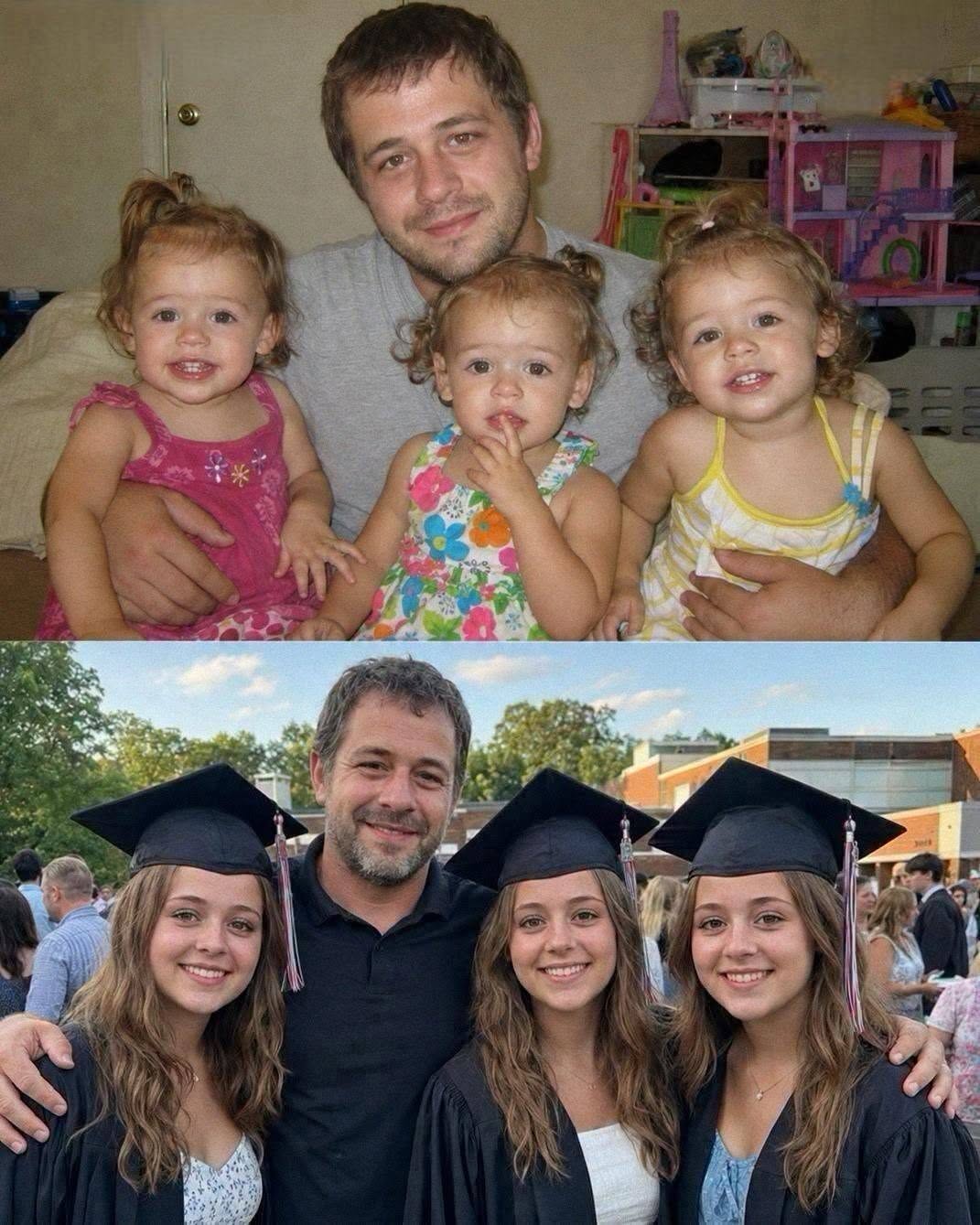
I Gave Up 22 Years of My Life Raising My Triplet Nieces — What They Did at Their College Graduation Changed Everything
Noah Carter was thirty-one years old when a single phone call shattered the future he had spent years imagining.
It was a Tuesday morning, and nothing about the day seemed unusual. Sunlight filtered through the kitchen window of his small apartment, casting pale rectangles across the table. His coffee was still warm, and a half-finished list of errands lay beside his phone. He had plans for the coming weekend, a few projects he wanted to finish at work, and a savings account he hoped would eventually help him buy a house.
At thirty-one, Noah believed his life was finally beginning to take shape.
He had worked hard to establish himself professionally. He had friends he occasionally met for dinner, hobbies he enjoyed when time allowed, and dreams of traveling to places he had only seen in photographs. He had also begun thinking more seriously about settling down. He imagined that, someday, he might meet someone with whom he could build a home and perhaps raise children of his own.
He had no reason to believe that everything would change before lunchtime.
Then his phone rang.
The number belonged to a hospital he didn’t recognize. He answered casually, expecting perhaps a routine question or an administrative matter.
Instead, a stranger introduced herself as a member of the hospital staff and asked whether he was Emily Carter’s brother.
“Yes,” Noah replied. “Is something wrong?”
There was a pause on the other end of the line. It lasted only a few seconds, but later Noah would remember it as one of the longest moments of his life.
His older sister, Emily, and her husband had been involved in a serious car accident. Emergency responders had taken them to the hospital, but neither had survived.
For several seconds, Noah couldn’t process the words.
He asked the woman to repeat herself. Then he asked whether she was certain she had the right family. He wanted to believe that there had been a misunderstanding, that someone had confused names or that another phone call would arrive to correct the terrible news.
But the woman spoke gently and clearly.
There had been no mistake.
Emily was gone.
Her husband was gone.
And their three infant daughters, Emma, Lily, and Grace, had suddenly lost both parents.
Noah sat motionless at the kitchen table. His coffee cooled beside him, unnoticed. He could hear the woman speaking about the next steps, but her words seemed to come from somewhere far away.
He had spoken to Emily only a few days earlier. She had laughed about how little sleep she was getting and complained affectionately about the difficulty of managing three babies at once. She had told him that motherhood was exhausting but wonderful, and that she couldn’t imagine loving anything more than her daughters.
Now he would never hear her voice again.
He ended the call only after receiving the hospital’s address and a request to come as soon as possible.
He grabbed his keys and left the apartment without finishing his coffee.
During the drive, memories flooded his mind. He remembered Emily as a little girl, running ahead of him through their childhood home. He remembered their teenage arguments, the holidays they spent together, and the way she had always defended him when he felt uncertain about himself.
He remembered her wedding day, when she had smiled at him and whispered that he was going to be the uncle who spoiled her children.
He had laughed and promised to buy them far too many presents.
He had never imagined that he would one day be responsible for raising them.
Three Little Girls and One Impossible Decision
When Noah arrived at the hospital, a nurse led him through a quiet corridor toward the nursery.
The building smelled faintly of disinfectant and fresh linen. Somewhere in the distance, a machine beeped steadily. Nurses moved between rooms, speaking in low voices, while families waited for news about people they loved.
Noah felt as though he had entered a world that no longer followed the rules of ordinary life.
A hospital social worker met him near the nursery and explained what had happened. She spoke compassionately, allowing him time to absorb each detail.
Then she took him to the window overlooking the babies.
There they were.
Emma, Lily, and Grace.
Three tiny girls wrapped in soft blankets, unaware that the people who had brought them into the world would never return.
One baby slept with her hands tucked beneath her chin. Another moved restlessly, making small sounds in her sleep. The third had begun to cry, her face turning red as a nurse gently lifted her.
Noah placed his palm against the glass.
He remembered holding the girls shortly after they were born. Emily had been exhausted but radiant, insisting that he hold each baby separately because she wanted him to understand that every one of them was special.
“They may look alike,” she had told him, “but wait until they grow up. You’ll see how different they are.”
Noah had smiled and told her that he would probably never be able to tell them apart.
Emily had laughed.
“Of course you will. You’re their uncle.”
That memory hurt more than he expected.
The social worker explained that the family needed to decide who would care for the children. There would be legal arrangements, financial considerations, and a great deal of practical planning.
Noah understood the words, but he was barely listening.
He was thinking about the babies.
Who would wake up when they cried? Who would comfort them when they were frightened? Who would attend their first birthdays, teach them to walk, and answer the questions they would eventually ask about their parents?
He had no experience raising children. He had never prepared a bottle in the middle of the night or changed a diaper. He lived alone in a small apartment and worked long hours. He had neither the money nor the knowledge required to raise three infants.
For the first time, he understood how little he knew about the life that might be waiting for him.
The social worker gently asked whether he had considered taking responsibility for the girls.
Noah looked at her, then turned back toward the nursery.
He imagined them growing up in different homes. He imagined birthdays spent apart, separate family traditions, and three sisters trying to understand why their lives had been divided after losing their parents.
He couldn’t bear the thought.
“I’ll take them,” he said quietly.
The social worker seemed surprised by the certainty in his voice.
“All three of them?”
Noah nodded.
“All three.”
“Mr. Carter, this will be a significant responsibility. You’ll need support, and there will be a lot to arrange before they can leave the hospital.”
“I understand.”
He didn’t, not really. He could not yet imagine the sleepless nights, financial pressure, emotional exhaustion, or thousands of decisions that would follow.
But he understood one thing clearly.
The girls had already lost too much.
He would not let them lose their family, too.
As he stood there, Noah made a promise he would carry for the next twenty-two years.
He would give them a home.
He would give them stability.
And, as far as he could, he would make sure they never had to wonder whether someone wanted them.
He would spend much of his adult life discovering just how much that promise would require.
Bringing the Babies Home
The first challenge was learning how to care for three infants simultaneously.
Noah’s apartment had never been designed for children. The living room contained a sofa, a television, a bookshelf, and a small desk where he sometimes worked late into the evening. Within days, the furniture was rearranged to make room for three cribs, a changing table, bags of diapers, and boxes of supplies.
He spent hours reading instructions and watching demonstrations about feeding, bathing, and soothing babies. He wrote schedules on sheets of paper and taped them to the refrigerator.
Emma’s feeding time.
Lily’s medication instructions.
Grace’s next appointment.
He quickly discovered that a schedule could be useful without ever being entirely reliable.
One baby would begin crying just as he finished feeding another. A bottle would roll beneath the sofa. Someone would need a diaper change immediately after Noah had washed his hands.
Sometimes all three cried at once.
On those nights, he moved between the cribs, picking up one baby, then another, speaking softly even when he felt close to tears himself.
“It’s all right,” he would whisper. “I’m here. I’ve got you.”
He repeated those words so often that they became a kind of prayer.
The first few weeks passed in a blur of exhaustion.
Noah learned to sleep in short stretches. He discovered that coffee could become a meal when he was too tired to cook, and that a load of laundry could wait longer than a crying baby.
He forgot appointments, misplaced paperwork, and occasionally stood in the kitchen unable to remember why he had walked into the room.
More than once, he called an older relative to ask a question that seemed embarrassingly simple.
Was it normal for a baby to cry for so long?
How could he tell whether they were hungry or simply tired?
What should he do when one refused to sleep?
He worried constantly about making mistakes.
Every cough made him anxious. Every unfamiliar sound sent him searching through books and medical instructions. When one of the girls developed a fever, he spent a frightening night monitoring her temperature and calling for professional advice.
He had never felt so responsible for another human being.
And he had never felt so alone.
Friends offered help when they could. Some brought food or helped assemble furniture. Others contributed clothes and baby supplies.
Noah was grateful for every gesture, but he quickly realized that raising three children was not a problem that could be solved by occasional acts of kindness.
It was a daily commitment.
It required him to show up when he was tired, frightened, frustrated, or uncertain.
It required him to keep going even when nobody was there to tell him that he was doing well.
He began to understand that love was not only a feeling.
Sometimes it was preparing another bottle at three in the morning.
Sometimes it was washing tiny clothes while the rest of the neighborhood slept.
And sometimes it was sitting on the floor beside three cribs, exhausted and overwhelmed, refusing to walk away because three little girls needed him.
The First Sacrifices
Within six months, Noah’s savings had begun to disappear.
The expenses were relentless. Formula, diapers, medical appointments, clothing, childcare, and the ordinary costs of maintaining a household added up faster than he had anticipated.
He started tracking every dollar.
He stopped ordering takeout, canceled subscriptions he rarely used, and postponed buying anything that wasn’t necessary. When his car needed repairs, he delayed the work until he could no longer safely do so.
Eventually, he had to make a decision about his job.
His employer had been understanding, but Noah could not continue working the same long hours while managing three infants without reliable childcare. He requested a reduction in his schedule, accepting the accompanying decrease in income.
It was a difficult choice.
He had worked hard to build his career, and he knew that reducing his hours might slow his professional progress. Yet the girls needed him more than his career needed another late night at the office.
He made the change.
Some evenings, after putting the babies to bed, he opened his laptop and tried to finish work he hadn’t managed during the day. He answered emails while laundry spun in the background and reviewed documents between interrupted stretches of sleep.
His colleagues moved forward with projects and promotions while he learned to measure success differently.
For Noah, a good day meant that all three girls had eaten, slept reasonably well, and smiled at least once.
He stopped thinking about the life he might have had because dwelling on it made the present harder to manage.
He told himself he would return to his own plans someday.
Someday, he would travel.
Someday, he would buy a house.
Someday, he would have time to build a relationship and explore interests beyond his responsibilities.
For now, the girls came first.
What he did not realize was that “someday” could quietly become a habit.
Years would pass before he understood how thoroughly he had organized his identity around putting his own life second.
Learning to Be Their Parent
As the girls grew, Noah became more confident.
He learned which cries meant hunger, which meant discomfort, and which simply meant that someone wanted to be held. He could prepare three breakfasts almost simultaneously and had a remarkable ability to find missing socks.
He also developed a sense of humor about the chaos.
When a friend asked how he managed three children, Noah replied, “Very carefully, and usually with at least one cup of coffee I never get to finish.”
The girls began crawling, then walking, then running through the apartment with an energy that seemed impossible for their small bodies.
Their personalities emerged in ways Noah could never have predicted.
Emma was observant and methodical. Even as a toddler, she seemed fascinated by how things worked. She liked arranging toys in neat rows and became upset when someone changed her carefully organized systems.
Lily was fearless. She climbed furniture, explored cupboards, and approached unfamiliar situations with the confidence of someone who believed the world existed to be investigated.
Grace was quieter, but she noticed everything. She often sat beside Noah when he looked tired, leaning against him without asking questions.
One evening, when the girls were still very young, Noah sat on the floor surrounded by blocks and toys. He had spent the day dealing with a difficult work problem, followed by a trip to the grocery store and an argument over bedtime.
He was exhausted.
Grace climbed into his lap and touched his face.
“Uncle Noah sad?”
He tried to smile.
“No, sweetheart. Just tired.”
She considered this answer for a moment before wrapping her small arms around his neck.
“Rest here.”
The simplicity of her words nearly broke his heart.
He held her close, listening to the sounds of her sisters playing nearby.
He had worried that he would never be enough for three children who had lost so much.
Yet in that moment, he realized that they were not asking him to be perfect.
They were asking him to stay.
So he stayed.
He attended their medical appointments, learned to braid hair well enough for school mornings, and practiced making three lunches without mixing up everyone’s preferences.
He memorized favorite bedtime stories. He learned which songs calmed them down and which snacks could repair a disappointing afternoon.
He became the person who checked under the bed after nightmares and sat beside them when thunder shook the windows.
He also became the person who established boundaries.
He taught them to apologize when they hurt one another, to tell the truth even when it was uncomfortable, and to understand that kindness mattered more than winning an argument.
He made mistakes along the way. Sometimes he was too protective. Sometimes he was so worried about their safety that he struggled to let them explore the world independently.
When he recognized those tendencies, he tried to change.
He wanted the girls to grow up with confidence, not fear.
He wanted them to understand that losing their parents was a terrible part of their story, but it did not have to define every chapter that followed.
Keeping Their Parents Alive in Their Memories
As the girls approached school age, they began asking more questions about their mother and father.
Why didn’t they have a mother at school events?
Where were their parents buried?
What had Emily been like when she was young?
Why did other children have family photographs that included both parents?
Noah knew he could not protect them from every painful question.
He could only answer honestly and make sure they knew they were allowed to feel whatever they felt.
He created a small album filled with photographs of Emily and her husband. He included pictures from their childhood, their wedding, holidays, and the early days after the triplets were born.
Whenever possible, he told the girls stories that brought their parents to life.
He described Emily’s habit of singing while she cooked. He explained how she had once spent an entire afternoon trying to repair a broken bicycle because she refused to admit defeat.
He told them that their father had been patient, funny, and wonderfully stubborn about certain things.
He made sure the girls understood that they had been deeply wanted.
“Your mother loved you before she ever saw your faces,” he told them one evening. “And your father was so proud of you. I wish they could have watched you grow up.”
Emma listened quietly, absorbing every word.
Lily asked a dozen questions.
Grace cried.
Noah held them and allowed the sadness to exist without trying to erase it.
He did not pretend that love could make every loss disappear.
Instead, he tried to show them that love could remain even when the person who had given it was no longer physically present.
On birthdays, he encouraged them to celebrate their lives while also remembering their parents. On anniversaries, he allowed the house to become quieter and made space for memories.
Sometimes he found himself missing Emily so intensely that he had to step into another room.
He would look at a photograph of her and wonder what she would think of the young women her daughters were becoming.
Would she laugh at Lily’s boldness?
Would she be impressed by Emma’s determination?
Would she recognize herself in Grace’s thoughtful eyes?
He wished he could tell her everything.
He wished he could call her and say, “They’re growing up. They’re doing well. I think you’d be proud.”
Instead, he carried those conversations silently.
He never regretted taking the girls in, but he understood that raising them meant carrying grief alongside love.
Both feelings became part of his life.
The Years He Quietly Gave Away
By the time Noah reached his late thirties, the triplets had become the center of nearly every decision he made.
His friends had begun settling into lives that looked very different from his own.
Some married and bought houses. Others traveled internationally, changed careers, or spent weekends pursuing hobbies. Their social gatherings increasingly revolved around couples, holidays, and plans that Noah could rarely join.
He was happy for them.
At the same time, he occasionally felt like someone watching life through a window.
He had dated a few times after the girls were old enough to sleep through the night, but relationships proved difficult to maintain.
There was always a school emergency, a financial problem, or a moment when one of the girls needed more attention than he had expected.
One relationship had ended after a woman he cared about admitted that she could no longer imagine where she fit into his life.
“You give everything to those girls,” she told him during their final conversation. “I admire that. But I don’t think there’s room for me.”
Noah wanted to disagree.
He wanted to explain that he cared about her, too, and that he was trying his best to balance everything.
But he knew she had identified a real problem.
He had become so accustomed to responding to the girls’ needs that he struggled to make space for his own desires, much less someone else’s.
He let the relationship end without resentment.
Then he returned to the life he understood.
At work, he became reliable and experienced, though his career did not progress as quickly as he had once hoped. He chose stability over opportunities that required travel or unpredictable hours.
He moved the girls into a more comfortable home when he could afford it, but he postponed buying the house he had once dreamed about.
He learned to repair broken appliances, shop for school supplies on a budget, and stretch a modest income across three growing children.
There were years when he worked extra hours during holidays, taking advantage of seasonal opportunities to build savings for the girls’ education.
He became an expert at making ordinary celebrations feel special.
Birthdays were decorated with homemade banners and carefully chosen gifts. Holidays included traditions that the girls came to associate with safety and belonging.
Noah made sure they never felt that their lives were smaller because their family had changed.
He encouraged them to invite friends over, participate in extracurricular activities, and pursue opportunities even when they seemed expensive or inconvenient.
Whenever he had to say no, he explained why. Whenever he could say yes, he tried to do so without making them feel guilty about the cost.
He never wanted them to grow up believing that their existence had ruined his life.
If anything, he wanted them to know that he had chosen this life because he loved them.
Still, some nights, after the house was quiet, he wondered what had happened to the man he had been before the accident.
He could remember his old interests, but they seemed to belong to someone younger.
He could remember his dreams, but they felt distant and unfamiliar.
He had become so good at being responsible that he had almost forgotten how to be spontaneous.
And because the girls were happy and thriving, he rarely gave himself permission to acknowledge the cost.
Three Different Dreams
As the girls entered their teenage years, Noah’s role began to change.
They no longer needed him to tie their shoes or pack their schoolbags. They could prepare meals, organize their schedules, and manage many of their own responsibilities.
They needed different things from him now.
Emma needed someone who would listen carefully when she worried about academic performance. She placed enormous pressure on herself and sometimes interpreted an imperfect result as evidence that she had failed.
Noah learned to remind her that achievement was not the same as worth.
“You don’t have to be the best at everything,” he told her one evening after she received a disappointing grade.
Emma frowned. “But I know I could have done better.”
“Maybe you could have. That doesn’t mean you should punish yourself for being human.”
She looked at him for a long moment before nodding.
Lily needed room to explore. She was passionate, outspoken, and impatient with rules that seemed unnecessary. Noah worried about her taking risks, but he gradually learned that protecting her did not mean controlling every decision.
He encouraged her to ask questions, defend her ideas respectfully, and accept the consequences of her choices.
Grace needed reassurance that her quiet nature was not a weakness. She loved writing, drawing, and spending time alone, and sometimes worried that she was less impressive than her sisters.
Noah made a point of celebrating her creativity.
When she wrote a short story for school, he read it twice and asked her about the characters. When she hesitated to share her work with others, he reminded her that not every valuable thing needed to be loud.
He was proud of how different the girls were becoming.
He had never wanted three copies of the same person.
He wanted three young women who could recognize their strengths, learn from their mistakes, and build lives that felt genuinely their own.
By their final years of high school, the house was filled with university brochures, application forms, scholarship information, and conversations about the future.
The girls spoke excitedly about the places they might go and the people they hoped to become.
Noah helped them complete forms, review essays, and prepare for interviews.
He encouraged them to apply for opportunities beyond their immediate comfort zone.
“You have worked hard for this,” he told them. “Don’t make your world smaller just because something feels unfamiliar.”
He meant every word.
Yet when the acceptance letters finally arrived, he discovered that he had not fully prepared himself for what those opportunities would mean.
Emma received an offer from a university with an excellent academic program.
Lily was accepted into a school where she could pursue communications and leadership.
Grace received an offer from a university with a creative writing program she had admired for years.
The girls screamed, hugged one another, and rushed around the house waving their letters.
Noah joined their celebration, laughing and wiping tears from his eyes.
But later that evening, when they were discussing housing arrangements and course schedules, he went into the kitchen and stood quietly beside the sink.
They were leaving.
The thought filled him with pride.
It also frightened him more than he wanted to admit.
When the House Began to Empty
The transition happened gradually.
First, there were campus visits and orientation days. Then came shopping trips for bedding, notebooks, laptops, and other things the girls would need.
Noah helped them pack, carefully folding clothes and labeling boxes.
He reminded them to keep copies of important documents, save emergency contact numbers, and call if they needed help.
He tried to make his advice practical rather than sentimental.
He didn’t want the girls to feel that leaving home meant abandoning him.
But after they had gone to bed, he sometimes found himself standing outside their rooms.
The posters on the walls, the books on the shelves, and the small objects they had collected over the years suddenly looked like pieces of a life that was moving away from him.
He remembered the first night he had brought them home.
He remembered wondering how he would manage three infants.
Now he was trying to understand how he would manage a house without three young women moving through it.
The first departure was especially difficult.
Noah carried Emma’s boxes to the car and helped her arrange everything in her new room. She hugged him tightly before he left.
“Thank you for everything,” she whispered.
He smiled.
“Just study hard, take care of yourself, and remember that you can call me whenever you need anything.”
“I will.”
He drove home alone.
The silence in the car seemed unusually loud.
At home, he walked into the kitchen and found one of Emma’s favorite mugs sitting beside the sink. He picked it up, washed it, and placed it carefully in the cupboard.
It was an ordinary object.
Yet he held it longer than necessary.
Over the following months, Lily and Grace left for their own university experiences.
The house grew quieter.
Noah still spoke with the girls regularly. They called to ask questions, tell him stories, and share their successes. Sometimes all three joined the same video call, interrupting one another while trying to explain everything that had happened that week.
Those conversations made him happy.
But after each call ended, he returned to the same quiet rooms.
He no longer needed to buy groceries for four people. The laundry basket filled more slowly. Weekends stretched before him without the familiar schedule of school events, activities, and family obligations.
For years, he had dreamed of having this much time.
Now he struggled to fill it.
He tried watching television, but he could never settle on anything. He began cleaning cupboards that did not need cleaning. He reorganized tools in the garage and sorted old paperwork.
He made himself useful because usefulness was familiar.
What he could not figure out was how to be content without having someone who needed him to do something.
Graduation Day
Twenty-two years after the accident, Noah found himself sitting in a crowded university auditorium, waiting for the ceremony that would mark the end of the girls’ undergraduate years.
He had arrived early, dressed in a dark suit he had not worn in years. He had polished his shoes, checked his phone several times, and brought a small gift for each girl.
The auditorium was filled with families. Parents leaned into the aisles to take photographs, grandparents held bouquets, and younger siblings waved handmade signs.
Noah watched them all with a mixture of excitement and nostalgia.
He remembered the hospital nursery.
He remembered the first night home, when he had sat between three cribs and wondered whether he was capable of raising the girls.
He remembered their first steps, their first days of school, their teenage arguments, and the long evenings spent helping with homework.
He remembered working extra hours to save money for their education.
He remembered the times he had wanted to give up, followed by the moments that reminded him why he never would.
When the ceremony began, he held his phone ready.
One by one, the graduates crossed the stage.
Then the names he had waited to hear were announced.
Emma Carter.
Lily Carter.
Grace Carter.
Noah stood and applauded so enthusiastically that he barely noticed the people around him smiling.
His eyes filled with tears.
The three babies he had once carried into his home had become educated, capable young women.
They had survived a childhood marked by loss, and they were stepping into a future with possibilities their parents had never been able to see.
He felt proud in a way that seemed too large for words.
When the ceremony ended, the graduates streamed into the lobby. Families embraced, flowers changed hands, and cameras flashed.
Noah waited near the edge of the crowd.
He expected the girls to find him quickly, as they always had.
For a few moments, however, he stood watching other families celebrate.
A father adjusted his daughter’s graduation cap. A mother cried while holding her son. An older couple embraced a young woman who kept laughing through her tears.
Noah smiled at the happiness around him.
Then he felt something unexpected.
Loneliness.
Not the sharp loneliness of having no family, but the strange emptiness of realizing that the role he had occupied for twenty-two years was changing.
He had spent his adulthood being the person who made everything possible for the girls.
Now they were standing at the beginning of their own independent lives.
He was happy for them.
But he had no idea what he was supposed to do next.
When Emma, Lily, and Grace finally reached him, he wrapped his arms around all three.
“I’m so proud of you,” he said, his voice breaking.
Emma hugged him tightly.
“We couldn’t have done this without you.”
Lily wiped her eyes.
“You gave us everything.”
Grace held his hand.
“We love you, Uncle Noah.”
He wanted to tell them that they were the best thing that had ever happened to him. He wanted to tell them that every sacrifice had been worth it.
Instead, he simply held them for another moment.
He did not want them to see the uncertainty he had been carrying.
He wanted their graduation to belong entirely to them.
But as they walked away to take more photographs with their friends, Noah realized that the celebration marked a change in his own life, too.
For twenty-two years, he had known exactly why he got up every morning.
Now he needed to discover a reason that belonged to him.
The Question Nobody Had Prepared Him For
That evening, Noah returned to the house alone.
He placed the graduation programs on the kitchen counter and set the flowers in a vase. He hung his suit in the closet, changed into comfortable clothes, and stood for several minutes in the middle of the living room.
The house was clean.
The dishes were washed.
There were no school forms waiting to be signed and no lunches to prepare for the next morning.
Nothing urgently required his attention.
For the first time in decades, he had an entire evening without responsibilities.
He should have felt relieved.
Instead, he felt lost.
He made dinner but ate only a little. He turned on the television and switched it off after a few minutes. He opened a book, read the same paragraph several times, and finally placed it back on the table.
His mind kept returning to a question that had been growing more difficult to ignore.
Who was he now?
He was still Noah Carter, of course. He was still the man who had taken three babies into his home and raised them into adulthood.
But he had spent so much of his life being their caregiver that he had never developed a clear picture of himself outside that responsibility.
He had postponed relationships, travel, hobbies, and personal ambitions.
Some of those sacrifices had been necessary. Others had become habits.
He had always assumed that when the girls grew up, he would automatically return to the person he had been before the accident.
But people do not remain unchanged while life moves around them.
The thirty-one-year-old man who had stood outside the hospital nursery was gone. In his place stood someone older, more experienced, and deeply shaped by twenty-two years of responsibility.
He could not simply return to his former life.
He needed to discover what his life could become.
That realization frightened him.
He looked through his phone, scrolling past work contacts and family members until he found a name he had not called in twelve years.
Diana.
He stared at it for a long time.
Diana had been part of his life before the girls’ needs became his entire world. They had met through mutual friends, and their relationship had developed slowly, built on shared conversations, long walks, and a quiet understanding of one another.
She had been patient with his responsibilities.
But patience could not create time that did not exist.
There had been dinners canceled because one of the girls was sick, weekends interrupted by emergencies, and conversations postponed until they became too difficult to resume.
Eventually, Diana had told him that she cared about him but could not keep waiting for a future that never seemed to arrive.
They had parted without hatred.
Still, Noah had often wondered what might have happened if circumstances had been different.
He had not called her in twelve years.
He did not know whether she was married, whether she had moved away, or whether she would even want to hear from him.
Yet something about that evening made him press the call button.
A Conversation Twelve Years in the Making
Diana answered after several rings.
“Noah?”
Her voice was older than he remembered, but unmistakably familiar.
“Hi, Diana.”
A pause followed.
“I wasn’t expecting to hear from you.”
“I know. I’m sorry it’s been so long.”
“Is everything all right?”
Noah almost gave his usual answer.
Everything was fine. The girls were doing well. Work was steady. Life was moving along.
He had spent years reassuring others that he could handle whatever came his way.
But he was tired of pretending he had every answer.
“The girls graduated today,” he said.
“Oh, Noah. That’s wonderful! You must be so proud.”
“I am. I really am.”
He told her about the ceremony, the photographs, and the moment he had watched all three walk across the stage. He described the strange feeling of returning home afterward, to a house that was quiet in a way he had never experienced before.
Diana listened.
After a while, he found himself telling her things he had not admitted to anyone else.
He told her that he was proud of the life he had given the girls but uncertain about the life waiting for him.
He told her that he had spent twenty-two years making decisions around their needs, and now he struggled to decide how to spend a free Saturday.
He told her that he sometimes felt guilty even thinking about his own future.
“I know this probably sounds ridiculous,” he said. “I wanted them to become independent. I worked for that. But now that they are, I don’t know what I’m supposed to do with myself.”
Diana was quiet for a moment.
Then she asked, “When was the last time you did something simply because you wanted to?”
Noah opened his mouth but could not answer.
He thought about the question.
He could remember taking the girls on trips they wanted to experience. He could remember attending events they cared about and buying things they needed.
But something he had done purely for his own enjoyment?
He struggled to find an example.
Diana continued gently.
“You’ve spent so many years making sure they had a future that you may have forgotten to imagine your own.”
The words struck him with uncomfortable accuracy.
“I don’t regret raising them,” he said quickly. “I need you to know that. If I had to make the same decision again, I would do it without hesitation.”
“I believe you.”
“They gave my life meaning.”
“I’m sure they did.”
“But I don’t know who I am supposed to be now.”
Diana took a slow breath.
“Maybe you don’t have to decide who you’re going to be for the rest of your life. Maybe you just need to start figuring out what makes you feel alive again.”
Noah leaned back in his chair.
He had been treating his uncertainty as though it were a problem he needed to solve immediately. He had imagined that he should have a plan, a goal, or a new purpose ready to replace the one that had guided him for more than two decades.
Diana’s suggestion was simpler.
Start small.
“What if I don’t know what I enjoy anymore?” he asked.
“Then try things. Go somewhere new. Call an old friend. Take a class. Do something you would have wanted to do before life became so busy.”
“And if it feels strange?”
“Then let it feel strange. You’re learning something new about yourself.”
Noah smiled faintly.
It had been a long time since anyone had spoken to him without expecting him to solve something.
For once, he did not need to be the responsible one with the practical answer.
He could simply admit that he was uncertain.
Before they ended the call, Diana gave him one more piece of advice.
“Don’t mistake being needed for being loved, Noah. The girls can build their own lives and still love you deeply. You don’t have to keep sacrificing everything to prove that you matter.”
He sat quietly after the call ended.
The house remained silent.
But the silence no longer seemed quite as threatening.
What He Had Never Allowed Himself to Want
That night, Noah took a notebook from a drawer and sat at the kitchen table.
He began writing down things he remembered enjoying before the accident.
Hiking.
Reading novels.
Traveling.
Photography.
Cooking new dishes.
Learning another language.
Spending time with friends without constantly checking the clock.
The list was modest, almost embarrassingly ordinary.
Yet he found himself smiling as he wrote.
He remembered weekend hikes through wooded trails, when the only decision he had to make was whether to follow the path uphill or turn toward the river.
He remembered visiting small towns and taking photographs of old buildings.
He remembered reading late into the night because a story had captured his imagination.
Those interests had not vanished.
They had simply been pushed aside until he stopped thinking of them as part of his identity.
He added another item to the list.
Learn how to live for myself without feeling guilty.
He stared at that sentence for a long time.
It was the most difficult goal he had written.
The following weekend, he went hiking for the first time in years.
At first, he felt uncomfortable. He kept checking his phone, wondering whether one of the girls might need him.
But nobody called with an emergency.
The trail was quiet. Leaves rustled in the wind, birds moved between the branches, and sunlight filtered through the trees.
After a while, Noah put his phone away.
He walked for nearly two hours, stopping occasionally to take photographs.
When he returned home, he felt tired in a way that was different from the exhaustion he had known for years.
It was physical, satisfying, and accompanied by a sense of accomplishment that belonged entirely to him.
He had done something simply because he wanted to.
The next week, he met an old friend for dinner.
A month later, he signed up for a photography workshop.
He began exploring the possibility of traveling to a place he had dreamed of visiting when he was younger.
The changes were small, but they mattered.
He was learning that an independent life did not have to mean abandoning his family.
It could mean expanding the space in which his family existed.
Learning to Be Uncle Noah Again
The girls noticed the changes before Noah fully recognized them himself.
During one of their regular video calls, Lily asked why he looked unusually cheerful.
“Did you win the lottery?” she joked.
“No. I went hiking.”
Emma raised an eyebrow.
“By yourself?”
“That’s generally how hiking works.”
Grace laughed.
But then Emma grew thoughtful.
“I’m glad you’re doing things for yourself,” she said. “We’ve been worrying about you.”
Noah was surprised.
“Worrying about me? Why?”
“Because you always ask us what we’re doing,” Emma explained. “You always make sure we’re okay. But when we ask about you, you say everything is fine.”
Lily nodded.
“You’ve spent our whole lives taking care of us. We want to know that you’re happy, too.”
Noah felt his throat tighten.
He had spent years believing that hiding his struggles was a way of protecting the girls. He had never wanted them to feel that they owed him something because he had raised them.
He had never wanted his sacrifices to become a burden they carried into adulthood.
But he was beginning to understand that honesty could bring them closer rather than make them feel responsible for him.
“I’m figuring things out,” he admitted. “It’s been strange learning how to have so much time after spending years being busy every minute of the day.”
Grace smiled.
“You don’t have to stop being our Uncle Noah just because we’re grown up.”
“I know.”
“And you don’t have to wait for us to need something before you do something for yourself,” Lily added.
Noah laughed softly.
“That sounds suspiciously like advice I should have given you.”
“Well, we learned from the best,” Emma replied.
For the first time, Noah began to see their independence not as the end of his purpose but as the beginning of a different relationship.
He no longer needed to organize every aspect of their lives.
He could listen without immediately trying to fix everything.
He could offer advice when they asked and step back when they wanted to make their own decisions.
He could be proud of their achievements without feeling responsible for every outcome.
And he could love them without allowing his entire identity to depend on how much they needed him.
The girls were no longer the infants he had carried home from the hospital.
They were adults building lives of their own.
And he was still part of those lives, not because they depended on him for everything, but because they wanted him there.
That distinction changed everything.
The Meaning of Twenty-Two Years
Looking back, Noah understood that the twenty-two years he had devoted to the girls had changed him in ways he could never have anticipated.
He had learned patience through sleepless nights, resilience through financial hardship, and courage through the thousands of small decisions that nobody else noticed.
He had discovered that family was not defined only by biology or circumstance. It was also defined by the people who showed up when life became difficult and continued showing up long after the emergency had passed.
He had given up opportunities.
He had postponed dreams.
He had spent years placing his own needs at the bottom of the list.
But he had also received something he could never have planned.
He had watched three children grow into thoughtful, capable adults.
He had seen them learn to trust again after loss.
He had helped them discover their interests, pursue their education, and imagine futures larger than their circumstances.
He had been there for the moments that mattered, including many that seemed insignificant at the time.
The first day of school.
The first successful science project.
The difficult conversation after a disappointing exam.
The nights when a frightened child needed reassurance.
The afternoons when laughter filled the house so completely that he forgot how tired he was.
Those moments were not a detour from his life.
They were his life.
Still, he no longer believed that devotion required him to abandon every part of himself.
The girls did not need him to remain lonely in order to prove that he loved them.
They needed him to continue being the person who had always supported them, while allowing himself the freedom to grow beyond the role that had once defined him.
He could honor Emily’s memory without spending the rest of his life standing still.
He could remember the sacrifices without treating them as a debt that had to be repaid through more sacrifice.
He could be proud of what he had done and still look forward to what he had not yet experienced.
For the first time in many years, the future no longer seemed like an empty room.
It looked like an open door.
A New Chapter Begins
Several months after graduation, Noah finally booked the trip he had been postponing for years.
It was not an extravagant vacation. He chose a destination that had always interested him, arranged a few days away from work, and packed a small suitcase.
The night before leaving, he walked through the house to make sure everything was in order.
He checked the windows, turned off unnecessary lights, and placed his travel documents beside his keys.
Then he stopped outside the girls’ old rooms.
They were no longer filled with the same noise and movement that had once defined his days. Some of their belongings remained, along with photographs, books, and small reminders of the lives they had built there.
He smiled.
He did not need to erase the past to make room for the future.
The following morning, he left the house with a feeling he had not experienced in a long time.
Anticipation.
During the trip, he took photographs, explored unfamiliar streets, tried local food, and spent long stretches of time simply observing the world around him.
He called the girls in the evenings and told them what he had seen.
They teased him about the number of photographs he was taking and demanded pictures of everything he ate.
Their laughter made him happy.
But when the calls ended, he no longer felt that he was waiting for his real life to resume.
He was already living it.
After he returned home, Noah began making plans for the following year. He considered taking a class, reconnecting with more friends, and exploring opportunities he had once dismissed as impractical.
He did not know exactly what the next decade would bring.
For the first time, he understood that he did not need to know.
At thirty-one, he had been forced to make a life-changing decision without knowing how he would manage the next day.
He had learned as he went, adapting to circumstances that were far beyond anything he could have predicted.
Now, at fifty-three, he was facing another unfamiliar beginning.
The difference was that this time, he was allowed to choose the direction.
He could build a life that included his family without revolving entirely around their needs.
He could make mistakes, change his mind, and discover interests he had never previously considered.
He could pursue companionship without feeling that doing so diminished his love for the girls.
And he could finally acknowledge that the man who had spent twenty-two years caring for others deserved care, too.
The girls still called him regularly. They still asked for advice, shared their problems, and celebrated their achievements with him.
Whenever they returned home, the house filled with conversation and laughter again.
Noah treasured those visits.
But he no longer counted the days between them as though his life were on hold.
He had learned to enjoy the quiet, to appreciate his own company, and to make plans that did not depend on someone else needing him.
The transformation had not happened overnight.
It had begun with a difficult question, a long-overdue phone call, and the uncomfortable realization that he had forgotten how to answer when someone asked what he wanted.
The answer was still developing.
But he was no longer afraid of that uncertainty.
What the Graduation Really Changed
One evening, Noah found himself looking through an old box of photographs.
There were pictures of the girls as babies, photographs from their first day of school, birthday celebrations, family holidays, and countless ordinary afternoons.
In one photograph, he was standing between the triplets in front of their elementary school. They were smiling at the camera, their arms wrapped around him.
He remembered that day clearly.
He had arrived late because of a problem at work, rushed through traffic, and worried that he had missed the moment entirely.
But the girls had waited for him.
When he finally arrived, Lily had run toward him, Grace had taken his hand, and Emma had asked whether he wanted to see their classrooms.
He had been exhausted that morning.
Looking at the photograph now, he understood that he had been happy, too.
Not because everything was easy.
Not because he had achieved every dream he once held.
But because he had been present for a life that mattered.
He placed the photograph back in the box and closed the lid.
For years, he had measured his life by the things he had given up.
The relationships that had ended.
The trips he had postponed.
The career opportunities he had declined.
The dreams he had set aside.
Now he was beginning to measure it differently.
He thought about the three young women who had crossed the graduation stage, carrying years of hard work and hope into their futures.
He thought about the promises he had made outside the hospital nursery.
He had promised to give them a home, stability, and the certainty that they were loved.
He had kept those promises.
But he had also learned something important about the years that followed.
Sacrifice was meaningful because it made room for something valuable, not because suffering itself was a virtue.
He did not need to keep giving up his own happiness to prove that the previous twenty-two years had been worthwhile.
Those years were already worthwhile.
They had helped three girls become adults who could build lives of their own.
And now, at last, he could build the next part of his life alongside theirs rather than entirely around them.
He thought again about the day of graduation.
The applause.
The flowers.
The three names announced one after another.
The way the girls had hugged him and told him that they loved him.
He had believed that day marked the end of his purpose.
Now he understood that it had marked the end of one kind of responsibility and the beginning of another kind of freedom.
He would always be the man who had taken three orphaned babies into his home.
He would always be the uncle who had stayed up through fevers, attended school meetings, paid tuition bills, and celebrated every milestone.
He would always love Emma, Lily, and Grace.
But he was no longer required to be only that man.
He could be Noah, too.
The brother who still missed Emily.
The friend who could finally accept an invitation.
The traveler who had places left to see.
The person who could sit quietly with a book, take a long walk, or make a decision simply because it brought him joy.
His life had not ended when the girls graduated.
It had not been wasted because he had postponed certain dreams.
And it did not need to remain suspended now that his nieces were independent.
Twenty-two years earlier, he had stood outside a hospital nursery and chosen a future he could not fully understand.
That choice had changed everything.
Now he was standing at another beginning, facing a future he could not completely predict.
This time, he did not need to choose between loving his family and allowing himself to live.
He could do both.
And perhaps that was the most important lesson those twenty-two years had taught him.
Love did not require a person to disappear.
Sometimes, love meant giving others the strength to stand on their own.
And sometimes, after years of helping everyone else find their way, it meant finally giving yourself permission to discover yours.
At thirty-one, Noah had promised three little girls that they would never have to face the world alone. At fifty-three, he was learning that keeping that promise did not mean he had to face his own future alone, either.
The girls had grown up.
Their lives were beginning.
And, quietly and unexpectedly, so was his.