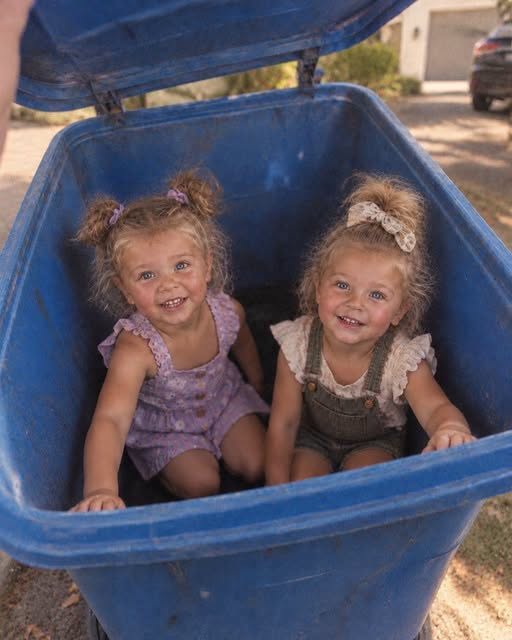
I Found My Neighbor’s Twin Toddlers Hiding in My Trash Can—What They Told Me Left Me Shaking
I was taking the trash outside when I heard a tiny voice coming from inside the bin. At first, I thought it was a stray kitten. Then I heard it again: “Please don’t tell Mommy we’re here.”
I froze.
It was a quiet Tuesday morning, the kind when nothing interesting ever seemed to happen in our neighborhood. The sun was shining, birds were singing in the trees, and I was already thinking about the errands I needed to finish before lunch.
Then I heard a small scratching sound.
It came from the large plastic trash can beside my garage.
I stepped closer and lifted the lid.
Two little faces stared back at me.
They were my neighbor’s twin toddlers, Emma and Ethan, both barely three years old. Their cheeks were dirty, their clothes were rumpled, and they were huddled together among a few empty cardboard boxes.
For a moment, I couldn’t speak.
“What on earth are you two doing in there?” I asked, trying to keep my voice calm.
Emma immediately reached for her brother’s hand.
“We’re hiding,” she whispered.
“From whom, sweetheart?”
She looked toward the house next door.
“Someone said we had to be quiet.”
My stomach tightened.
I carefully lifted both children out of the bin and checked them for injuries. They seemed frightened, but they were awake and responsive.
I had known their mother, Vanessa, for almost two years. She was a single mother who often appeared exhausted, but she had always seemed devoted to her children.
I couldn’t imagine why the twins would be hiding in my trash can.
And then Ethan tugged at my sleeve.
“Please,” he said, his little voice trembling. “Don’t make us go back yet.”
The Neighbors Had Always Seemed Perfectly Ordinary
Vanessa and her children had moved into the house next door two summers earlier.
She was polite, kept to herself, and rarely invited people inside. Sometimes I heard the twins laughing in their backyard, and occasionally I watched Vanessa push them down the sidewalk in their little double stroller.
We exchanged greetings, borrowed packages from one another, and helped with small neighborhood errands.
Nothing had ever made me seriously concerned about the children’s safety.
Still, I remembered a few things that seemed different in hindsight.
Vanessa had recently stopped spending time outside with the twins. Her curtains were often closed, even on sunny afternoons. A few times, I had heard raised voices coming from her house late at night.
I had assumed she was dealing with personal difficulties.
Now, with two frightened toddlers standing on my porch, those memories felt much more troubling.
I crouched down so that I was at their eye level.
“You’re safe here for the moment,” I told them gently. “I’m going to make sure you’re both okay.”
Emma began to cry.
Ethan wrapped his arms around her.
And then the little girl told me something I would never forget.
“We Weren’t Supposed to Come Outside”
Emma explained, in the fragmented language of a three-year-old, that the twins had been playing near the back door.
They had become frightened by something happening inside the house and had wandered outside looking for somewhere to hide.
Their explanation was confusing. They couldn’t clearly describe what had frightened them, and I didn’t want to frighten them further by asking too many questions.
But one thing was clear: they were scared, and they were too young to understand the danger of climbing into a trash can.
I brought them inside my house, away from the street, and gave them water while I checked whether either child was hurt.
I did not treat their words as proof of what had happened next door. Young children can struggle to describe events accurately, especially when they’re frightened.
But I knew I couldn’t simply return them to the yard and hope everything was fine.
I needed to make sure they were safe.
The Phone Call That Changed Everything
I called Vanessa.
There was no answer.
I tried again.
Still nothing.
I then contacted emergency services and explained that I had found two very young children hiding inside a trash can, that they appeared frightened, and that I could not establish whether their home was safe.
The dispatcher advised me on what to do while help was arranged.
I stayed with the twins, kept them away from the road and the trash bin, and avoided questioning them about what might have happened.
A short time later, a child welfare professional and local responders arrived to assess the situation.
They spoke gently with the children and asked me to describe exactly what I had observed.
I told them everything, making sure to separate what I had personally seen from what the toddlers had said.
Then a responder went next door to check on Vanessa.
What happened after that was something I could not have predicted.
What the Responders Discovered
A little later, one of the responders returned to speak with me.
Vanessa had been located, and the authorities were working to understand the circumstances surrounding the children’s disappearance from the house.
I was not given private details about her situation, and I didn’t ask for information I had no right to know.
What mattered was that the twins were receiving attention from people qualified to assess their safety.
As the professionals continued their work, I sat quietly in my living room, watching Emma and Ethan play with a pair of soft toys someone had brought them.
They were still nervous, but they had begun to relax.
Ethan placed a toy in his sister’s lap.
“You’re okay,” he told her.
The words were so small and so sincere that I felt tears gathering in my eyes.
They were only toddlers. They should have been thinking about cartoons, playgrounds, and what they wanted for lunch—not finding places to hide.
I wondered how frightened they must have been to climb into a trash can.
I also wondered how many warning signs adults might overlook when they assumed that everything was fine behind a closed door.
A Reminder About Children Who Cannot Explain Their Fear
Children this young often cannot describe danger in the same way an older child or adult can.
They may communicate distress through behavior, short phrases, changes in sleep, clinginess, or unusual fear.
None of these signs automatically proves abuse or neglect. Children can become frightened for many reasons.
But when toddlers are found hiding in a dangerous place, the situation deserves immediate attention.
A trash can can expose a child to sharp objects, harmful substances, suffocation risks, and injury. If a child is found inside one, the first priority is to remove them safely and seek emergency help if they are injured, unresponsive, or having trouble breathing.
It is equally important not to pressure children into giving explanations or suggest answers to them. Their safety should come first, and trained professionals can determine what questions need to be asked.
The Days That Followed
Over the next several days, I kept thinking about the twins.
I wanted to know whether they were safe, whether they were receiving the support they needed, and whether the family would be able to move forward.
But I also understood that their situation was private.
I did not spread rumors around the neighborhood or tell people that I knew what had happened inside their home.
Instead, I shared only the information necessary with the appropriate authorities and followed their guidance.
Eventually, I received confirmation through the proper channels that the children’s situation was being assessed.
I was relieved to know that people with the necessary training were involved.
I couldn’t solve every problem in their lives, and I couldn’t determine the full truth from one frightening morning.
What I could do was respond when two vulnerable children needed help.
Sometimes, that is the most important thing a neighbor can do.
What That Morning Taught Me
Before that day, I had always thought of neighborhood safety in simple terms.
We locked our doors, watched our belongings, and called someone when we noticed a suspicious vehicle.
But finding Emma and Ethan changed my understanding of what it means to look out for the people living around us.
Sometimes, the person who needs help is not a stranger walking down the street.
Sometimes, it is a child next door who is too young to explain why something feels wrong.
And sometimes, the most important thing we can do is notice, stay calm, and seek help rather than assuming that someone else will handle the situation.
I still remember the sound that morning: a faint little voice coming from inside the trash can.
I remember lifting the lid and seeing two frightened faces looking up at me.
I remember the way Emma held her brother’s hand.
And I remember the realization that I had a responsibility to take their fear seriously, even though I did not yet understand it.
I had opened the trash can expecting to find rubbish. Instead, I found two little children who needed an adult to take their safety seriously.
I never forgot that morning.
Because sometimes, a single moment of paying attention can make all the difference in a child’s life.
Editorial note: This is a fictional, dramatized story inspired by the supplied headline. The characters and events are illustrative and are not presented as a verified news report.