If You See Someone with a Three-Dot Tattoo, Don’t Jump to Conclusions: The Meaning May Surprise You
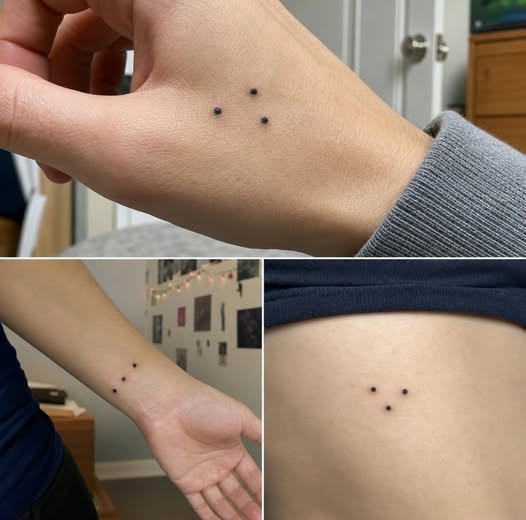
A small tattoo can sometimes tell a story far bigger than its appearance suggests. Among the many designs people choose to place on their skin, the three-dot tattoo is one of the most recognizable and misunderstood. Often seen on the hand, near the fingers, or beside the eye, this simple design has attracted attention for decades because of the different meanings associated with it.
Some people associate the three dots with a difficult past, while others connect the symbol with personal freedom, survival, spirituality, or the idea that life continues despite its challenges. In certain contexts, the design has also been associated with prison culture and criminal groups.
But there is one important thing to remember: seeing someone with a three-dot tattoo does not tell you who that person is, what they have experienced, or whether they have ever been involved in criminal activity.
The meaning depends on the individual, the cultural background, the location of the tattoo, and the circumstances in which it was chosen. A symbol that carries a serious meaning for one person may represent something entirely different to someone else.
Understanding these differences is essential before making assumptions about a stranger based on a few small marks on their skin.
1. What Does the Three-Dot Tattoo Actually Mean?
The three-dot tattoo is often associated with the phrase mi vida loca, a Spanish expression meaning “my crazy life.”
In some communities, the design has been used to represent a difficult, unpredictable, or unconventional lifestyle. It may symbolize a person’s experiences, the challenges they have faced, or a feeling of living outside society’s expectations.
The dots are sometimes arranged in a triangular pattern, making the design easy to recognize even though it requires very little space.
However, the phrase associated with the tattoo does not automatically indicate criminal activity. People may choose the design for personal reasons, and its meaning can vary considerably between individuals and communities.
For some, it may reflect a period of hardship. For others, it may be an aesthetic choice or a reminder of a personal experience. Some people may not be aware of all the cultural associations attached to the symbol when they decide to get it.
This is why context matters.
A tattoo is a form of personal expression, but it is not a reliable biography. Without hearing the person’s own explanation, outsiders cannot know what the design means to them.
2. Why Is the Symbol Sometimes Associated with Prison Culture?
One reason the three-dot tattoo attracts attention is its historical association with certain prison environments and street cultures.
In some settings, tattoos have been used to communicate identity, belonging, personal experiences, or attitudes toward society. Designs can develop particular meanings within a group, and those meanings may become known beyond the original community.
The three-dot symbol has been documented in connection with prison culture in various places. However, its use is not universal, and the design is not an exclusive identifier of any particular organization.
Popular media has sometimes reinforced the idea that a person with three dots must have a criminal background. Movies, television programs, and online stories frequently emphasize the most dramatic interpretations of tattoos, which can make a complicated symbol seem to have only one meaning.
Reality is more complicated.
People acquire tattoos for different reasons, and the same design may appear in different communities without carrying the same message. A person might have chosen the tattoo years ago, before understanding how others would interpret it. Another person may have selected it because of a private experience that has nothing to do with crime.
It is therefore inaccurate to assume that everyone displaying this symbol has been imprisoned or belongs to a gang.
The design alone cannot establish a person’s history.
3. Does the Tattoo Mean Someone Has Been to Prison?
This is one of the most common questions surrounding the three-dot tattoo.
The short answer is no: the tattoo alone does not prove that someone has been incarcerated.
Although the design has associations with prison culture in some contexts, it is also used by people whose personal histories are entirely different.
A tattoo may reflect a cultural influence, a personal belief, a friendship, an emotional experience, or a decision made without much consideration of its wider associations. The person wearing it may attach a meaning to the design that differs from the interpretation commonly found online.
Even when a tattoo is associated with a particular subculture, it does not establish membership, criminal conduct, or a person’s current circumstances.
The same principle applies to other visible characteristics. Clothing, hairstyles, piercings, and tattoos may influence first impressions, but they do not provide sufficient evidence to determine whether someone is trustworthy, dangerous, or responsible.
If someone wants to understand the meaning of a person’s tattoo, the most reliable source is the individual who chose it, provided they are comfortable discussing it.
Making assumptions based on appearance can lead to unfair treatment and unnecessary suspicion.
4. Why Are the Three Dots Often Placed on the Hand or Near the Eye?
The placement of a tattoo can influence how visible it is and how others interpret it.
Three-dot designs are sometimes seen on the hand, near the fingers, or around the eye. These areas are noticeable, and tattoos placed there can be difficult to conceal in everyday situations.
In some subcultures, visible tattoos have carried particular significance. In other cases, people simply prefer a location that makes the design easy to see.
The position alone, however, does not establish the meaning.
A small tattoo near the eye may attract more attention than the same design hidden beneath clothing. That attention can cause observers to associate it with a particular lifestyle, even when they have no information about the person who wears it.
It is also worth remembering that tattoos are permanent or difficult to remove. Someone’s appearance may reflect a decision made many years earlier, during a different stage of life.
The design may no longer represent the person’s current beliefs or identity.
Before interpreting a tattoo, it is important to distinguish between what is visible and what is actually known.
5. Can the Three Dots Represent Something Positive?
Yes. Although the tattoo has associations with difficult experiences and certain subcultures, some people interpret the three dots in personal or symbolic ways that are unrelated to crime.
For one person, the dots may represent the past, present, and future. For another, they may symbolize three important people, a personal journey, or a reminder to continue moving forward through difficult times.
These interpretations should not be treated as a universal meaning of the design. They are examples of how individuals can assign personal significance to a simple symbol.
Tattoos often become meaningful because of the memories and emotions attached to them. A small design can represent a turning point in someone’s life, a connection to a loved one, or a reminder of an experience they do not wish to forget.
The meaning may be obvious to the person wearing it but completely invisible to everyone else.
This is one reason tattoos can be misunderstood. Observers see the same marks, but they do not necessarily share the experiences that gave those marks their significance.
A symbol does not have to carry a single, universally accepted meaning.
6. The Role of Culture and Personal Experience
The interpretation of tattoos can change across countries, communities, and generations.
A design that has a strong association in one environment may be relatively unfamiliar in another. Even within the same community, different people may interpret a symbol in different ways.
Popular culture also plays a role. When films or television shows repeatedly connect a particular tattoo with criminal characters, audiences may begin treating that association as a universal rule.
Social media can intensify the effect by circulating short explanations that leave out important context. A post may claim that a specific tattoo always means one thing, even when the reality is more nuanced.
This can create misunderstandings that follow people into everyday life.
Someone may be judged during a job interview, in a public place, or during an ordinary social interaction because another person believes they understand the meaning of a tattoo.
Yet the observer may know nothing about the wearer’s background, intentions, or personality.
Cultural awareness means recognizing that symbols can carry multiple meanings and that no single interpretation should automatically be applied to everyone.
7. Why You Should Never Judge Someone by a Tattoo Alone
Imagine meeting someone whose hand displays three small dots. You might recognize the design from something you have seen online and immediately form an opinion.
But what do you actually know about that person?
You do not know why they chose the tattoo. You do not know when they got it, what it represents to them, or what experiences shaped their decision.
You may not even know whether they are familiar with the symbol’s more controversial associations.
Judging someone without this information replaces knowledge with assumption.
This does not mean that cultural symbols should never be discussed or that their historical associations should be ignored. Understanding those associations can be valuable, especially when a symbol has a documented connection to a particular group or setting.
The important distinction is between recognizing a possible association and treating that association as proof about an individual.
A person’s behavior provides much more meaningful information about their character than a small tattoo does.
How someone treats others, whether they respect boundaries, and how they respond to difficult situations are all more relevant to understanding who they are.
A tattoo cannot answer those questions for you.
8. Why This Small Tattoo Continues to Attract Attention
The three-dot tattoo remains a subject of curiosity partly because it is simple, recognizable, and associated with several different interpretations.
Its appearance invites people to search for a hidden meaning. Once a design becomes associated with a dramatic story, people may assume that everyone who wears it shares the same background.
But symbols rarely operate in such a straightforward way.
Their meanings can change over time, travel between communities, and become separated from their original context. Individuals may also reinterpret familiar designs according to their own experiences.
That complexity makes the three-dot tattoo an interesting example of how people communicate through appearance—and how easily those messages can be misunderstood.
The tattoo may tell you that someone chose to place a particular symbol on their body. Beyond that, the conclusions you can draw are limited unless you have more information.
Curiosity is reasonable. Unfounded certainty is not.
9. What Should You Do If You See Someone With Three Dots?
In most everyday situations, there is no special action you need to take simply because someone has this tattoo.
You can recognize the symbol, understand that it has several cultural associations, and continue treating the person respectfully.
If you know the individual and genuinely want to understand the tattoo, you can ask about it politely when the situation is appropriate. However, no one is obligated to explain their body art or disclose personal experiences to satisfy another person’s curiosity.
It is also important not to repeat unverified claims about someone based solely on their appearance.
If there is a genuine safety concern, focus on observable behavior and the circumstances at hand rather than relying on a tattoo as a substitute for evidence.
A symbol may provide cultural context, but it cannot reliably predict what a person will do.
Final Thoughts: The Meaning Behind the Three Dots Is Not Always What You Think
The three-dot tattoo has developed a range of associations, including the phrase mi vida loca, certain prison cultures, and personal interpretations connected to life’s experiences.
Its history helps explain why the design attracts attention, but it does not justify assuming that every person who wears it has the same background or beliefs.
Some tattoos carry meanings that are widely recognized within particular communities. Others have personal significance that outsiders may never fully understand.
The most responsible approach is to acknowledge the known associations while remaining open to individual differences.
A person’s appearance may prompt a question, but it should not determine the answer before the person has even had a chance to speak.
The next time you see someone with a three-dot tattoo, remember this: the symbol may have a history, but the person wearing it has a story of their own. And you cannot know that story from three small dots alone.