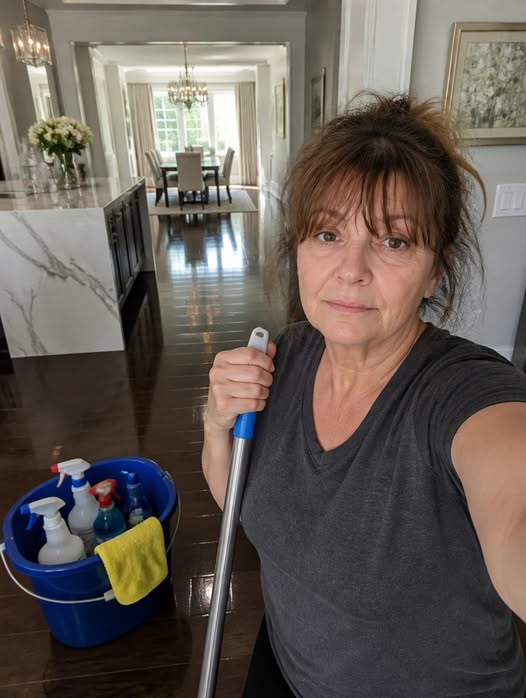
I spent eight years cleaning the home of Mrs Whitaker every Thursday while diligently maintaining a very strict professional distance between us. I always believed that keeping my head down and focusing solely on my work was the most respectful way to handle our arrangement. My daughter Willa was young when I first started cleaning, and I desperately needed the reliable income to support us. Because of that, I never wanted to blur the lines between being a dedicated employee and becoming a casual friend. I would even ask for permission to use a simple drinking glass, despite having my own key to her front door. Looking back now at the day she finally asked me to visit her without bringing any of my cleaning supplies, I find myself questioning those rigid rules. I wonder if our mutual insistence on maintaining such firm boundaries was actually the right choice, or if those very same boundaries kept us from truly understanding each other much sooner than we did.
From my perspective, protecting that professional boundary felt like an absolute necessity for my livelihood and my pride. When you are hired to perform a service inside the personal sanctuary of someone else, you become highly aware of your place in their world. I was determined to prove my reliability, which meant I always ate my packed lunches in the backseat of my car instead of sitting comfortably at her kitchen table. I avoided initiating deep conversations because I worried that crossing into personal territory might make her uncomfortable or jeopardize my weekly employment. I assumed that a kind woman like Mrs Whitaker simply appreciated a quiet and efficient worker who did not take advantage of her pleasant demeanor. I filed away all her small gestures of warmth, such as asking about Willa or worrying about my car troubles, as nothing more than polite small talk. My personal rules were designed to protect us both, but they ultimately blinded me to the very real human connection that was developing right in front of me.
I eventually learned that Mrs Whitaker was protecting that exact same boundary from the opposite side of our dynamic. After her husband George passed away during my fourth year of working there, her world became much smaller and significantly more lonely. I noticed she stayed home more often while I worked, occasionally appearing in whatever room I was dusting to ask harmless questions. She later confessed that she often wanted to invite me to sit down and share a cup of coffee with her. However, she held herself back because she recognized the inherent power imbalance in our relationship. She knew I was a single mother rushing through a tight schedule to make it to school pickup on time. She profoundly feared that her loneliness might become a burden I felt obligated to manage simply because she was the person signing my paycheck. Her restraint was born entirely out of deep respect for my time and my autonomy, ensuring she never used her financial position to demand my companionship.
The sheer ridiculousness of our mutual silence became incredibly clear to me when she showed me a box of old greeting cards from her daughter Mara. As I read through years of family correspondence, I was completely stunned to find my own name woven throughout their private letters. Mara knew about Willa learning to drive, my back pain from moving heavy furniture, and even my specific Thursday schedule. I suddenly realized that I was not just a passing employee in her life, but a steady presence she valued enough to discuss with her own family. We had spent nearly a decade silently orbiting one another, each completely convinced that the other preferred strict professional isolation. We missed countless opportunities to share coffee, swap stories, and comfort each other during difficult seasons. Our shared fear of overstepping the mark created an invisible wall that prevented us from recognizing how much we genuinely mattered to one another outside of our Thursday cleaning appointments.
Ultimately, I believe those firm boundaries were both necessary and slightly tragic, as they kept us from understanding our bond sooner but also guaranteed our eventual friendship was built on profound mutual respect. We needed those years of cautious distance to prove our character to one another, ensuring that neither of us would ever take advantage of the vulnerability of the other person. When Mrs Whitaker finally asked me to visit on a Saturday with an empty car and no cleaning supplies, she intentionally stripped away the financial transaction that defined our past. She wanted a day where neither of us owed the other anything, allowing us to interact purely as equals. While I deeply regret the many hours I spent eating alone in my car, I appreciate the beautiful foundation our careful boundaries created. Now that I have left my brass key behind and shared my personal phone number, we can finally move forward in a genuine friendship that we both freely choose.