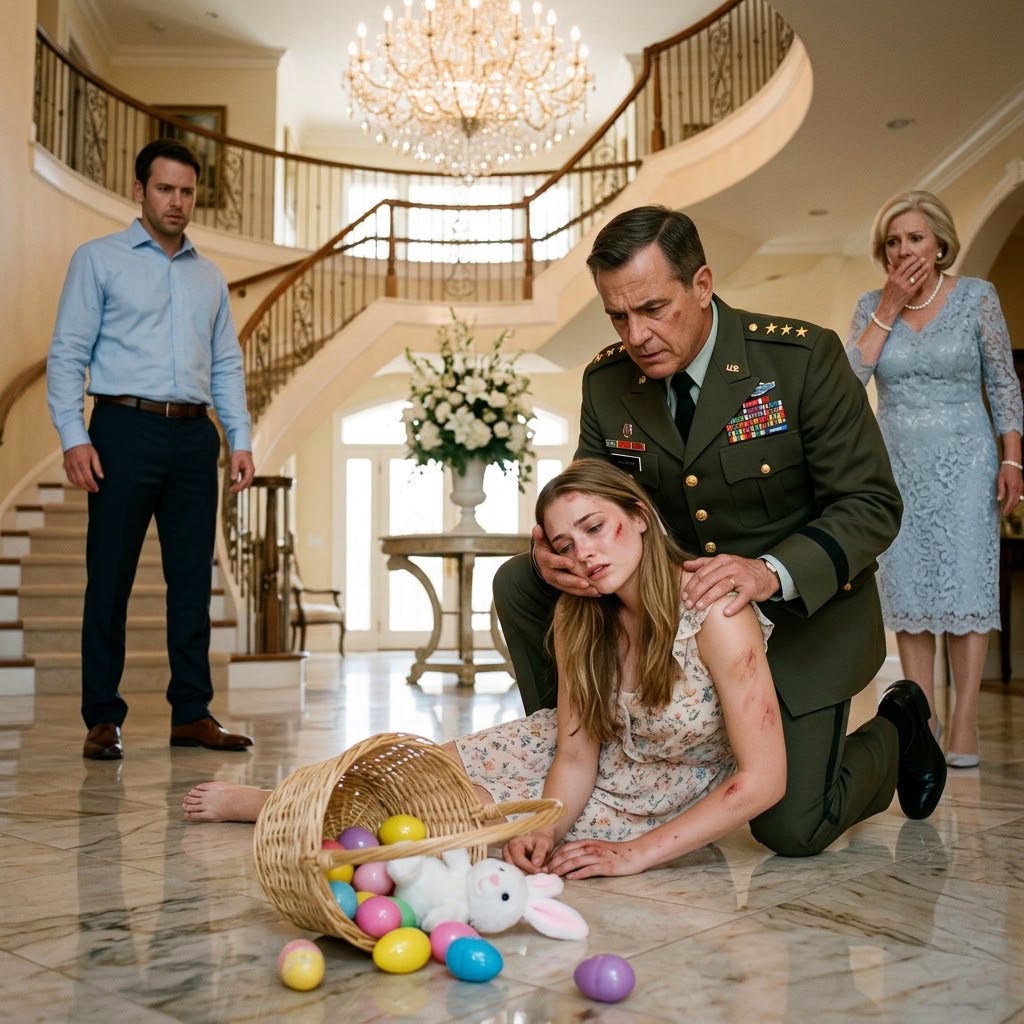
My name is Christopher Montgomery, and after spending three decades serving as a military colonel, I had convinced myself that the hardest chapters of my life were finally behind me.
For most of my career, I had lived according to discipline, routine, and responsibility. I had learned how to remain calm when everyone around me was panicking, how to make decisions when there was very little information, and how to recognize danger even when someone was desperately trying to hide it.
After retiring from the military, I wanted something completely different.
I settled near Indianapolis and built a quiet civilian life around ordinary routines. Mornings were slower. Evenings were peaceful. Holidays were supposed to be about family, food, and conversations that had nothing to do with emergencies.
Then came Easter Sunday.
The afternoon had been quiet until my phone rang.
The moment I saw Hannah’s name on the screen, I smiled.
I expected a cheerful holiday greeting.
Instead, I heard something in her voice that immediately erased every thought of celebration.
She was struggling to speak.
Her breathing was uneven, and she sounded terrified.
“Dad, I need you to come get me.”
I asked where she was.
She gave me the address.
Then she said something that changed everything.
“I’m in danger.”
The call ended shortly afterward.
For a few seconds, I simply stared at the phone.
Then my military instincts took over.
Panic would accomplish nothing.
I needed information.
I needed help.
And most importantly, I needed to get my daughter somewhere safe.
Hannah had been married to Zachary Albright for six years.
From the outside, their marriage looked almost perfect.
Zachary was a highly successful technology executive with an impressive reputation. He appeared frequently at business events, spoke confidently about innovation, and had built a public image around intelligence and success.
People admired him.
They respected him.
They trusted him.
But I had always sensed something different when I was around him.
There was a certain control in the way he spoke to Hannah.
He often answered questions directed at her.
He corrected small details of her stories.
He seemed to know where she was, who she had spoken to, and what she intended to do.
At the time, I had wondered whether I was simply being overly protective.
Now, after hearing the fear in my daughter’s voice, I understood that what I had dismissed as personality might have been something much more serious.
I immediately contacted my former colleague Gabriel Ross.
Gabriel had known me for years and understood that I did not make dramatic calls without reason.
I explained what Hannah had said.
He listened carefully and then gave me direct instructions.
Contact local authorities.
Give them every detail.
Do not attempt to handle the situation alone.
Gabriel also reached out to his brother, Detective Aaron Ross, who worked in law enforcement.
I called emergency services and provided Hannah’s location, the names of everyone involved, and everything I knew about the situation.
Then I got into my vehicle and started driving toward Carmel.
Every mile seemed longer than the last.
I kept thinking about Hannah as a little girl.
I remembered teaching her how to ride a bicycle.
I remembered school plays, birthdays, family vacations, and all the ordinary moments parents assume they will have forever.
Now I was driving toward her home wondering whether she was injured.
Whether she was being held against her will.
Whether I would arrive too late.
When I finally reached the Albright estate, something immediately felt wrong.
The property was enormous, but strangely silent.
The main gates were wide open.
No security personnel stopped me.
No one came outside.
I parked and hurried toward the house.
The front door was unlocked.
Inside, the scene looked nothing like the home I remembered.
A chair had been overturned.
Holiday dishes were shattered across the floor.
Decorations were scattered everywhere.
A broken cellular phone lay near the entrance.
It looked as though an argument had turned into a physical struggle.
I called Hannah’s name.
No answer.
Then Victoria Albright appeared.
She was Zachary’s mother.
She looked nervous.
Not merely surprised to see me.
Nervous.
She immediately began trying to explain that everything was under control and that there had been a misunderstanding.
I asked where my daughter was.
Victoria avoided the question.
That was enough to make my instincts intensify.
Before I could press her further, Zachary appeared at the top of the staircase.
He looked exhausted and unkempt.
The polished executive image was gone.
His clothes were disordered.
His face was tense.
And his eyes immediately became defensive when he saw me.
He tried to explain that Hannah had become emotional.
He described the situation as a marital disagreement that had simply gotten out of control.
I had heard explanations like that before.
People often call serious situations misunderstandings when they are trying to make them disappear.
I refused to accept his version.
I demanded to see Hannah.
Zachary tried to delay me.
I stepped forward.
The tension in the room became almost unbearable.
Then the sound of approaching vehicles broke the silence.
Sheriff’s deputies arrived.
Detective Aaron Ross arrived with them.
The atmosphere changed immediately.
The deputies separated the people inside the house and secured the property.
Medical personnel were brought in to evaluate Hannah.
For the first time since arriving, I felt that she was surrounded by people who could protect her.
Aaron approached me and listened carefully as I explained what I knew.
He did not make assumptions.
He focused on one thing.
Hannah needed to feel safe enough to speak freely.
When she was finally brought to a private area, she began telling the truth about what had been happening inside the marriage.
And what she revealed was far worse than I had imagined.
Zachary had installed surveillance equipment throughout the house.
Cameras.
Monitoring devices.
Systems designed to track her movements.
Hannah said she had gradually realized that she was never truly alone.
She could not move around the house without wondering whether she was being watched.
She could not make a private phone call without worrying that someone might know.
She could not visit friends freely.
She could not make decisions without explaining herself.
The surveillance had become another method of control.
Zachary apparently believed he was protected by technology.
He had told Hannah that the recordings were stored on encrypted corporate servers.
According to him, accessing them would require an extremely powerful warrant.
He believed that meant no one could ever use the recordings against him.
But he had underestimated Hannah.
She had been preparing for this moment for years.
Quietly.
Patiently.
Without telling him.
She had learned about cybersecurity by studying his own interviews, presentations, and public discussions about technology.
She had watched how he talked about encryption.
She learned how digital evidence could be preserved.
And she began secretly copying information.
She saved recordings.
Messages.
Files.
Images.
Logs.
Anything that documented what was happening inside the house.
She transferred the material onto a hidden external drive.
Then she placed that drive inside a false electrical junction box in her dressing room.
It was a location Zachary would never think to search.
Hannah told me later that the decision had terrified her.
Every time she copied another file, she wondered whether he would discover what she was doing.
But she knew she needed evidence.
Without it, she feared people would believe his version of events.
Zachary had already spent years controlling the narrative around their marriage.
To everyone outside the home, he was successful, generous, intelligent, and respectable.
Hannah was simply his wife.
And because she had gradually been isolated from our family, there were fewer people around her who understood what was really happening.
She told the investigators that Zachary had deliberately created that isolation.
He discouraged her from maintaining close relationships with us.
He questioned every friendship.
He monitored her communication.
He restricted her access to money.
Eventually, he convinced her to leave her career.
Once she stopped working, her financial independence disappeared.
The more dependent she became, the more power he gained.
It was not one dramatic act.
It was a series of small restrictions that slowly became a cage.
Then Hannah told me about Natalie Prescott.
Natalie had once been associated with Zachary professionally.
Unlike most people around him, Natalie had apparently seen another side of his personality.
She had quietly warned Hannah that Zachary had a history that did not match his public image.
At first, Hannah had been frightened to believe her.
But the warning stayed with her.
Natalie’s words became the beginning of Hannah’s preparation.
From that point forward, Hannah began planning an escape.
She created copies of important documents.
She preserved digital evidence.
She kept records.
She began thinking about where she could go if she ever needed to leave suddenly.
She did all of it without allowing Zachary to realize that she was preparing to become independent.
That was why the events of Easter Sunday had not been spontaneous.
They were the result of years of fear, preparation, and quiet resistance.
When Hannah finally finished telling her story, I looked at her and realized something that broke my heart.
My daughter had been fighting a battle inside that enormous house for years.
And I had not known how serious it had become.
I had spent my life believing that protecting my family meant being strong enough to confront any visible threat.
But Hannah had been facing something different.
Her enemy did not announce itself.
It hid behind wealth, reputation, technology, and a carefully constructed public image.
Now that image was beginning to crack.
Detective Aaron carefully examined the evidence Hannah had preserved.
The external drive could potentially establish a timeline that would be difficult to dismiss.
The surveillance recordings could reveal patterns of behavior.
Financial records could show how her independence had been restricted.
Messages could establish who knew what and when.
And Natalie Prescott could potentially provide another account of Zachary’s history.
For the first time, Hannah was not standing alone.
The people who had doubted her could now hear her story.
The people who had admired Zachary could be confronted with evidence.
And I could finally do what I had wanted to do from the moment she called me.
Stand beside my daughter.
Not as a military officer.
Not as someone looking for revenge.
But simply as her father.
The Easter Sunday that was supposed to be a peaceful family holiday had instead exposed a hidden life that had been carefully concealed behind wealth and respectability.
Yet there was something else I understood that evening.
Hannah was not helpless.
She had spent years being made to feel powerless, but she had quietly prepared herself for the moment when she could finally leave.
She had preserved the truth.
She had protected the evidence.
And when the moment came, she had found the courage to call me.
That single phone call changed everything.
The investigation was only beginning, and there were still difficult questions ahead.
But as I watched Hannah sit safely beside the investigators, I knew one thing with absolute certainty.
Zachary could control a house.
He could control money.
He could monitor screens and collect information.
He could build an impressive public reputation.
But he could no longer control the truth.
And my daughter had finally found her way out of the silence.