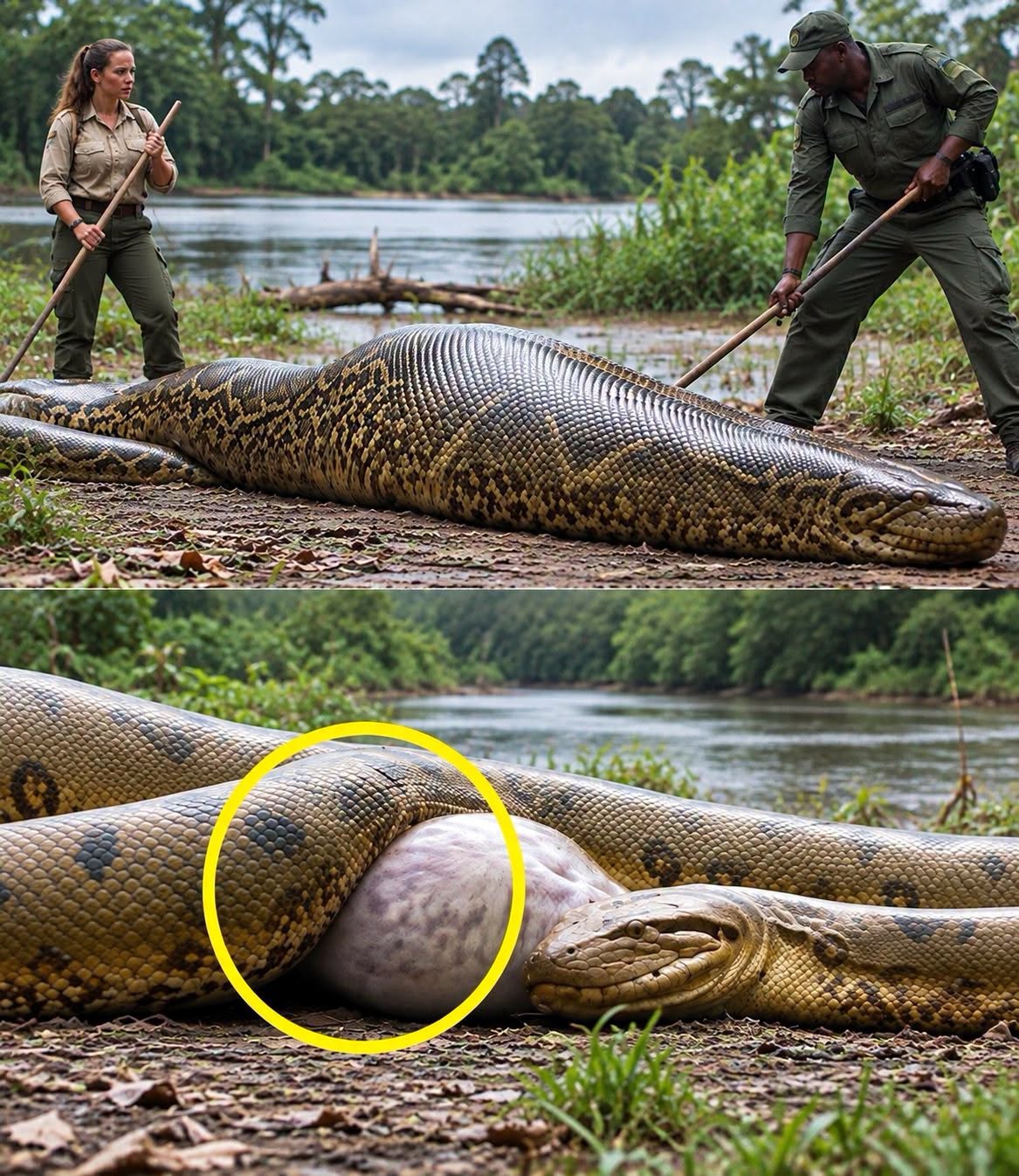
The anaconda reportedly appeared weak when park personnel first assessed its condition, raising immediate concern about what might have happened to one of the wetland’s most powerful predators.
According to the account, the animal had apparently swallowed an object that left it struggling, prompting park personnel to step in and assess the situation. They took measures intended to assist the snake, but important details remain unclear. The report does not identify exactly what the anaconda had swallowed, does not explain precisely how personnel intervened, and does not confirm whether the animal ultimately recovered.
Those missing details matter.
Without independent confirmation, this should not be presented as a verified story of a successful wildlife rescue or a guaranteed recovery. The account gives us only part of the picture, and filling in the missing details with assumptions could turn a real wildlife concern into a story that says more than the available evidence supports.
Still, even with those uncertainties, the situation highlights an important reality about wildlife.
Anacondas are enormous, powerful animals, capable of surviving in difficult environments and consuming prey that would be impossible for many other species to handle. Their size and strength can make them appear almost invulnerable.
But even an animal that powerful has limits.
A swallowed piece of debris, discarded material, fishing equipment, or another unfamiliar object can create a serious problem. An animal may be unable to recognize the danger before ingesting it, and once something is inside its body, there may be little it can do to correct the mistake.
That is one reason encounters like this can be so concerning.
The animal may look frightening or intimidating to people, but from another perspective, it may simply be a wild creature struggling with a problem created by its environment.
And that creates an important distinction when humans encounter distressed wildlife.
Helping does not necessarily mean getting closer.
It does not necessarily mean touching the animal, attempting to remove an object, or trying to move it to another location.
In fact, an untrained intervention can make a dangerous situation worse—for both the animal and the person trying to help.
A large snake that appears weak can still react defensively if it feels threatened.
Even when an animal seems exhausted or helpless, its instincts remain unpredictable.
That is why trained wildlife professionals are better equipped to assess the situation, determine whether intervention is necessary, and choose a method that reduces unnecessary risk.
The broader concern, however, extends far beyond a single anaconda.
Across wetlands, rivers, forests, coastlines, and other natural habitats, discarded human waste can become a hidden threat to wildlife.
Plastic packaging can be mistaken for food.
Fishing line can become wrapped around bodies, tails, wings, or limbs.
Hooks can injure mouths and digestive systems.
Containers and other debris can trap smaller animals.
Even objects that appear harmless to humans can become dangerous once they enter an environment where animals search for food, shelter, or nesting material.
Wild animals do not understand the difference between something intentionally left in nature and something that accidentally ended up there.
To them, a piece of plastic floating through the water may simply look like something edible.
A discarded line may become part of the environment until an animal becomes entangled in it.
A strange object may become something to investigate—and potentially swallow.
That is why keeping natural areas clean is more than an issue of appearance.
A clean wetland is not simply a more pleasant place for visitors.
It is a safer environment for the interconnected network of animals, plants, insects, fish, birds, reptiles, and microorganisms that depend on it.
Every piece of rubbish removed from a habitat is one less potential hazard.
Of course, individual visitors cannot solve every environmental problem.
But small actions still matter.
People can carry their rubbish out instead of leaving it behind.
They can dispose of fishing equipment responsibly.
They can follow park rules designed to protect wildlife and sensitive habitats.
They can avoid feeding wild animals, since human food and discarded objects can alter natural behavior.
And when they encounter an animal that appears injured or distressed, they can report the situation to qualified wildlife authorities rather than attempting a dramatic rescue themselves.
That final point is especially important.
Wildlife rescue can look simple from a distance.
A person sees an animal in trouble and naturally wants to help.
The instinct is compassionate.
But compassion needs to be combined with judgment.
Approaching a distressed wild animal without the proper training can cause additional stress, provoke defensive behavior, or interfere with the very professionals who are trying to assess the situation.
Sometimes the most helpful thing a person can do is observe from a safe distance, record the location if appropriate, and contact the people equipped to respond.
That may feel less heroic than physically intervening.
But responsible wildlife care is not about appearing brave.
It is about achieving the safest possible outcome for the animal while protecting everyone involved.
The reported anaconda is a powerful reminder of that principle.
An animal that appears enormous and almost unstoppable can still be vulnerable to something as ordinary as human waste.
Its strength cannot protect it from every danger.
Its size cannot guarantee that it will avoid harmful objects.
And its natural instincts cannot compensate for an environment increasingly filled with materials that never belonged there in the first place.
There is also something important to remember about how these stories spread.
A dramatic wildlife rescue can quickly become a viral story.
Photographs and short descriptions may circulate far beyond the original report, sometimes gaining details that were never confirmed.
As the story travels, uncertainty can disappear.
A report that originally said an animal was found struggling can eventually be repeated as though its condition, treatment, and recovery were all known facts.
That is why careful wording matters.
In this case, the available account describes an anaconda that reportedly appeared weak and received assistance from park personnel.
But it does not establish every detail of what happened afterward.
We should not invent a successful recovery simply because that would make the story more satisfying.
The reality may be more complicated.
What we can say with confidence is that the situation raises a legitimate concern about the dangers wildlife can face when human-made objects enter their habitat.
And that lesson applies far beyond anacondas.
A wetland is an interconnected system.
What humans leave behind can eventually affect creatures that have nothing to do with the original source of the waste.
A bottle discarded near a path can reach a stream.
Fishing line left near the water can remain in the environment long after the person who used it has gone.
Plastic can break into smaller pieces without actually disappearing.
The consequences may not be immediately visible, but wildlife can encounter those materials weeks, months, or even years later.
That makes prevention especially important.
We cannot always know which animal will encounter a piece of rubbish.
We cannot predict whether it will be ignored, investigated, swallowed, or become an entanglement hazard.
But we can reduce the number of dangerous objects entering the environment in the first place.
And when something does go wrong, the best response is often not to become part of the rescue ourselves.
It is to recognize the danger, keep a safe distance, and contact qualified professionals.
The anaconda may be one of the most imposing animals in its habitat, but its reported struggle reveals a much larger truth.
Wildlife does not have to be small or defenseless to be vulnerable.
Sometimes the danger is not another predator.
Sometimes it is something humans left behind.
That is why protecting wildlife begins long before an emergency rescue.
It begins with what we carry into natural places, what we take back out, and how carefully we behave when we encounter animals in distress.
A clean habitat protects more than scenery.
It protects lives.
And when a wild animal is already struggling, the most compassionate response is often the quietest one: keep your distance, avoid making the situation worse, and let trained specialists decide how best to help.