Hello and welcome to another fun and casual brain-teasing challenge!
Today, I have a simple-looking image puzzle that might be much trickier than it first appears.
You may have seen puzzles like this before. They look innocent enough at first, but they are designed to make your eyes focus on the obvious details while hiding the important ones in plain sight. They are a fun way to test your observation skills, concentration, and ability to notice unusual shapes.
So, take a good look at the image on the screen.
At first glance, everything seems perfectly ordinary.
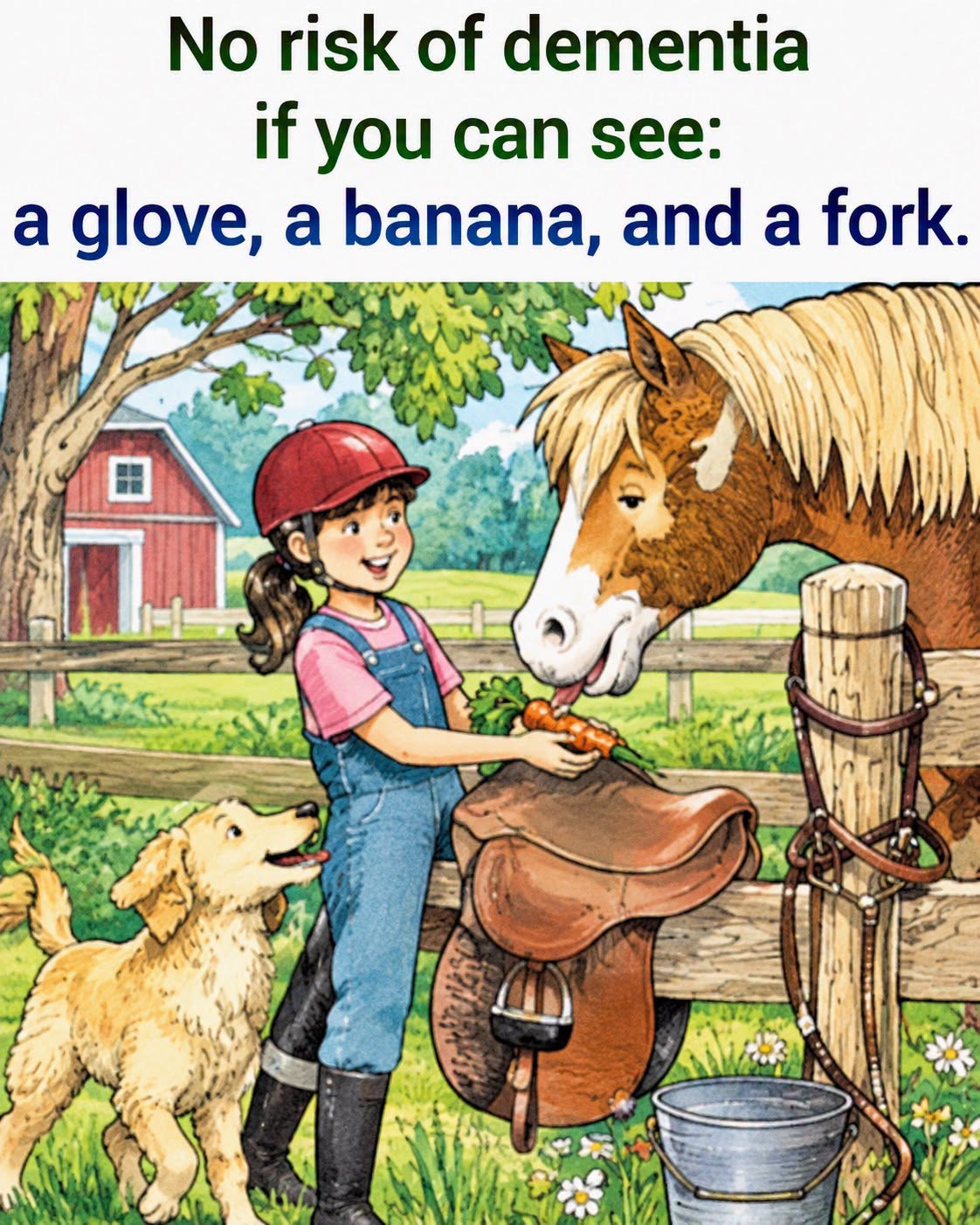
It’s a simple black-and-white line drawing showing what looks like a peaceful farm or stable scene.
In the center, you can see a young girl wearing a small hat. She appears to be reaching forward, holding out something that looks very much like a carrot.
Standing beside her is a large horse.
The horse appears calm and friendly, leaning toward the girl as though it is interested in the treat she is offering.
On the other side of the scene, there is a goat watching the interaction. The goat looks equally curious, almost as though it wants to be part of the little exchange.
Behind them, you can see a wooden fence, along with trees and other simple details that help create the feeling of a countryside setting.
Nothing seems unusual.
There are animals.
There is a child.
There is a fence.
There are trees.
Everything fits naturally into the picture.
But that is exactly what makes this puzzle so challenging.
There is something hidden within all those familiar shapes.
The text at the top of the image makes a playful claim. It suggests that your mind must be especially sharp if you can find three specific objects hidden somewhere inside the drawing.
And those three objects are a glove, a banana, and a fork.
Sounds easy, right?
Maybe not.
At first glance, you probably won’t immediately see a glove sitting on the fence, a banana lying beside the horse, or a fork being held by the girl.
That would be far too easy.
Instead, the artist has cleverly incorporated the shapes of these everyday objects into the existing lines of the illustration.
The hidden objects are disguised as parts of the scene.
That means you have to stop looking at the picture as one complete image and start breaking it down into individual shapes.
Think like a visual detective.
Don’t simply ask yourself, “Where is the glove?”
Instead, ask yourself, “What shape in this picture could become a glove if I looked at it differently?”
That small change in perspective can make all the difference.
Start with the glove.
A glove usually has a recognizable shape, with several fingers extending from one side and a larger thumb positioned slightly apart.
But in a puzzle like this, those features may be disguised.
The fingers could be formed by several nearby lines.
The thumb might look like part of an animal, a plant, clothing, or even a fence.
So carefully examine the outlines of the major figures.
Look at the girl.
Look at the horse.
Look at the goat.
Look at the fence.
Don’t assume that every line belongs exactly where your brain initially tells you it does.
Now move on to the banana.
A banana is very different from a glove.
It has a long, curved shape, and that curve can easily be hidden inside another object.
Look for unusual arcs.
Look at the horse’s body.
Examine the girl’s clothing.
Check the fence and the trees.
Even the outlines of objects that seem completely ordinary may contain the shape you are searching for.
Sometimes your brain recognizes the entire object before it notices the smaller shape hidden inside it.
That’s one of the main tricks these puzzles use.
Your brain is very good at recognizing familiar scenes quickly.
When you see a horse, your mind immediately identifies it as a horse.
When you see a girl feeding an animal, you understand the scene almost instantly.
Because you already understand what you’re looking at, your brain doesn’t necessarily stop to inspect every individual line.
That’s where the hidden objects can escape your attention.
The final object is the fork.
This one might be particularly difficult because a fork has a very distinctive feature: its prongs.
Look for three or four narrow lines running parallel to one another.
They may not look like a fork at first.
Instead, they could appear to be part of the fence, an animal’s features, a branch, or another background detail.
Try looking for groups of lines that seem slightly out of place.
If you notice a shape that resembles several thin prongs coming together at one point, take a closer look.
It could be exactly what you’re searching for.
And remember, you don’t have to find all three objects immediately.
In fact, that’s part of the fun.
Give your eyes a chance to adjust.
Start at one side of the image and slowly move across it.
Then try another method.
Instead of scanning from left to right, focus on one character at a time.
Study the girl.
Then study the horse.
Then the goat.
After that, examine the fence and background.
This prevents your eyes from jumping randomly around the picture.
Another useful trick is to stop looking for the objects themselves and start looking for their outlines.
Ask yourself what the shape of a glove would look like if it were turned sideways.
Ask what a banana would look like if it were stretched along another object.
Ask how the prongs of a fork might blend into several existing lines.
Once you start thinking in terms of shapes rather than objects, hidden-image puzzles often become much easier.
But don’t rush.
These puzzles are designed to reward patience.
If you stare too intensely, everything can begin to blend together.
Sometimes it helps to look away for a few seconds and then return to the image.
A fresh look can make a previously invisible shape suddenly appear.
You might even experience that classic puzzle moment when you finally see one of the hidden objects and wonder how you could possibly have missed it.
That’s the fun of visual illusions.
The object was there the entire time.
Nothing changed.
Your eyes simply interpreted the lines differently.
And once your brain recognizes the hidden shape, it becomes much harder to “unsee” it.
So, before searching for any external hints, give yourself a fair chance.
Take a slow look at the entire image.
Examine the animals.
Check the girl’s figure.
Study the fence.
Look at the trees.
Pay attention to unusual curves, unexpected angles, and groups of lines that seem slightly different from the rest.
Remember the three targets:
A glove.
A banana.
And a fork.
All three are hidden somewhere within the illustration.
The challenge is not about how quickly you can find them.
It’s about whether you can notice something your brain initially decided was just an ordinary part of the picture.
And don’t worry if you struggle.
Missing a hidden object doesn’t mean your eyesight or intelligence is lacking.
These puzzles are deliberately designed to take advantage of the way our brains process familiar images.
When everything looks like it belongs, we naturally stop questioning what we’re seeing.
That’s why patience and attention are often more important than speed.
So take another look.
Maybe the glove is hiding in a shape you have already examined several times.
Maybe the banana is disguised by a smooth curve that looks completely natural.
And perhaps the fork is hiding among several ordinary lines that you never thought to question.
The artist has carefully blended each object into the scene, turning the entire picture into one large visual trick.
Once you find the first hidden object, don’t stop.
Finding one can actually make the other two easier because your brain begins to understand how the artist is hiding the shapes.
You’ll start noticing that the objects aren’t necessarily drawn separately.
They are created from lines that already belong to the illustration.
That’s what makes the puzzle so satisfying.
You’re not simply searching for three objects.
You’re learning to see the same picture in a completely different way.
So, are you ready?
Look carefully.
Slow down.
Forget about the obvious scene for a moment and search for the unexpected shapes hidden inside it.
Can you find the glove?
Can you spot the banana?
And can you locate the fork?
Take your time and see if you can discover all three without using any hints.
And when you finally find them, take another look at the picture.
You’ll probably wonder how those objects managed to stay hidden for so long.
That’s the magic of a good spot-the-hidden-object puzzle.
Everything you need to solve it is already right there in front of you.
You just have to look at it differently.
Good luck, enjoy the challenge, and most importantly, have fun testing your observation skills!