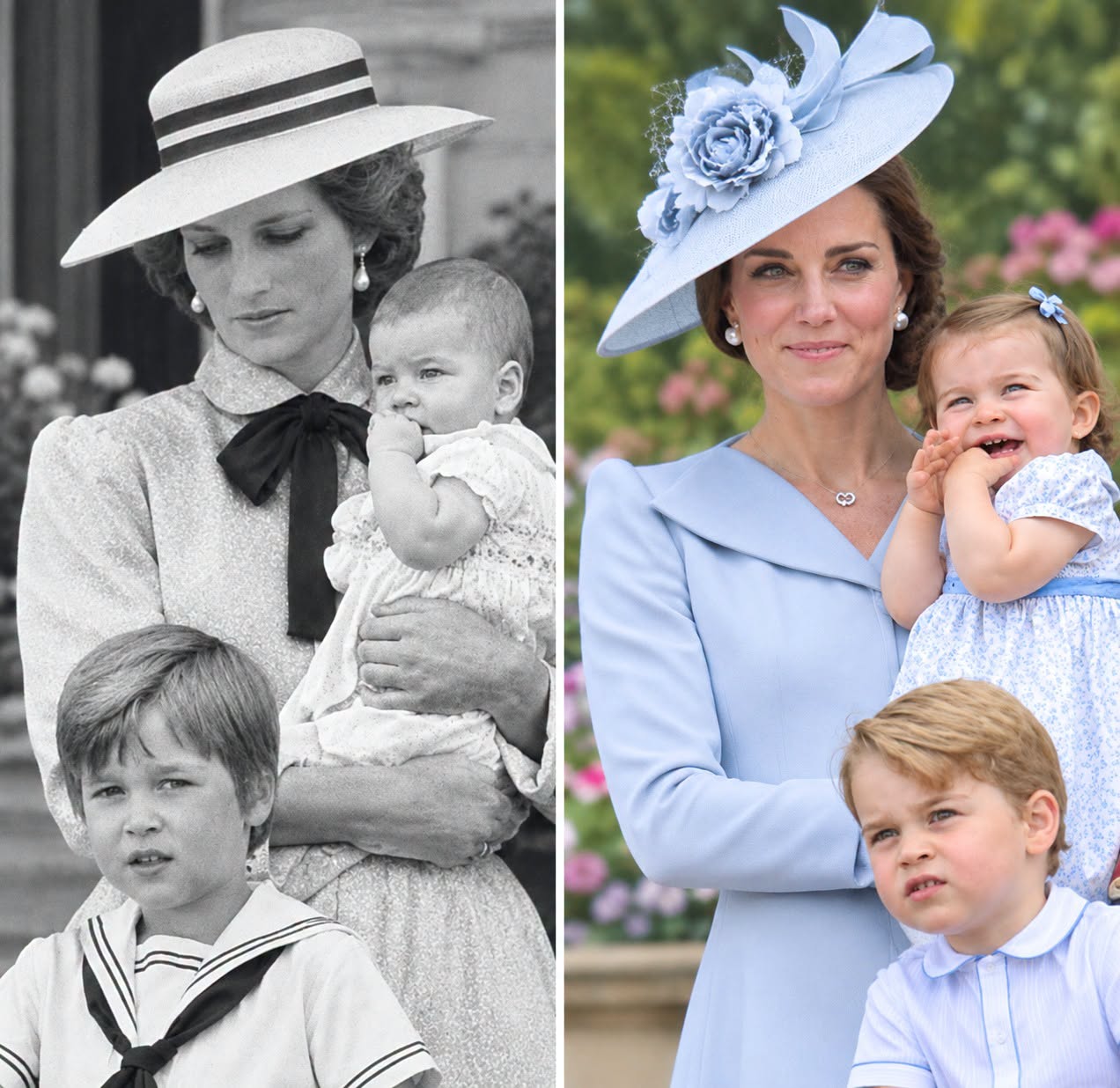
Diana’s most affecting photographs are often not the grand portraits or carefully staged images taken during official ceremonies. Instead, they are the quieter photographs—the moments in which she appears simply to be a mother, a listener, a friend, or a person offering comfort to someone who needed it.
A photograph of Diana spending time with William and Harry can sometimes say more about her than an entire collection of formal royal portraits. In those ordinary scenes, the attention shifts away from titles, protocol, and public expectations and toward something much more familiar: a mother trying to give her children a sense of normality in a life that was anything but ordinary.
Other photographs capture her speaking with patients, meeting people who were experiencing difficult circumstances, or smiling without the carefully controlled expression expected at formal events.
These images do not explain every contradiction in Diana’s life.
They cannot reveal everything she experienced privately, nor can a photograph provide a complete understanding of the pressures that surrounded her. But they can offer something valuable: a glimpse of the human being behind one of the most recognizable public images of the twentieth century.
Diana was born into an aristocratic family in 1961, growing up surrounded by privilege and expectations. Her background gave her access to a world that most people could never experience, but privilege did not mean that her life was free from emotional pressures or personal difficulties.
As she became more visible to the public, the distance between her private identity and her public image became increasingly complicated.
Millions of people saw Diana as a princess.
They saw the clothing, the official engagements, the ceremonies, the crowds, and the photographs that appeared on magazine covers around the world.
But the quieter images often revealed another side.
They showed someone who could sit beside a person without immediately turning the moment into a performance.
They showed someone willing to listen.
They showed warmth in situations where formality might otherwise have dominated.
That quality became an important part of how many people remembered her.
Perhaps nowhere was that contrast more visible than in her relationship with William and Harry.
As their mother, Diana appeared determined to give her sons experiences that felt as ordinary as possible despite the extraordinary circumstances surrounding their upbringing.
She could take them to places where they were exposed to everyday life rather than keeping them completely separated from it. She wanted them to understand that the world extended far beyond palaces, ceremonies, and royal expectations.
Those moments became especially poignant because the boys were growing up under an extraordinary level of public attention.
Even ordinary family outings could attract photographers.
Simple moments could become headlines.
A mother taking her children somewhere could become an international news story.
Diana understood that reality, yet she continued trying to create private moments of connection wherever she could.
Photographs from those years sometimes capture the contrast beautifully.
In one frame, she might appear as one of the most famous women in the world.
In another, she simply looks like a mother paying attention to her children.
That contrast is part of what made her public image so powerful.
People did not only respond to the princess.
They responded to the person they believed they could recognize beneath the title.
The same quality appeared in photographs of Diana interacting with patients and people facing illness or difficult circumstances.
Her approach often seemed less distant than the formal expectations traditionally associated with royalty.
A photograph might show her sitting beside someone, speaking directly with them, smiling, or simply remaining present during a difficult moment.
The image does not necessarily tell us what was said.
It does not reveal every emotion involved.
But it captures something visible: attention.
And sometimes attention is one of the most meaningful forms of kindness.
Being willing to listen to someone, particularly when they are vulnerable, can communicate respect without requiring dramatic words.
Diana’s public work became associated with that kind of human connection.
Her presence could draw attention to causes that might otherwise have received less public interest. Her ability to communicate warmth helped people who felt overlooked or isolated feel seen, at least for a moment.
This became part of the legacy associated with her name.
Yet it is important not to reduce her entire life to an uncomplicated story of kindness.
Diana’s life contained contradictions.
She experienced extraordinary privilege alongside intense personal pressures.
She was surrounded by people while also living under an enormous degree of public scrutiny.
She could appear confident in public while dealing with private difficulties that the cameras could not fully capture.
That complexity is precisely why photographs should be viewed carefully.
An image is powerful, but it is never the entire story.
A photograph can preserve one moment without explaining what happened immediately before or afterward.
It can capture a smile without revealing what the person was feeling internally.
It can show closeness without explaining the full nature of a relationship.
And it can become symbolic in ways the people inside the photograph never intended.
For Diana, this was especially significant because so much of her life was photographed.
Her image became part of global culture.
There were countless photographs of her at official events, charity engagements, family gatherings, public appearances, and private moments that became public.
Some images became iconic.
Others disappeared into archives.
Some were reproduced repeatedly.
Others were forgotten for years before being rediscovered.
When an overlooked photograph of Diana resurfaces, there is often a temptation to search for a hidden story.
People may assume that an unfamiliar photograph must reveal a secret.
But sometimes the photograph does not contain a revelation at all.
Sometimes its importance comes from something much simpler.
It reminds viewers of something they already knew.
It brings a familiar quality into sharper focus.
An image of Diana laughing with her children does not necessarily uncover new information.
But it may remind us that beneath the formal role was a mother who wanted to enjoy ordinary moments with her sons.
A photograph of her speaking with a patient may not reveal a secret.
But it can reinforce the image of someone who was willing to approach people with warmth and attention.
A candid smile may not change the historical record.
But it can make a familiar figure feel human again.
That may be the true power of these quieter photographs.
They do not need to rewrite history.
They simply allow people to see it from another angle.
Diana’s legacy also continues through the values that became associated with her memory: empathy, generosity, compassion, and service.
Those qualities have been reflected in different ways in the public lives of both William and Harry.
The connection is not necessarily about copying their mother’s exact approach. Each has developed his own identity, responsibilities, and causes.
But the influence of a parent can be visible in the values a child carries forward.
For people who remember Diana, seeing her sons engage with charitable causes, speak about difficult subjects, or interact with vulnerable communities can naturally bring memories of her back.
The photographs therefore become more than historical documents.
They become part of a larger family story.
A picture of Diana with young William or Harry captures one moment in their childhood, but it also preserves a relationship that continued to shape them as they grew older.
Those images can be particularly emotional because they freeze a period that can never return.
The children grow up.
The circumstances change.
The world moves forward.
But the photograph remains.
In that sense, photographs have a strange power.
They stop time without actually stopping history.
The moment disappears, but the image survives.
Years later, someone can look at that same photograph and experience it differently because they now know what happened afterward.
A simple family photograph can become more meaningful with time because viewers bring later knowledge to an earlier moment.
That is one reason Diana’s photographs continue to attract attention decades later.
Her life became part of a larger cultural memory, and each generation discovers different aspects of it.
Some people remember her directly.
Others know her primarily through photographs, documentaries, stories, or memories passed down by parents.
For younger generations, a photograph may be their first encounter with a side of Diana that is not defined by headlines.
They may see her laughing with her children.
They may see her sitting beside someone who needed comfort.
They may see her walking through a crowd.
They may see a woman who, despite the extraordinary attention surrounding her, could still appear remarkably ordinary in certain moments.
That ordinariness may be one of the most enduring aspects of her appeal.
Diana was surrounded by extraordinary circumstances, but she often seemed most recognizable when she was doing something simple.
Listening.
Smiling.
Holding her children’s hands.
Sharing a quiet conversation.
Offering reassurance.
Those moments created a sense of connection that formal ceremonies could not always provide.
It is also why the most memorable photographs are not necessarily the most glamorous.
A beautifully composed portrait can show elegance.
A candid photograph can show humanity.
And humanity is often what people remember longest.
Diana’s public image was shaped by fashion, royalty, celebrity, and history, but her emotional legacy has frequently been described in more personal terms.
People remember how she made them feel.
They remember the impression that she cared.
They remember the way she interacted with people who were often overlooked.
They remember her relationship with her sons.
They remember her ability to bring warmth into situations that could otherwise feel distant or formal.
Those memories have survived because they connect to universal experiences.
Almost everyone understands the importance of family.
Almost everyone knows what it means to need comfort.
Almost everyone understands the value of being listened to.
Those shared experiences can make the photographs feel relevant even decades after they were taken.
That is why an overlooked photograph does not need to reveal a secret to be meaningful.
Sometimes the most powerful image is the one that confirms what people already sensed.
Behind the famous face was a woman who valued her children.
Behind the royal title was someone capable of sitting with another person and listening.
Behind the global attention was an individual whose life contained both privilege and profound personal pressure.
And behind the carefully photographed public figure was someone whose most lasting moments may have been the ones that looked almost ordinary.
The quieter photographs allow those moments to breathe.
They do not need dramatic captions.
They do not need sensational explanations.
They simply show a person being present.
That presence became part of Diana’s enduring appeal.
Her story cannot be reduced to a photograph, just as her legacy cannot be reduced to a single quality. She was a complex person who lived an unusually visible life, and any honest understanding of her must leave room for both the public image and the private difficulties.
But the photographs can still offer something valuable.
They can remind us that history is made not only through grand events, but through ordinary moments that happen to be captured and preserved.
A mother smiling at her children.
A conversation with someone who needed attention.
A moment of laughter away from ceremony.
A gesture of comfort.
A simple expression that reveals warmth.
These moments may seem small compared with the major events surrounding Diana’s life, but they are often the images that people return to.
Perhaps that is because they show something universal.
Before she was a global icon, she was a person.
Before she was remembered through photographs, she was living those moments.
And before the world turned her life into history, she was simply trying to navigate family, responsibility, expectations, and the complicated reality of being constantly watched.
The most affecting photographs preserve that humanity.
They do not tell us everything.
They do not erase the contradictions.
They do not transform the past into a perfect story.
But they remind us that behind the celebrated image was someone who loved her children, offered comfort, valued human connection, and tried to make room for kindness in a life lived under extraordinary scrutiny.
That may be why these quieter images continue to resonate.
They do not ask us to see Diana as perfect.
They simply invite us to see her as human.
And sometimes, that is the most enduring picture of all.